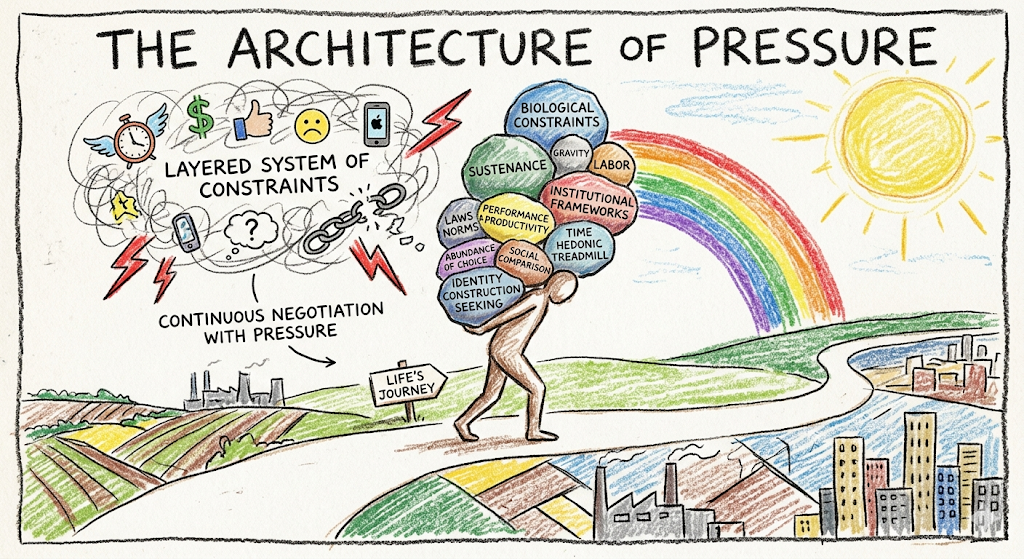
Human life, often narrated as a journey of freedom and self-realization, can equally be understood as a continuous negotiation with pressure. From the moment of birth to the inevitability of death, existence unfolds within a layered system of constraints — physical, social, and psychological — each exerting its own demands upon the individual. These pressures do not merely shape life; they constitute the very conditions under which life is possible.
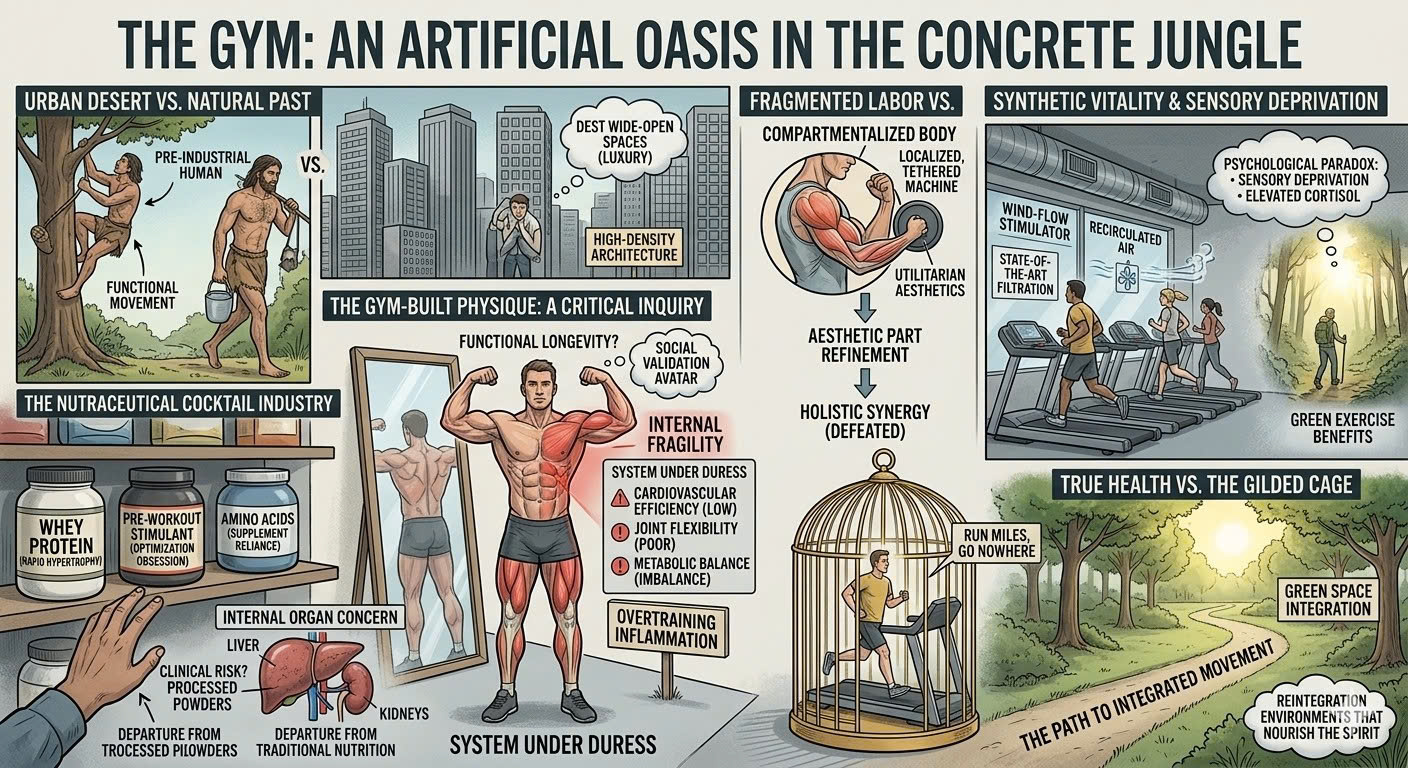
At the most fundamental level lie biological constraints, which operate independently of human intention. The body itself is never at rest from the forces acting upon it. Gravity, silent yet unrelenting, imposes a constant demand on muscles, bones, and circulation. Even in stillness, the body labors to maintain equilibrium. This physical burden extends into the necessity of movement: a paradox in which health is preserved only through continuous exertion. The modern individual must exercise not to advance, but simply to avoid decline.
Closely intertwined with this is the discipline of sustenance. Eating, once a straightforward response to hunger, has evolved into a complex domain of decision-making. Individuals are required to navigate an environment saturated with abundance yet structured by risk. Every choice carries implications for long-term health, transforming nourishment into a site of ongoing vigilance. In this sense, the body is not merely lived in, but actively managed — an object of constant maintenance under the threat of deterioration.
Beyond the biological, socio-economic structures impose a different category of pressure. Survival in modern society is rarely direct; it is mediated through systems that require participation. The necessity of labor — often detached from intrinsic meaning — becomes the primary mechanism through which individuals secure their existence. Work, in this context, is not always an expression of purpose, but a condition of survival. To opt out is, for most, not a viable alternative.
This necessity is reinforced by institutional frameworks that govern behavior. Laws, norms, and social contracts establish the boundaries of acceptable conduct, offering stability in exchange for compliance. While such systems enable large-scale coordination, they also constrain individual autonomy. The price of belonging is adherence, and deviation carries both social and material consequences.
Within these structures emerges the modern imperative of performance. Productivity is no longer confined to the workplace; it permeates all aspects of life. Time itself becomes an economic resource to be optimized. Even rest is reframed as a functional necessity — not valued for its own sake, but for its role in sustaining further output. The individual is thus caught in a cycle where existence is continuously evaluated in terms of efficiency.
Compounding this is the acceleration of time. Technological advancement, while increasing convenience, has also compressed the temporal rhythm of life. Communication is instantaneous, expectations are immediate, and delays are perceived as failures. The present moment becomes saturated with demands, leaving little space for reflection or disengagement. Life is experienced not as a flow, but as a sequence of urgent responses.
Yet perhaps the most intricate pressures are those that arise internally. Once basic survival is secured, the individual confronts the instability of satisfaction itself. The phenomenon often described as the hedonic treadmill ensures that improvements in circumstance yield only temporary increases in well-being. What was once desired becomes normalized, prompting the search for new sources of gratification. Desire, rather than being resolved, perpetuates itself.
Simultaneously, the abundance of choice introduces its own form of constraint. In a world of seemingly limitless possibilities, the burden of decision-making intensifies. Each choice carries the weight of excluded alternatives, generating uncertainty and regret. Freedom, in this sense, becomes entangled with anxiety, as individuals struggle to navigate a landscape without clear direction.
This tension is further amplified by the dynamics of social comparison. Digital platforms function as mirrors that reflect not reality, but curated versions of it. Individuals are exposed to idealized representations of others’ lives, against which their own experiences are measured. The result is a persistent sense of insufficiency, as the gap between lived reality and perceived possibility widens.
In response, individuals engage in the ongoing construction of identity. The self becomes a project — something to be defined, refined, and presented. This process, while offering a sense of agency, also imposes a continuous burden. To maintain a coherent identity in a rapidly changing environment requires constant adjustment, creating a tension between authenticity and adaptation.
Ultimately, these layers of pressure converge in a deeper existential question. When the demands of the body, society, and the psyche are accounted for, what remains is the need to locate meaning within them. The universe offers no definitive answer; it neither prescribes purpose nor guarantees fulfillment. The individual is left to construct significance within a framework that is, at its core, indifferent.
In this light, life can be seen not as the absence of constraint, but as the capacity to navigate it. Pressure is not an anomaly to be eliminated, but a structural feature of existence. The question, then, is not how to escape these forces, but how to relate to them — whether they are experienced as burdens to be endured, or as conditions that give shape and intensity to the experience of being alive.