The Discipline of Inner Direction
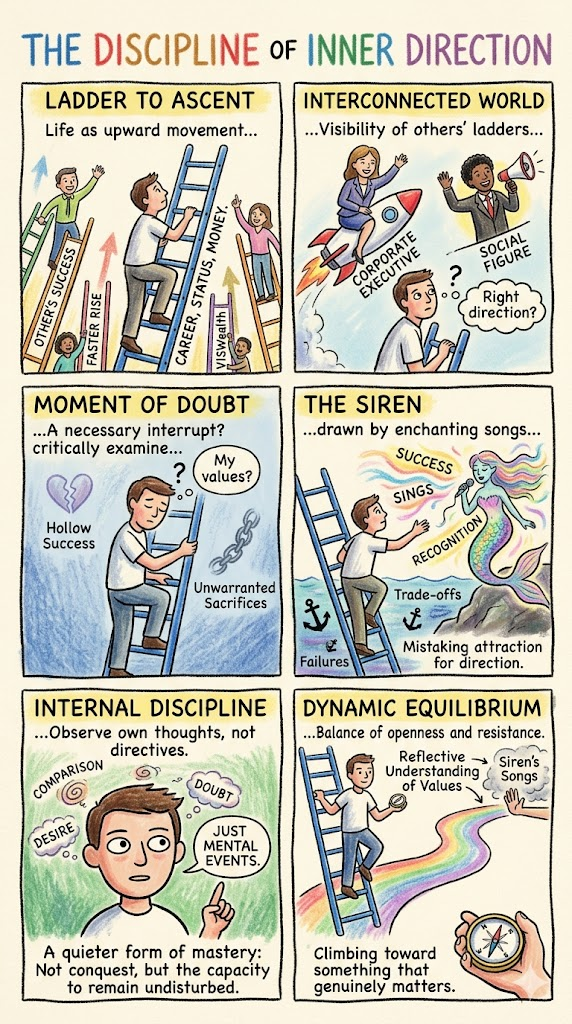
Human life is often imagined as a process of ascent — a gradual movement upward along some form of ladder. Whether defined in terms of career advancement, social status, or financial accumulation, this metaphor exerts a powerful influence on how individuals orient their efforts. Each step promises proximity to a desirable endpoint, a future state in which success is secured and uncertainty diminished. Yet within this seemingly straightforward progression lies a persistent source of distraction: the visibility of others climbing different ladders, often at a pace or toward a destination that appears more desirable.
In an interconnected world, such comparisons are not occasional but continuous. One observes the rapid rise of a corporate executive, the public recognition of a social figure, or the visible wealth of an entrepreneur. These trajectories, though external to one’s own path, exert a gravitational pull on attention. The individual, once focused on a chosen direction, begins to question not only their progress, but the validity of their entire trajectory. The question subtly shifts from “Am I moving forward?” to “Am I moving in the right direction at all?”
This moment of doubt is not inherently irrational. It may, in fact, represent a necessary interruption — an opportunity to critically examine the ladder one has chosen to climb. Not all ladders lead to meaningful destinations. Some culminate in forms of success that, while socially admired, may be personally hollow. Others demand sacrifices that outweigh their rewards. To persist unquestioningly is to risk reaching a summit only to discover that it does not correspond to one’s deeper values.
However, the difficulty lies in distinguishing between reflective reassessment and reactive distraction. The success of others does not merely present alternative possibilities; it often distorts perception. Achievements are observed in their most visible and refined form, stripped of the context, trade-offs, and failures that accompanied them. What appears as effortless ascent is, in reality, the product of conditions that may not be replicable or even desirable.
The metaphor of the siren is particularly apt in this context. Just as sailors in ancient narratives were drawn toward destruction by the enchanting songs of unseen figures, modern individuals may find themselves captivated by the allure of external success. The appeal lies not only in the promise of reward, but in the intensity of the image itself — vivid, immediate, and emotionally charged. Yet, as with the siren’s call, the danger lies in mistaking attraction for direction.
To resist this pull requires more than mere awareness; it demands a form of internal discipline. The capacity to observe one’s own thoughts — to recognize comparison, desire, and doubt as mental events rather than directives — becomes essential. Without this capacity, the mind is easily carried from one object of attention to another, each promising a different version of fulfillment. The result is not progress, but fragmentation.
This raises the question of whether mastery over one’s thoughts is the only viable path to stability. While such mastery may indeed provide a foundation for clarity, it is perhaps more accurate to describe it as a necessary but insufficient condition. The regulation of attention prevents distraction, but it does not, on its own, determine direction. One must also engage in the more demanding task of defining what constitutes a meaningful endpoint.
In this sense, the challenge is twofold. First, to cultivate the ability to remain anchored in one’s own trajectory, resisting the constant pull of external comparison. Second, to ensure that this trajectory itself is grounded in a reflective understanding of one’s values, rather than in inherited or unexamined assumptions. Without the first, one is perpetually diverted; without the second, one may persist in a direction that ultimately proves unsatisfying.
The notion of “controlling one’s life” is therefore more complex than it initially appears. It is not achieved through rigid adherence to a fixed plan, nor through the elimination of all external influence. Rather, it emerges from a dynamic equilibrium — a balance between openness to reconsideration and resistance to distraction.
Ultimately, the image of climbing a ladder conceals as much as it reveals. It suggests linear progress, yet obscures the question of orientation. The more fundamental issue is not how high one climbs, but whether one is climbing toward something that genuinely matters. In a world filled with competing ladders and persuasive voices, the ability to discern this difference may be less a matter of ambition than of awareness.
And in that awareness lies a quieter form of mastery: not the conquest of external heights, but the capacity to remain undisturbed by the songs that lead elsewhere.