The Gym: An Artificial Oasis in the Concrete Jungle
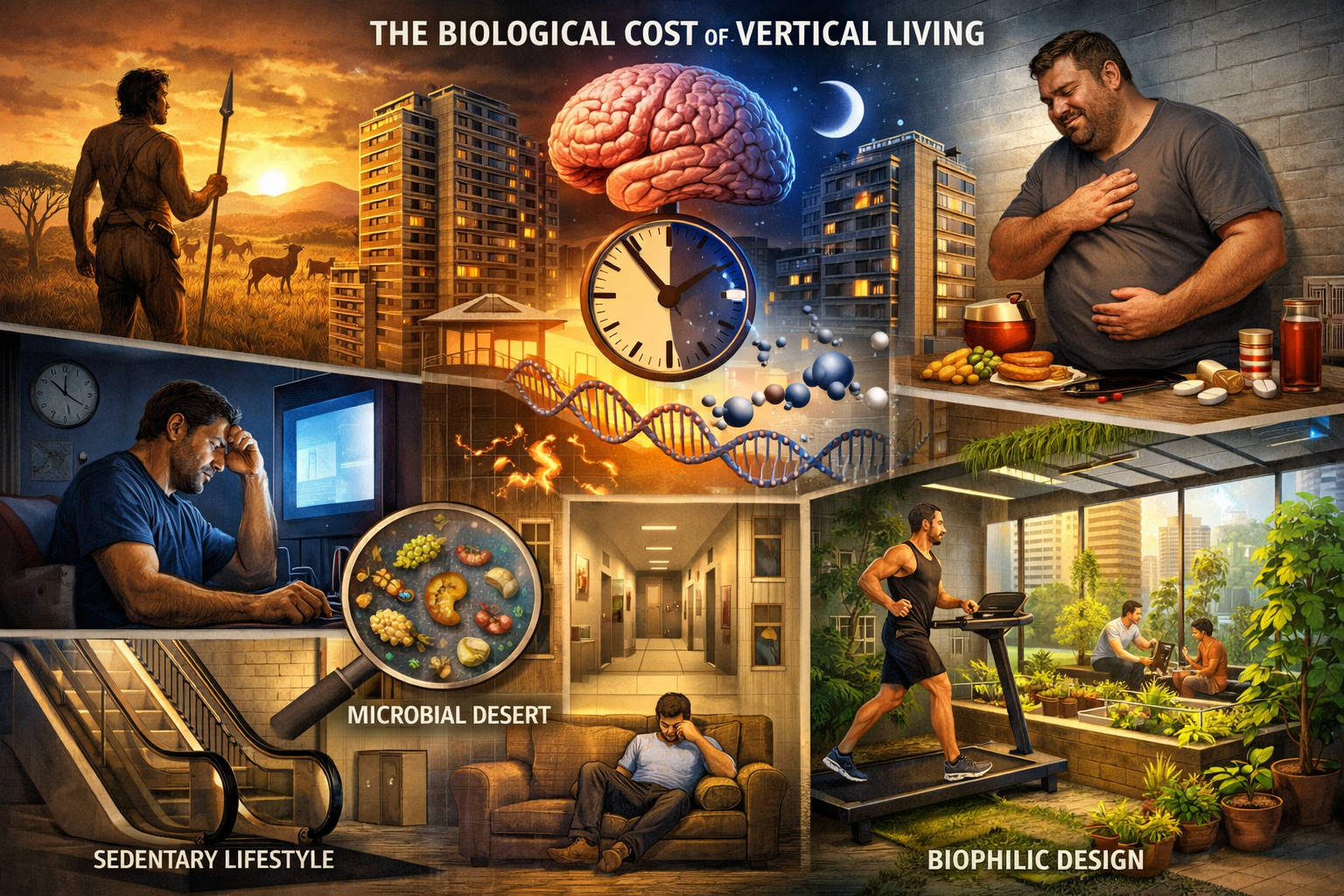
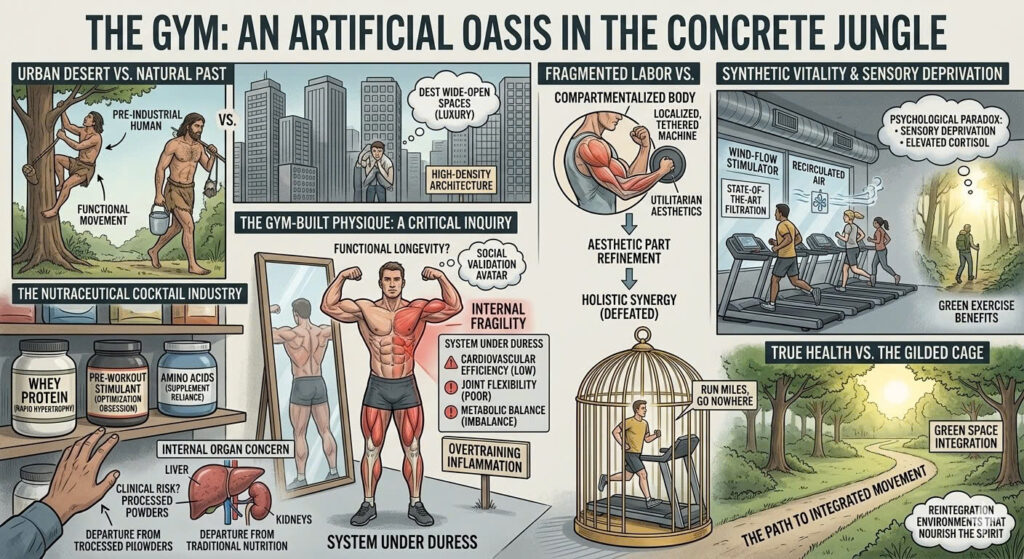
A. In the pre-industrial era, physical exertion was an intrinsic byproduct of existence. The human body was forged through functional movement—climbing, lifting, and traversing vast distances in open, oxygen-rich environments. However, the modern urban landscape, characterized by high-density architecture and the commodification of space, has effectively stripped the individual of these natural arenas. As cities become increasingly claustrophobic, the fitness industry has stepped in to fill the void, giving rise to the modern gymnasium: a sterile, controlled environment designed to compensate for a world where wide-open spaces have become a luxury of the elite.
B. The architecture of the gym reflects a shift from holistic physical development to what sociologists call “fragmented labor.” In a gymnasium, the sprawling complexity of human movement is distilled into mechanical, localized exercises. Instead of the multi-planar engagement of a forest hike or agricultural toil, individuals are tethered to stationary machines that target specific muscle groups in isolation. This “compartmentalization” of the body suggests a utilitarian approach to health, where the goal is often the aesthetic refinement of the “parts” rather than the functional synergy of the “whole.”
C. Furthermore, the atmospheric conditions of these indoor sanctuaries stand in stark contrast to the environments the human respiratory system evolved to thrive in. Encapsulated within windowless walls and cooled by recirculated air, the gym offers a synthetic experience of vitality. While these facilities boast state-of-the-art filtration, they cannot replicate the psychological and physiological benefits of “green exercise”—physical activity performed in natural settings. The absence of sunlight and fresh air can lead to a sensory deprivation that, paradoxically, may elevate cortisol levels even as the individual strives to reduce stress through exercise.
D. Parallel to the rise of the gym is the booming industry of “nutraceuticals” and dietary supplements. In a society obsessed with rapid results and “optimization,” natural sustenance is often viewed as insufficient. The modern gym-goer is frequently encouraged to rely on a cocktail of whey proteins, pre-workout stimulants, and amino acids. These products are marketed as essential tools for muscle hypertrophy, yet their long-term impact on internal organ health—specifically the liver and kidneys—is a subject of growing clinical concern. The reliance on processed powders marks a departure from traditional nutrition, further distancing the modern athlete from the natural world.
E. This leads to a critical inquiry into the true nature of contemporary health: is the “gym-built” physique a genuine indicator of well-being? We are witnessing a phenomenon where individuals possess formidable external musculature but suffer from internal fragility. The hyper-focus on hypertrophy (muscle growth) often comes at the expense of cardiovascular efficiency, joint flexibility, and metabolic balance. A body that looks “fit” in a mirror may, in reality, be a system under duress, struggling with the inflammatory effects of overtraining and a restricted, supplement-heavy diet.
F. Moreover, the psychological motivation behind gym attendance is frequently rooted in “body dysmorphia” and social validation rather than functional longevity. In an age dominated by digital imagery, the gym serves as a laboratory for the construction of a socially acceptable “avatar.” The pursuit of “ripped” abs or “boulder” shoulders often supersedes the pursuit of a heart that can withstand the rigors of age. This obsession with the external shell creates a deceptive facade of health, masking a sedentary soul that only moves when the clock of a treadmill dictates it.
G. Ultimately, the proliferation of gyms is a symptom of a society that has lost its connection to the outdoors. While these facilities provide a necessary outlet for physical activity in an over-urbanized world, they remain a “patchwork” solution. True health requires more than just local muscle stimulation and protein shakes; it demands a reintegration of movement into the fabric of daily life and a return to environments that nourish the spirit as much as the bicep. Until we address the scarcity of green spaces, the gym will remain a gilded cage—a place where we run for miles but never truly go anywhere.
Special Section
Volcabulary Recap
Click to expand …
| Term | Pronunciation | Definition | Vietnamese Translation | Usage Example |
| Physical exertion | /ˈfɪz.ɪ.kəl ɪɡˈzɜː.ʃən/ | Strenuous physical effort or exercise. | Sự nỗ lực thể chất | He was exhausted by the sheer physical exertion of the hike. |
| Traverse | /trəˈvɜːrs/ | To travel across or through an area. | Băng qua / Đi ngang qua | The explorers had to traverse a treacherous mountain range. |
| The commodification of space | /kəˌmɒd.ɪ.fɪˈkeɪ.ʃən/ | Turning physical areas into products or services that can be bought and sold. | Sự hàng hóa hóa không gian | The commodification of space in cities means even small parks now require entry fees. |
| Claustrophobic | /ˌklɒs.trəˈfəʊ.bɪk/ | Inducing a fear of being enclosed in a small or tight space. | Gây cảm giác ngột ngạt | The elevator was tiny and felt incredibly claustrophobic. |
| Sterile environment | /ˈster.aɪl ɪnˈvaɪ.rən.mənt/ | An area that is excessively clean, plain, or lacking in character and life. | Môi trường vô trùng / Đơn điệu | Hospitals are often criticized for being a sterile environment for patients. |
| Holistic physical development | /həʊˈlɪs.tɪk/ | Improvement of the body that considers the whole system rather than isolated parts. | Sự phát triển thể chất toàn diện | Yoga focuses on holistic physical development rather than just muscle size. |
| Gymnasium | /dʒɪmˈneɪ.zi.əm/ | A room or building equipped for gymnastics, games, and physical exercise. | Phòng tập thể dục | The local gymnasium was packed with people after work hours. |
| The sprawling complexity | /ˈsprɔː.lɪŋ kəmˈplek.sə.ti/ | Something that is large, disorganized, and highly complicated. | Sự phức tạp lan tỏa | Navigating the sprawling complexity of the city’s transit system took months. |
| Distill | /dɪˈstɪl/ | To extract the essential meaning or most important aspects of something. | Chắt lọc | He managed to distill a long lecture into three simple points. |
| Multi-planar engagement | /ˈmʌl.ti ˈpleɪ.nər/ | Moving the body in various directions (forward, sideways, rotational) during exercise. | Sự vận động đa diện | Climbing requires multi-planar engagement, unlike a stationary bike. |
| Agricultural toil | /ˌæɡ.rɪˈkʌl.tʃər.əl tɔɪl/ | Hard, exhausting work related to farming. | Sự lao dịch nông nghiệp | Before machinery, humans survived through years of agricultural toil. |
| Utilitarian approach | /ˌjuː.tɪ.lɪˈteə.ri.ən/ | Focusing on usefulness and practicality rather than beauty or style. | Cách tiếp cận thực dụng | His house had a utilitarian approach, with only the bare essentials. |
| Aesthetic | /esˈθet.ɪk/ | Concerned with beauty or the appreciation of beauty. | Thẩm mỹ | The cafe’s aesthetic was inspired by 1920s jazz clubs. |
| The functional synergy | /ˈfʌŋk.ʃən.əl ˈsɪn.ə.dʒi/ | The way different parts of a system work together effectively to achieve a goal. | Sự hiệp lực chức năng | There is a functional synergy between the heart and the lungs. |
| Stand in stark contrast | /stɑːrk ˈkɒn.trɑːst/ | To be very different from something else in an obvious way. | Đối lập hoàn toàn | Her quiet nature stood in stark contrast to her brother’s loud energy. |
| Thrive in | /θraɪv/ | To grow, develop, or be successful in a particular environment. | Phát triển mạnh mẽ trong | Certain plants thrive in damp, shady conditions. |
| Filtration | /fɪlˈtreɪ.ʃən/ | The process of removing impurities from a liquid or gas. | Sự thanh lọc / Lọc | The air filtration system in the office keeps the environment dust-free. |
| Nutraceuticals | /ˌnuː.trəˈsuː.tɪ.kəlz/ | Food or parts of food that provide medical or health benefits. | Thực phẩm chức năng | Many athletes use nutraceuticals to speed up recovery after a race. |
| Muscle hypertrophy | /ˈmʌs.əl haɪˈpɜː.trə.fi/ | The growth and increase in the size of muscle cells. | Sự phì đại cơ bắp | Weightlifting is the primary way to achieve muscle hypertrophy. |
| Formidable external musculature | /fɔːˈmɪd.ə.bəl/ | Powerful and impressive-looking muscles on the outside of the body. | Cơ bắp bề ngoài ấn tượng | The bodybuilder displayed a formidable external musculature on stage. |
| Body dysmorphia | /ˌbɒd.i dɪsˈmɔː.fi.ə/ | A mental health condition where you spend a lot of time worrying about flaws in your appearance. | Hội chứng mặc cảm ngoại hình | Body dysmorphia can lead people to exercise obsessively. |
| Ripped abs | /rɪpt æbz/ | Very well-defined and visible abdominal muscles. | Cơ bụng sáu múi rõ nét | He spent six months dieting and training to get ripped abs. |
| Boulder shoulder | /ˈbəʊl.də ˈʃəʊl.də/ | Slang for very large, rounded, and powerful-looking shoulders. | Cơ vai to như khối đá | His boulder shoulders made him look much wider than he actually was. |
| Supersede | /ˌsuː.pəˈsiːd/ | To take the place of something that is old-fashioned or no longer effective. | Thay thế / Thế chỗ | Digital streaming has largely superseded physical DVDs. |
| The rigors of age | /ˈrɪɡ.ərz əv eɪdʒ/ | The demanding and difficult conditions or challenges associated with getting older. | Sự khắc nghiệt của tuổi già | Regular exercise helps the body withstand the rigors of age. |
| Deceptive facade of health | /dɪˈsep.tɪv fəˈsɑːd/ | An outward appearance of being healthy that hides internal illness or weakness. | Vẻ ngoài khỏe mạnh giả tạo | Using steroids can create a deceptive facade of health while damaging the heart. |
| Gilded cage | /ˌɡɪl.dɪd ˈkeɪdʒ/ | A place where someone lives in luxury but has very little freedom. | Chiếc lồng son | She felt her high-paying job was a gilded cage that she couldn’t escape. |
English Vietnamese Translation
Click to expand …
The Gym: An Artificial Oasis in the Concrete Jungle
A.
In the pre-industrial era, physical exertion was an intrinsic byproduct of existence. The human body was forged through functional movement—climbing, lifting, and traversing vast distances in open, oxygen-rich environments. However, the modern urban landscape, characterized by high-density architecture and the commodification of space, has effectively stripped the individual of these natural arenas. As cities become increasingly claustrophobic, the fitness industry has stepped in to fill the void, giving rise to the modern gymnasium: a sterile, controlled environment designed to compensate for a world where wide-open spaces have become a luxury of the elite.
B.
The architecture of the gym reflects a shift from holistic physical development to what sociologists call “fragmented labor.” In a gymnasium, the sprawling complexity of human movement is distilled into mechanical, localized exercises. Instead of the multi-planar engagement of a forest hike or agricultural toil, individuals are tethered to stationary machines that target specific muscle groups in isolation. This “compartmentalization” of the body suggests a utilitarian approach to health, where the goal is often the aesthetic refinement of the “parts” rather than the functional synergy of the “whole.”
C.
Furthermore, the atmospheric conditions of these indoor sanctuaries stand in stark contrast to the environments the human respiratory system evolved to thrive in. Encapsulated within windowless walls and cooled by recirculated air, the gym offers a synthetic experience of vitality. While these facilities boast state-of-the-art filtration, they cannot replicate the psychological and physiological benefits of “green exercise”—physical activity performed in natural settings. The absence of sunlight and fresh air can lead to a sensory deprivation that, paradoxically, may elevate cortisol levels even as the individual strives to reduce stress through exercise.
D.
Parallel to the rise of the gym is the booming industry of “nutraceuticals” and dietary supplements. In a society obsessed with rapid results and “optimization,” natural sustenance is often viewed as insufficient. The modern gym-goer is frequently encouraged to rely on a cocktail of whey proteins, pre-workout stimulants, and amino acids. These products are marketed as essential tools for muscle hypertrophy, yet their long-term impact on internal organ health—specifically the liver and kidneys—is a subject of growing clinical concern. The reliance on processed powders marks a departure from traditional nutrition, further distancing the modern athlete from the natural world.
E.
This leads to a critical inquiry into the true nature of contemporary health: is the “gym-built” physique a genuine indicator of well-being? We are witnessing a phenomenon where individuals possess formidable external musculature but suffer from internal fragility. The hyper-focus on hypertrophy (muscle growth) often comes at the expense of cardiovascular efficiency, joint flexibility, and metabolic balance. A body that looks “fit” in a mirror may, in reality, be a system under duress, struggling with the inflammatory effects of overtraining and a restricted, supplement-heavy diet.
F.
Moreover, the psychological motivation behind gym attendance is frequently rooted in “body dysmorphia” and social validation rather than functional longevity. In an age dominated by digital imagery, the gym serves as a laboratory for the construction of a socially acceptable “avatar.” The pursuit of “ripped” abs or “boulder” shoulders often supersedes the pursuit of a heart that can withstand the rigors of age. This obsession with the external shell creates a deceptive facade of health, masking a sedentary soul that only moves when the clock of a treadmill dictates it.
G.
Ultimately, the proliferation of gyms is a symptom of a society that has lost its connection to the outdoors. While these facilities provide a necessary outlet for physical activity in an over-urbanized world, they remain a “patchwork” solution. True health requires more than just local muscle stimulation and protein shakes; it demands a reintegration of movement into the fabric of daily life and a return to environments that nourish the spirit as much as the bicep. Until we address the scarcity of green spaces, the gym will remain a gilded cage—a place where we run for miles but never truly go anywhere.
Phòng Gym: Ốc Đảo Nhân Tạo Trong Rừng Bê Tông
A. Trong thời kỳ tiền công nghiệp, nỗ lực thể chất là một hệ quả tất yếu của sự tồn tại. Cơ thể con người được trui rèn thông qua những chuyển động mang tính chức năng — leo trèo, mang vác và băng qua những khoảng cách bao la trong môi trường mở, giàu oxy. Tuy nhiên, cảnh quan đô thị hiện đại, đặc trưng bởi kiến trúc mật độ cao và sự thương mại hóa không gian, đã tước đi của cá nhân những đấu trường tự nhiên này một cách hiệu quả. Khi các thành phố ngày càng trở nên chật hẹp, ngành công nghiệp thể hình đã bước vào để lấp đầy khoảng trống đó, tạo nên phòng tập gym hiện đại: một môi trường vô trùng, được kiểm soát, thiết kế để bù đắp cho một thế giới nơi những không gian mở bao la đã trở thành thứ xa xỉ của giới thượng lưu.
B. Kiến trúc của phòng gym phản ánh sự dịch chuyển từ phát triển thể chất toàn diện sang cái mà các nhà xã hội học gọi là “lao động phân mảnh”. Trong một phòng tập, sự phức tạp trải dài của chuyển động con người được chưng cất thành các bài tập cơ học, cục bộ. Thay vì sự tham gia đa diện của một chuyến đi bộ đường dài trong rừng hay lao động nông nghiệp, các cá nhân bị “xích” vào những cỗ máy cố định nhằm mục tiêu cô lập các nhóm cơ cụ thể. Sự “chia ngăn” cơ thể này gợi ý một cách tiếp cận thực dụng đối với sức khỏe, nơi mục tiêu thường là sự tinh chỉnh thẩm mỹ của các “bộ phận” hơn là sự hiệp đồng chức năng của một “chỉnh thể”.
C. Hơn nữa, điều kiện khí quyển bên trong những “thánh đường trong nhà” này hoàn toàn tương phản với môi trường mà hệ hô hấp của con người đã tiến hóa để phát triển. Được bao bọc trong những bức tường không cửa sổ và làm mát bằng khí tuần hoàn, phòng gym mang lại một trải nghiệm tổng hợp về sức sống. Dù các cơ sở này tự hào với hệ thống lọc khí tối tân, chúng không thể tái tạo những lợi ích tâm lý và sinh lý của “bài tập xanh” (green exercise) — các hoạt động thể chất được thực hiện trong bối cảnh tự nhiên. Sự thiếu vắng ánh nắng mặt trời và không khí trong lành có thể dẫn đến sự suy giảm cảm giác, mà trớ trêu thay, có thể làm tăng nồng độ cortisol ngay cả khi cá nhân đang nỗ lực giảm căng thẳng thông qua việc tập luyện.
D. Song hành với sự trỗi dậy của phòng gym là ngành công nghiệp “thực phẩm chức năng” và thực phẩm bổ sung đang bùng nổ. Trong một xã hội bị ám ảnh bởi kết quả nhanh chóng và sự “tối ưu hóa”, nguồn dinh dưỡng tự nhiên thường bị coi là không đủ. Những người đi tập gym hiện đại thường được khuyến khích dựa vào một “cocktail” gồm đạm whey, chất kích thích trước tập (pre-workout) và các axit amin. Những sản phẩm này được tiếp thị như những công cụ thiết yếu cho sự phì đại cơ bắp, nhưng tác động lâu dài của chúng đối với sức khỏe các cơ quan nội tạng — cụ thể là gan và thận — là một vấn đề đáng lo ngại về mặt lâm sàng. Việc lạm dụng các loại bột chế biến đánh dấu sự rời bỏ dinh dưỡng truyền thống, càng làm xích xa khoảng cách giữa vận động viên hiện đại và thế giới tự nhiên.
E. Điều này dẫn đến một cuộc truy vấn quan trọng về bản chất thực sự của sức khỏe đương đại: liệu một vóc dáng “đúc từ phòng gym” có phải là chỉ số thực sự của sự khỏe mạnh? Chúng ta đang chứng kiến một hiện tượng nơi các cá nhân sở hữu hệ cơ bắp bên ngoài đáng nể nhưng lại chịu đựng sự mong manh bên trong. Sự tập trung quá mức vào sự phì đại (hypertrophy) thường đi kèm với cái giá là hiệu quả tim mạch, sự linh hoạt của khớp và sự cân bằng trao đổi chất bị suy giảm. Một cơ thể trông có vẻ “cân đối” trong gương, trên thực tế, có thể là một hệ thống đang chịu áp lực nặng nề, vật lộn với các tác động viêm nhiễm do tập luyện quá sức và một chế độ ăn kiêng khắt khe, nặng tính bổ trợ nhân tạo.
F. Hơn nữa, động lực tâm lý đằng sau việc đến phòng gym thường bắt nguồn từ “mặc cảm ngoại hình” (body dysmorphia) và sự công nhận xã hội hơn là sự trường thọ về chức năng. Trong kỷ nguyên bị thống trị bởi hình ảnh kỹ thuật số, phòng gym đóng vai trò như một phòng thí nghiệm để xây dựng một “hình đại diện” (avatar) được xã hội chấp nhận. Việc theo đuổi cơ bụng “sáu múi” hay bờ vai “vạm vỡ” thường thay thế cho việc theo đuổi một trái tim có thể chịu đựng được sự khắc nghiệt của tuổi tác. Nỗi ám ảnh về lớp vỏ bên ngoài này tạo ra một vẻ bề ngoài khỏe mạnh giả tạo, che giấu một tâm hồn ít vận động — vốn chỉ cử động khi chiếc đồng hồ trên máy chạy bộ ra lệnh.
G. Cuối cùng, sự phổ biến của các phòng gym là triệu chứng của một xã hội đã mất kết nối với thế giới bên ngoài. Mặc dù các cơ sở này cung cấp một lối thoát cần thiết cho hoạt động thể chất trong một thế giới quá tải đô thị, chúng vẫn chỉ là một giải pháp “chắp vá”. Sức khỏe thực sự đòi hỏi nhiều hơn là chỉ kích thích cơ bắp cục bộ và uống bột đạm; nó đòi hỏi sự tái tích hợp vận động vào cấu trúc của đời sống hàng ngày và sự trở lại với những môi trường nuôi dưỡng tâm hồn nhiều như nuôi dưỡng bắp tay. Cho đến khi chúng ta giải quyết được sự khan hiếm của các không gian xanh, phòng gym sẽ vẫn là một chiếc lồng son — nơi chúng ta chạy hàng dặm nhưng chẳng bao giờ thực sự đi đến đâu.