Coffee and the Paradox of Modern Alertness
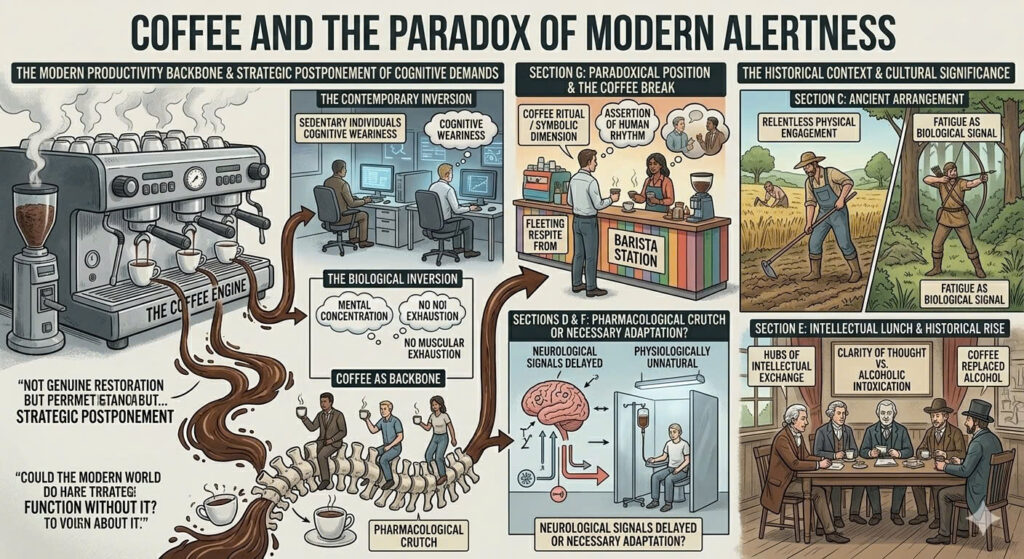
It is tempting to view coffee merely as a beverage — a pleasant ritual that punctuates the morning routine or accompanies a momentary pause in the workday. Yet such a modest interpretation fails to capture its deeper cultural significance. In many respects, coffee has become the pharmacological backbone of modern productivity, a substance that quietly sustains a way of life in which physical exertion has diminished while cognitive demands have intensified.
For most of human history, survival required relentless physical engagement with the environment. Agricultural toil, hunting, and manual craftsmanship ensured that exhaustion was primarily muscular rather than mental. Under such conditions, stimulants played only a minor role in daily life; fatigue itself served as a biological signal to rest. The rhythms of daylight and physical effort governed the tempo of existence.
The contemporary world, however, has inverted this ancient arrangement. Today, millions of individuals spend their days seated before screens, navigating the sprawling complexity of digital information systems. The body remains largely inert while the mind is expected to maintain prolonged concentration. This arrangement produces a peculiar form of fatigue — not the heaviness of physical exertion but a diffuse cognitive weariness that resists simple remedies such as sleep or movement.
Coffee, in this context, functions as a kind of biochemical intermediary between the evolutionary past and the technological present. Its primary psychoactive compound, caffeine, temporarily blocks adenosine receptors in the brain, delaying the neurological signals associated with tiredness. The result is not genuine restoration but rather the strategic postponement of fatigue — a chemical distillation of alertness that allows modern workers to continue operating within environments that demand constant attention.
This dynamic raises an intriguing question: was coffee, historically speaking, uniquely suited to the emergence of modern intellectual labor? While it would be misleading to suggest that coffee was consciously “created” for this purpose, its global spread coincided strikingly with the rise of urban commerce, scientific inquiry, and bureaucratic administration. Early coffeehouses in cities such as London, Vienna, and Istanbul were not merely places of leisure but hubs of intellectual exchange where writers, merchants, and philosophers congregated. In these spaces, coffee replaced alcohol as the beverage of discussion, fostering an atmosphere in which clarity of thought rather than convivial intoxication became the social norm.
Nevertheless, the relationship between coffee and modern life is not entirely harmonious. Critics argue that reliance on caffeine represents a subtle form of adaptation to environments that are themselves physiologically unnatural. The human body evolved under conditions of movement, sunlight, and intermittent rest — not prolonged immobility under artificial illumination. In this sense, coffee may be less a salvation than a compensatory mechanism, enabling individuals to endure lifestyles that stand in stark contrast to the conditions for which their biology was originally calibrated.
Yet this critique, while compelling, overlooks coffee’s symbolic dimension. Beyond its biochemical effects, coffee rituals provide moments of structure within otherwise continuous streams of digital labor. The act of preparing or purchasing coffee punctuates the day, offering brief intervals of reflection or social contact. In sterile office environments defined by algorithmic efficiency, the coffee break becomes a small but meaningful assertion of human rhythm.
Thus, coffee occupies a paradoxical position in contemporary society. It both enables the sedentary, cognitively demanding structures of modern work and offers fleeting respite from them. Whether it should be understood as a tool of productivity, a cultural artifact, or a pharmacological crutch remains open to interpretation. What is certain, however, is that the modern world — with its relentless demands for mental alertness divorced from physical exertion — would feel profoundly different without it.
Audio
Volcabulary Recap
Click to expand …
| Term | Pronunciation | Root | Definition | Vietnamese Translation | Usage Example |
| Physical exertion | /ˈfɪz.ɪ.kəl ɪɡˈzɜː.ʃən/ | Latin exserere (to thrust out) | Strenuous physical effort or exercise. | Sự nỗ lực thể chất | After hours of physical exertion, he fell into a deep sleep. |
| The tempo of existence | /ˈtem.pəʊ əv ɪɡˈzɪs.təns/ | Latin tempus (time) + exsistere (to emerge) | The speed or pace at which life is lived. | Nhịp độ của sự tồn tại / Nhịp sống | Modern technology has drastically increased the tempo of existence. |
| Invert | /ɪnˈvɜːt/ | Latin invertere (turn upside down) | To put upside down or in the opposite position/order. | Đảo ngược | The coach decided to invert the team’s strategy for the final match. |
| Inert | /ɪˈnɜːt/ | Latin iners (unskilled/idle) | Lacking the ability or strength to move; chemically inactive. | Trì trệ / Bất động | Without a clear goal, he remained inert on the sofa all afternoon. |
| A peculiar form of fatigue | /pəˈkjuː.li.ər… fəˈtiːɡ/ | Latin peculiaris (private property/strange) | A strange or unusual type of tiredness. | Một dạng mệt mỏi kỳ lạ | Staring at screens all day causes a peculiar form of fatigue that sleep doesn’t always fix. |
| Diffuse cognitive wariness | /dɪˈfjuːs ˈkɒɡ.nɪ.tɪv ˈweə.ri.nəs/ | Latin diffundere (spread out) + cognoscere (to know) | A spread-out, non-specific feeling of mental caution or alertness. | Sự thận trọng nhận thức lan tỏa | Walking through a strange city at night creates a sense of diffuse cognitive wariness. |
| Remedy | /ˈrem.ə.di/ | Latin remedium (to cure again) | A medicine or treatment for a disease or injury; a way of setting a situation right. | Biện pháp khắc phục / Phương thuốc | Building more parks is a great remedy for urban stress. |
| A chemical distillation | /ˈkem.ɪ.kəl ˌdɪs.tɪˈleɪ.ʃən/ | Greek khēmeia + Latin destillare (to drip down) | The essence or purest form of a substance produced by a chemical process. | Một sự chưng cất hóa học | The perfume was a chemical distillation of thousands of rose petals. |
| Intriguing question | /ɪnˈtriː.ɡɪŋ ˈkwes.tʃən/ | Latin intricare (to entangle) | A question that arouses great interest or curiosity. | Câu hỏi hấp dẫn / Gợi tò mò | How the pyramids were built remains an intriguing question for historians. |
| Coincide | /ˌkəʊ.ɪnˈsaɪd/ | Latin co- (together) + incidere (fall upon) | To happen at the same time or to be in agreement. | Trùng hợp / Khớp với | My holiday plans coincide with the local festival dates. |
| Scientific inquiry | /ˌsaɪ.ənˈtɪf.ɪk ɪnˈkwaɪ.ri/ | Latin scire (to know) + inquaerere (to seek) | The process of looking for truth or knowledge through scientific methods. | Sự truy vấn khoa học | Scientific inquiry is based on evidence and repeatable experiments. |
| Bureaucratic administration | /ˌbjʊə.rəˈkræt.ɪk/ | French bureau (desk/office) + Latin administrare | Management characterized by complex rules, hierarchy, and paperwork. | Bộ máy quản lý hành chính | Navigating bureaucratic administration can be a slow and frustrating process. |
| Congregate | /ˈkɒŋ.ɡrɪ.ɡeɪt/ | Latin con- (together) + grex (flock) | To gather into a crowd or mass. | Tập hợp / Tụ họp | Crowds began to congregate in the square before the concert. |
| Convivial intoxication | /kənˈvɪv.i.əl ɪnˌtɒk.sɪˈkeɪ.ʃən/ | Latin convivium (banquet) + toxicum (poison) | A friendly, lively state of being drunk in a social setting. | Sự say sưa vui vẻ / Hội hè | The wedding ended in a state of convivial intoxication for all the guests. |
| A subtle form of adaptation | /ˈsʌt.əl… ˌæd.æpˈteɪ.ʃən/ | Latin subtilis (fine/delicate) + adaptare | A small, not easily noticed change to suit new conditions. | Một dạng thích nghi tinh tế | Changing his tone of voice was a subtle form of adaptation to his new workplace. |
| Salvation | /sælˈveɪ.ʃən/ | Latin salvare (to save) | Deliverance from harm, ruin, or loss. | Sự cứu rỗi | For the exhausted traveler, the roadside inn was his salvation. |
| Stand in stark contrast | /stɑːrk ˈkɒn.trɑːst/ | German starc (strong/stiff) + Latin contra- | To be extremely different from something else. | Đối lập hoàn toàn | The luxury hotels stand in stark contrast to the surrounding slums. |
| Calibrate | /ˈkæl.ɪ.breɪt/ | Arabic qalib (mold for casting) | To adjust precisely or mark with a standard scale. | Hiệu chuẩn / Điều chỉnh chính xác | We need to calibrate the sensors to ensure the data is accurate. |
| Sterile office | /ˈster.aɪl ˈɒf.ɪs/ | Latin sterilis (barren) | A workspace that is plain, clean, but lacks inspiration or character. | Văn phòng đơn điệu / Vô cảm | He felt trapped in his sterile office, dreaming of the outdoors. |
| Fleeting | /ˈfliː.tɪŋ/ | Old English fleotan (to float/flow) | Lasting for a very short time. | Thoáng qua / Ngắn ngủi | Happiness can be fleeting, so we should cherish the good moments. |
| Pharmacological crutch | /ˌfɑː.mə.kəˈlɒdʒ.ɪ.kəl krʌtʃ/ | Greek pharmakon (drug) + Germanic krukja | A drug or medication used as a psychological support or “helper” to get by. | Điểm tựa dược lý / Sự lệ thuộc vào thuốc | He relied on caffeine as a pharmacological crutch to finish his night shifts. |
English Vietnamese Translation
Click to expand …
Coffee and the Paradox of Modern Alertness
It is tempting to view coffee merely as a beverage — a pleasant ritual that punctuates the morning routine or accompanies a momentary pause in the workday. Yet such a modest interpretation fails to capture its deeper cultural significance. In many respects, coffee has become the pharmacological backbone of modern productivity, a substance that quietly sustains a way of life in which physical exertion has diminished while cognitive demands have intensified.
For most of human history, survival required relentless physical engagement with the environment. Agricultural toil, hunting, and manual craftsmanship ensured that exhaustion was primarily muscular rather than mental. Under such conditions, stimulants played only a minor role in daily life; fatigue itself served as a biological signal to rest. The rhythms of daylight and physical effort governed the tempo of existence.
The contemporary world, however, has inverted this ancient arrangement. Today, millions of individuals spend their days seated before screens, navigating the sprawling complexity of digital information systems. The body remains largely inert while the mind is expected to maintain prolonged concentration. This arrangement produces a peculiar form of fatigue — not the heaviness of physical exertion but a diffuse cognitive weariness that resists simple remedies such as sleep or movement.
Coffee, in this context, functions as a kind of biochemical intermediary between the evolutionary past and the technological present. Its primary psychoactive compound, caffeine, temporarily blocks adenosine receptors in the brain, delaying the neurological signals associated with tiredness. The result is not genuine restoration but rather the strategic postponement of fatigue — a chemical distillation of alertness that allows modern workers to continue operating within environments that demand constant attention.
This dynamic raises an intriguing question: was coffee, historically speaking, uniquely suited to the emergence of modern intellectual labor? While it would be misleading to suggest that coffee was consciously “created” for this purpose, its global spread coincided strikingly with the rise of urban commerce, scientific inquiry, and bureaucratic administration. Early coffeehouses in cities such as London, Vienna, and Istanbul were not merely places of leisure but hubs of intellectual exchange where writers, merchants, and philosophers congregated. In these spaces, coffee replaced alcohol as the beverage of discussion, fostering an atmosphere in which clarity of thought rather than convivial intoxication became the social norm.
Nevertheless, the relationship between coffee and modern life is not entirely harmonious. Critics argue that reliance on caffeine represents a subtle form of adaptation to environments that are themselves physiologically unnatural. The human body evolved under conditions of movement, sunlight, and intermittent rest — not prolonged immobility under artificial illumination. In this sense, coffee may be less a salvation than a compensatory mechanism, enabling individuals to endure lifestyles that stand in stark contrast to the conditions for which their biology was originally calibrated.
Yet this critique, while compelling, overlooks coffee’s symbolic dimension. Beyond its biochemical effects, coffee rituals provide moments of structure within otherwise continuous streams of digital labor. The act of preparing or purchasing coffee punctuates the day, offering brief intervals of reflection or social contact. In sterile office environments defined by algorithmic efficiency, the coffee break becomes a small but meaningful assertion of human rhythm.
Thus, coffee occupies a paradoxical position in contemporary society. It both enables the sedentary, cognitively demanding structures of modern work and offers fleeting respite from them. Whether it should be understood as a tool of productivity, a cultural artifact, or a pharmacological crutch remains open to interpretation. What is certain, however, is that the modern world — with its relentless demands for mental alertness divorced from physical exertion — would feel profoundly different without it.
Cà Phê và Nghịch Lý của Sự Tỉnh Táo Hiện Đại
Thật dễ dàng khi coi cà phê đơn thuần là một thức uống — một nghi thức dễ chịu điểm xuyết cho buổi sáng hay đồng hành cùng một nhịp nghỉ tạm thời trong ngày làm việc. Tuy nhiên, cách giải thích khiêm tốn như vậy đã không nắm bắt được ý nghĩa văn hóa sâu xa hơn của nó. Ở nhiều khía cạnh, cà phê đã trở thành xương sống dược lý của năng suất hiện đại, một chất duy trì một cách lặng lẽ cho lối sống mà trong đó nỗ lực thể chất đã giảm bớt trong khi các yêu cầu về nhận thức ngày càng tăng cao.
Trong phần lớn lịch sử nhân loại, sự sinh tồn đòi hỏi sự tương tác vật lý không ngừng nghỉ với môi trường. Công việc nông nghiệp, săn bắn và thủ công mỹ nghệ đảm bảo rằng sự kiệt sức chủ yếu nằm ở cơ bắp hơn là tâm trí. Trong những điều kiện như vậy, các chất kích thích chỉ đóng một vai trò thứ yếu trong đời sống hàng ngày; bản thân sự mệt mỏi đóng vai trò như một tín hiệu sinh học để nghỉ ngơi. Nhịp điệu của ánh sáng ban ngày và nỗ lực thể chất chi phối nhịp độ của sự tồn tại.
Thế giới đương đại, tuy nhiên, đã đảo ngược sự sắp xếp cổ xưa này. Ngày nay, hàng triệu cá nhân dành cả ngày ngồi trước màn hình, điều hướng sự phức tạp ngổn ngang của các hệ thống thông tin kỹ thuật số. Cơ thể phần lớn vẫn bất động trong khi tâm trí được kỳ vọng sẽ duy trì sự tập trung kéo dài. Sự sắp xếp này tạo ra một dạng mệt mỏi kỳ lạ — không phải sự nặng nề của nỗ lực thể chất mà là một sự rệu rã nhận thức lan tỏa, thứ chống lại những phương thuốc đơn giản như giấc ngủ hay vận động.
Cà phê, trong bối cảnh này, hoạt động như một loại trung gian hóa sinh giữa quá trình tiến hóa trong quá khứ và hiện tại công nghệ. Hợp chất kích thích thần kinh chính của nó, caffeine, tạm thời ngăn chặn các thụ thể adenosine trong não, trì hoãn các tín hiệu thần kinh liên quan đến sự mệt mỏi. Kết quả không phải là sự phục hồi thực sự mà là sự trì hoãn chiến lược đối với sự mệt mỏi — một sự chưng cất hóa học của sự tỉnh táo cho phép những người lao động hiện đại tiếp tục vận hành trong những môi trường đòi hỏi sự chú ý liên tục.
Điều này đặt ra một câu hỏi thú vị: xét về mặt lịch sử, liệu cà phê có phù hợp một cách độc đáo với sự trỗi dậy của lao động trí óc hiện đại? Mặc dù sẽ là sai lầm nếu cho rằng cà phê được “tạo ra” một cách có ý thức cho mục đích này, nhưng sự lan rộng toàn cầu của nó trùng hợp một cách đáng ngạc nhiên với sự trỗi dậy của thương mại đô thị, nghiên cứu khoa học và quản lý hành chính. Những quán cà phê sơ khai ở các thành phố như London, Vienna và Istanbul không chỉ là nơi giải trí mà còn là trung tâm trao đổi trí tuệ, nơi các nhà văn, thương nhân và triết gia tụ họp. Trong những không gian này, cà phê đã thay thế rượu để trở thành thức uống của những cuộc thảo luận, thúc đẩy một bầu không khí mà trong đó sự minh mẫn của tư duy hơn là sự say sưa trở thành chuẩn mực xã hội.
Tuy nhiên, mối quan hệ giữa cà phê và đời sống hiện đại không hoàn toàn hòa hợp. Những người chỉ trích lập luận rằng sự phụ thuộc vào caffeine đại diện cho một hình thức thích nghi tinh vi với những môi trường mà bản thân chúng không tự nhiên về mặt sinh lý. Cơ thể con người tiến hóa dưới các điều kiện vận động, ánh sáng mặt trời và nghỉ ngơi ngắt quãng — chứ không phải sự bất động kéo dài dưới ánh sáng nhân tạo. Theo nghĩa này, cà phê có thể không phải là một sự cứu rỗi mà là một cơ chế bù đắp, cho phép các cá nhân chịu đựng lối sống đứng ở thế đối lập hoàn toàn với các điều kiện mà sinh học của họ ban đầu được hiệu chỉnh để thích nghi.
Tuy nhiên, lời phê bình này, dù đầy thuyết phục, đã bỏ qua chiều kích biểu tượng của cà phê. Vượt ra ngoài các tác dụng hóa sinh, các nghi thức cà phê cung cấp những khoảnh khắc có cấu trúc bên trong các dòng chảy liên tục của lao động kỹ thuật số. Hành động chuẩn bị hoặc mua cà phê tạo ra những điểm ngắt trong ngày, mang lại những khoảng thời gian ngắn để phản chiếu hoặc tiếp xúc xã hội. Trong môi trường văn phòng vô trùng được định nghĩa bởi hiệu quả thuật toán, giờ nghỉ giải lao với cà phê trở thành một sự khẳng định nhỏ bé nhưng đầy ý nghĩa về nhịp điệu của con người.
Vì vậy, cà phê chiếm một vị trí nghịch lý trong xã hội đương đại. Nó vừa cho phép các cấu trúc công việc hiện đại ngồi yên và đòi hỏi nhận thức cao, vừa mang lại sự nghỉ ngơi thoáng qua khỏi chúng. Liệu nó nên được hiểu là một công cụ của năng suất, một hiện vật văn hóa hay một chiếc “nạng” dược lý, điều đó vẫn còn để ngỏ cho những cách diễn giải khác nhau. Tuy nhiên, có một điều chắc chắn là thế giới hiện đại — với những đòi hỏi không ngừng nghỉ về sự tỉnh táo tinh thần tách biệt khỏi nỗ lực thể chất — sẽ cảm thấy khác biệt sâu sắc nếu thiếu nó.