The Paradox of Purpose: Labor, Leisure, and the Digital Refuge
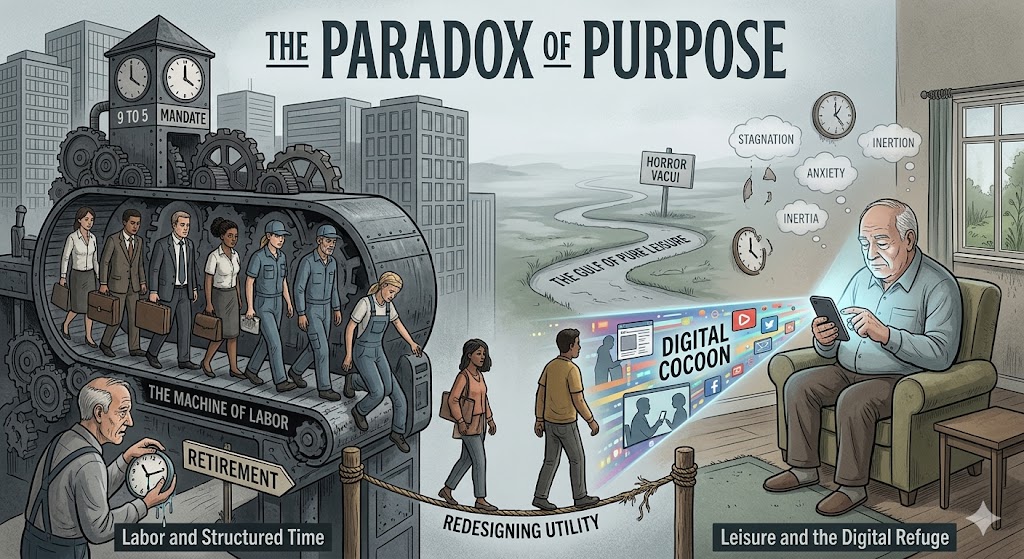
A. In the contemporary era, a profound paradox governs human existence: the systemic compulsion to labor. Despite the burgeoning discourse on “work-life balance” and the psychological toll of the modern workplace—often described as a source of existential angst and physical exhaustion—the mandate to remain employed remains absolute. For the majority, work is not merely a means of capital accumulation but a structural anchor. Without the rigid framework of a nine-to-five schedule, the individual is cast into a void of unstructured time, a prospect that, ironically, evokes more dread than the most grueling of professional tasks.
B. This dread stems from the inability of the modern subject to navigate “pure leisure.” When the shackles of employment are removed, the resulting temporal vacuum often leads to a phenomenon known as horror vacui—the fear of empty space. Historically, leisure was the ultimate goal of civilization, yet today, it is frequently met with a sense of paralysis. Without a predefined objective, the human mind tends to drift toward introspection, which, in a hyper-competitive society, often devolves into anxiety over one’s perceived stagnation or lack of utility.
C. The gravity of this issue is most visible in the demographic of the elderly. Retirement, once heralded as the “golden age” of liberation, frequently transmogrifies into a period of acute marginalization. Herein lies a cruel irony: the elderly possess the very commodity that the working population craves—abundance of time—yet they are often stripped of the biological and environmental prerequisites to utilize it. Physical frailty, sensory decline, and the thinning of social networks create a barrier, rendering the “freedom” of old age a stagnant pool rather than a flowing river of opportunity.
D. Furthermore, the cognitive decline associated with advanced age complicates the pursuit of complex hobbies or new intellectual ventures. The “intellectual agility” required to master new skills often wanes just as the opportunity to pursue them peaks. Consequently, the elderly find themselves in a state of involuntary inertia. They are victims of a societal structure that equates value with productivity; once removed from the machine of labor, they are left with a surplus of hours and a deficit of “functional purpose.”
E. In this landscape of stagnation, the smartphone has emerged not merely as a communication tool, but as a cognitive “life raft.” For the aging individual, the digital interface serves as a crucial intervention against the doldrums of isolation. The device offers a low-barrier entry to world events, social interaction, and passive entertainment, effectively bridging the gap between physical limitation and the need for mental stimulation. It provides a semblance of “flow”—a psychological state where time passes unnoticed—which is the ultimate antidote to the crushing weight of empty hours.
F. However, critics argue that this digital “rescue” is a double-edged sword. While it alleviates the symptoms of stagnation, it may also act as a digital sedative. For the elderly, the smartphone can become a substitute for physical movement or authentic community engagement, creating a “cocoon effect.” Yet, in a world where external conditions—such as urban design that favors the young and healthy—are increasingly hostile to the aged, the virtual realm often remains the only accessible territory for exploration and social validation.
G. Ultimately, the modern struggle with time reveals a fundamental flaw in our social evolution. We have built a world that knows how to work, but has forgotten how to be. Whether it is the worker clinging to a miserable job to avoid the abyss of boredom, or the retiree tethered to a glowing screen to escape the silence of a quiet house, the challenge remains the same. We must redefine “utility” beyond the confines of economic output, or remain forever haunted by the very free time we claim to desire.
Audio
Volcabulary Recap
Click to expand …
| Term | Pronunciation | Definition | Vietnamese Translation | Usage Example |
| The burgeoning discourse | /ˈbɜː.dʒən.ɪŋ ˈdɪs.kɔːrs/ | A rapidly growing or developing conversation/debate about a topic. | Sự thảo luận đang phát triển mạnh mẽ | The burgeoning discourse around AI ethics is reshaping the tech industry. |
| The psychological toll | /ˌsaɪ.kəˈlɒdʒ.ɪ.kəl təʊl/ | The negative impact or emotional cost of a difficult situation on the mind. | Cái giá về mặt tâm lý / Hệ lụy tâm lý | Working 80 hours a week took a heavy psychological toll on his health. |
| Existential angst | /ˌeɡ.zɪˈsten.ʃəl æŋkst/ | A deep feeling of dread or anxiety about the meaning or purpose of life. | Nỗi lo âu hiện sinh | Many young adults face existential angst when choosing a career path. |
| A structural anchor | /ə ˈstrʌk.tʃər.əl ˈæŋ.kər/ | Something that provides stability, routine, or a foundation in life. | Điểm tựa cấu trúc / Nòng cốt | For many, a daily job acts as a structural anchor that keeps life organized. |
| Prospect | /ˈprɒs.pekt/ | The possibility or likelihood of some future event occurring. | Triển vọng / Khả năng | The prospect of living on Mars is becoming more realistic every year. |
| Ironically | /aɪˈrɒn.ɪ.kəl.i/ | In a way that is contrary to what is expected, often in a funny or bitter way. | Trớ trêu thay | Ironically, the computer repairman’s own laptop was broken. |
| The shackles of employment | /ðə ˈʃæk.əlz əv ɪmˈplɔɪ.mənt/ | A metaphorical way to describe a job as something that limits one’s freedom. | Xiềng xích của công việc | He felt finally free after escaping the shackles of employment to travel. |
| Horror vacui | /ˈhɒr.ər ˈvæk.ju.aɪ/ | The fear or dislike of empty spaces (literally “fear of the vacuum”). | Nỗi sợ khoảng trống | His house was cluttered because he suffered from horror vacui. |
| Devolves into | /dɪˈvɒlvz ˈɪn.tuː/ | To degenerate or pass into a lower/worse state. | Suy thoái thành / Biến chất thành | The peaceful protest quickly devolves into a chaotic riot. |
| Lack of utility | /læk əv juːˈtɪl.ə.ti/ | The state of being useless or having no practical function. | Sự thiếu tính hữu dụng | The old law was repealed due to its total lack of utility in modern times. |
| Demographic of elderly | /ˌdem.əˈɡræf.ɪk əv ˈel.dər.li/ | The specific part of the population consisting of older people. | Nhóm nhân khẩu học người cao tuổi | Markets are shifting to cater to the growing demographic of elderly citizens. |
| Herald | /ˈher.əld/ | To be a sign that something is about to happen; a messenger. | Báo hiệu / Sứ giả | The blooming cherry blossoms herald the arrival of spring. |
| Transmogrify | /trænzˈmɒɡ.rɪ.faɪ/ | To transform in a surprising or magical (often grotesque) manner. | Biến hình / Biến đổi kỳ quặc | In the story, the prince is transmogrified into a giant toad. |
| Acute marginalization | /əˈkjuːt ˌmɑː.dʒɪ.nəl.aɪˈzeɪ.ʃən/ | The extreme state of being pushed to the edges of society and ignored. | Sự gạt ra bên lề xã hội một cách gay gắt | Poverty leads to the acute marginalization of many urban families. |
| A cruel irony | /ə kruːəl ˈaɪ.rə.ni/ | A situation that is strange or funny because things happen in a way that is opposite of what you want. | Một sự mỉa mai cay nghiệt | It is a cruel irony that he won the lottery the day after he went bankrupt. |
| Physical frailty | /ˈfɪz.ɪ.kəl ˈfreɪl.ti/ | The state of being physically weak or delicate, especially due to age. | Sự yếu đuối về thể chất | Despite her physical frailty, her mind remained sharp and alert. |
| Intellectual venture | /ˌɪn.təlˈek.tʃu.əl ˈven.tʃər/ | An undertaking or project that involves deep thinking or academic effort. | Chuyến phiêu lưu trí tuệ | Writing a philosophy book is a massive intellectual venture. |
| Wane | /weɪn/ | To decrease in power, importance, or intensity. | Suy yếu / Mờ nhạt dần | As the night went on, the loud music began to wane. |
| A state of involuntary inertia | /ɪnˈvɒl.ən.tri ɪˈnɜː.ʃə/ | Being stuck in a state of doing nothing against one’s own will. | Trạng thái trì trệ không tự nguyện | Without a car, he was trapped in a state of involuntary inertia at home. |
| Life raft | /ˈlaɪf rɑːft/ | Something used for protection or survival in a difficult situation. | Cái phao cứu sinh | For the lonely student, the local library was a life raft. |
| Intervention | /ˌɪn.təˈven.ʃən/ | Action taken to improve a situation or stop something from happening. | Sự can thiệp | The government’s intervention prevented the bank from failing. |
| The doldrums of isolation | /ðə ˈdəʊl.drəmz əv ˌaɪ.səˈleɪ.ʃən/ | A state of stagnation, depression, or inactivity caused by being alone. | Sự đình trệ của nỗi cô độc | He struggled to escape the doldrums of isolation during the lockdown. |
| A semblance of “flow” | /ə ˈsem.bləns əv fləʊ/ | A slight appearance or trace of being fully immersed in an activity. | Một chút cảm giác “dòng chảy” | Gardening gave him a semblance of flow in an otherwise boring day. |
| Antidote | /ˈæn.ti.dəʊt/ | A medicine or remedy that counteracts an unpleasant feeling or situation. | Thuốc giải độc / Giải pháp | Laughter is often the best antidote to stress. |
| Crushing weight | /ˈkrʌʃ.ɪŋ weɪt/ | An overwhelming amount of pressure, responsibility, or sadness. | Áp lực đè nén | He felt the crushing weight of his family’s expectations. |
| Alleviate | /əˈliː.vi.eɪt/ | To make suffering, deficiency, or a problem less severe. | Làm nhẹ bớt / Giảm bớt | The new medicine helped to alleviate her chronic back pain. |
| A digital sedative | /ə ˈdɪdʒ.ɪ.təl ˈsed.ə.tɪv/ | Using digital devices (scrolling, games) to numb one’s mind or escape reality. | “Thuốc an thần” kỹ thuật số | Endless scrolling on social media acts as a digital sedative for the bored. |
| Cocoon effect | /kəˈkuːn ɪˈfekt/ | The tendency of people to withdraw into the safety and comfort of their homes. | Hiệu ứng kén (thu mình lại) | The cold weather created a cocoon effect, keeping everyone indoors. |
| The virtual realm | /ðə ˈvɜː.tʃu.əl relm/ | The world of online spaces, gaming, and digital interaction. | Thế giới ảo | Much of our social life has moved into the virtual realm. |
| A fundamental flaw | /ə ˌfʌn.dəˈmen.təl flɔː/ | A basic and very important weak point or mistake. | Một lỗi cơ bản / Khiếm khuyết cốt lõi | There is a fundamental flaw in the design of this bridge. |
| Cling to | /klɪŋ tuː/ | To hold onto something tightly, literally or metaphorically (like a hope or belief). | Bám lấy / Níu kéo | Even in the darkest times, people cling to hope. |
| Abyss of boredom | /əˈbɪs əv ˈbɔː.dəm/ | A deep, seemingly bottomless hole of extreme lack of interest or activity. | Vực thẳm của sự chán chường | Without a hobby, the long summer felt like an abyss of boredom. |
| Haunt | /hɔːnt/ | (Of a ghost or a memory) to appear frequently in the mind of someone. | Ám ảnh | The mistakes of his past continued to haunt him years later. |
English Vietnamese Translation
Click to expand …
The Paradox of Purpose: Labor, Leisure, and the Digital Refuge
A. In the contemporary era, a profound paradox governs human existence: the systemic compulsion to labor. Despite the burgeoning discourse on “work-life balance” and the psychological toll of the modern workplace—often described as a source of existential angst and physical exhaustion—the mandate to remain employed remains absolute. For the majority, work is not merely a means of capital accumulation but a structural anchor. Without the rigid framework of a nine-to-five schedule, the individual is cast into a void of unstructured time, a prospect that, ironically, evokes more dread than the most grueling of professional tasks.
B. This dread stems from the inability of the modern subject to navigate “pure leisure.” When the shackles of employment are removed, the resulting temporal vacuum often leads to a phenomenon known as horror vacui—the fear of empty space. Historically, leisure was the ultimate goal of civilization, yet today, it is frequently met with a sense of paralysis. Without a predefined objective, the human mind tends to drift toward introspection, which, in a hyper-competitive society, often devolves into anxiety over one’s perceived stagnation or lack of utility.
C. The gravity of this issue is most visible in the demographic of the elderly. Retirement, once heralded as the “golden age” of liberation, frequently transmogrifies into a period of acute marginalization. Herein lies a cruel irony: the elderly possess the very commodity that the working population craves—abundance of time—yet they are often stripped of the biological and environmental prerequisites to utilize it. Physical frailty, sensory decline, and the thinning of social networks create a barrier, rendering the “freedom” of old age a stagnant pool rather than a flowing river of opportunity.
D. Furthermore, the cognitive decline associated with advanced age complicates the pursuit of complex hobbies or new intellectual ventures. The “intellectual agility” required to master new skills often wanes just as the opportunity to pursue them peaks. Consequently, the elderly find themselves in a state of involuntary inertia. They are victims of a societal structure that equates value with productivity; once removed from the machine of labor, they are left with a surplus of hours and a deficit of “functional purpose.”
E. In this landscape of stagnation, the smartphone has emerged not merely as a communication tool, but as a cognitive “life raft.” For the aging individual, the digital interface serves as a crucial intervention against the doldrums of isolation. The device offers a low-barrier entry to world events, social interaction, and passive entertainment, effectively bridging the gap between physical limitation and the need for mental stimulation. It provides a semblance of “flow”—a psychological state where time passes unnoticed—which is the ultimate antidote to the crushing weight of empty hours.
F. However, critics argue that this digital “rescue” is a double-edged sword. While it alleviates the symptoms of stagnation, it may also act as a digital sedative. For the elderly, the smartphone can become a substitute for physical movement or authentic community engagement, creating a “cocoon effect.” Yet, in a world where external conditions—such as urban design that favors the young and healthy—are increasingly hostile to the aged, the virtual realm often remains the only accessible territory for exploration and social validation.
G. Ultimately, the modern struggle with time reveals a fundamental flaw in our social evolution. We have built a world that knows how to work, but has forgotten how to be. Whether it is the worker clinging to a miserable job to avoid the abyss of boredom, or the retiree tethered to a glowing screen to escape the silence of a quiet house, the challenge remains the same. We must redefine “utility” beyond the confines of economic output, or remain forever haunted by the very free time we claim to desire.
Nghịch Lý của Mục Đích: Lao Động, Giải Trí và Nơi Trú Ẩn Kỹ Thuật Số
A. Trong kỷ nguyên đương đại, một nghịch lý sâu sắc đang chi phối sự tồn tại của con người: sự cưỡng bách mang tính hệ thống đối với lao động. Bất chấp những cuộc thảo luận ngày càng tăng về “cân bằng giữa công việc và cuộc sống” cũng như những tổn hại tâm lý của nơi làm việc hiện đại — vốn thường được mô tả là nguồn cơn của nỗi lo âu hiện sinh và sự kiệt quệ về thể chất — thì mệnh lệnh phải duy trì việc làm vẫn là tuyệt đối. Đối với đa số, công việc không đơn thuần là phương tiện tích lũy tư bản mà là một mỏ neo cấu trúc. Nếu không có khung giờ cứng nhắc của lịch trình chín-giờ-sáng đến năm-giờ-chiều, cá nhân sẽ bị ném vào một hố sâu thăm thẳm của thời gian không cấu trúc, một viễn cảnh mà trớ trêu thay, lại gợi lên nỗi khiếp sợ hơn cả những nhiệm vụ chuyên môn khắc nghiệt nhất.
B. Nỗi khiếp sợ này bắt nguồn từ sự bất lực của chủ thể hiện đại trong việc điều hướng “sự giải trí thuần túy”. Khi những xiềng xích của việc làm được tháo gỡ, khoảng chân không thời gian hệ quả thường dẫn đến một hiện tượng được gọi là horror vacui — nỗi sợ những khoảng trống. Trong lịch sử, giải trí từng là mục tiêu tối thượng của văn minh, thế nhưng ngày nay, nó thường bị đối mặt với một cảm giác tê liệt. Nếu không có một mục tiêu được định nghĩa trước, tâm trí con người có xu hướng trôi dạt vào sự hướng nội, thứ mà trong một xã hội siêu cạnh tranh, thường thoái hóa thành nỗi lo âu về sự đình trệ hoặc sự thiếu hụt giá trị sử dụng của chính mình.
C. Trọng tâm của vấn đề này hiển hiện rõ nhất ở nhóm nhân khẩu học là người cao tuổi. Nghỉ hưu, vốn từng được ca ngợi là “thời đại vàng” của sự giải phóng, thường biến tướng thành một giai đoạn bị gạt ra ngoài lề xã hội một cách gay gắt. Đây chính là một sự mỉa mai nghiệt ngã: người già sở hữu chính loại “hàng hóa” mà những người đang lao động khao khát — sự dư dả về thời gian — nhưng họ lại thường bị tước đi các điều kiện tiên quyết về sinh học và môi trường để sử dụng nó. Sự suy nhược về thể chất, sự suy giảm giác quan và sự thưa thớt của các mạng lưới xã hội tạo ra một rào cản, biến “tự do” của tuổi già thành một vũng nước đọng thay vì một dòng sông của những cơ hội chảy trôi.
D. Hơn nữa, sự suy giảm nhận thức đi kèm với tuổi tác làm phức tạp hóa việc theo đuổi các sở thích phức tạp hoặc các dự án trí tuệ mới. “Sự linh hoạt trí tuệ” cần thiết để làm chủ các kỹ năng mới thường tàn lụi ngay khi cơ hội để theo đuổi chúng đạt đỉnh. Hệ quả là, người cao tuổi thấy mình trong trạng thái trì trệ không tự nguyện. Họ là nạn nhân của một cấu trúc xã hội đánh đồng giá trị với năng suất; một khi bị tách khỏi cỗ máy lao động, họ bị bỏ lại với sự dư thừa về giờ giấc và sự thiếu hụt về “mục đích chức năng”.
E. Trong bối cảnh trì trệ này, chiếc điện thoại thông minh đã trỗi dậy không chỉ như một công cụ giao tiếp, mà còn như một “chiếc phao cứu sinh” nhận thức. Đối với những cá nhân đang già đi, giao diện kỹ thuật số đóng vai trò như một sự can thiệp thiết yếu chống lại sự ảm đạm của nỗi cô đơn. Thiết bị này cung cấp một lối vào với rào cản thấp để tiếp cận các sự kiện thế giới, tương tác xã hội và giải trí thụ động, lấp đầy khoảng trống giữa những hạn chế về thể chất và nhu cầu kích thích tinh thần một cách hiệu quả. Nó tạo ra một dáng dấp của trạng thái “dòng chảy” (flow) — một trạng thái tâm lý nơi thời gian trôi qua mà không được để ý đến — vốn là liều thuốc giải độc tối thượng cho sức nặng nghiền nát của những giờ phút trống rỗng.
F. Tuy nhiên, các nhà phê bình lập luận rằng cuộc “giải cứu” kỹ thuật số này là một con dao hai lưỡi. Mặc dù nó làm giảm bớt các triệu chứng của sự đình trệ, nó cũng có thể đóng vai trò như một loại thuốc an thần kỹ thuật số. Đối với người cao tuổi, điện thoại thông minh có thể trở thành vật thay thế cho vận động thể chất hoặc sự gắn kết cộng đồng đích thực, tạo ra một “hiệu ứng kén” (cocoon effect). Tuy nhiên, trong một thế giới nơi các điều kiện bên ngoài — chẳng hạn như thiết kế đô thị vốn ưu tiên những người trẻ và khỏe mạnh — đang ngày càng thù địch với người già, thì thế giới ảo thường vẫn là vùng lãnh thổ duy nhất có thể tiếp cận để khám phá và xác nhận giá trị xã hội.
G. Cuối cùng, cuộc vật lộn hiện đại với thời gian tiết lộ một khiếm khuyết căn bản trong quá trình tiến hóa xã hội của chúng ta. Chúng ta đã xây dựng một thế giới biết cách làm việc, nhưng lại quên mất cách để tồn tại (how to be). Cho dù đó là người lao động đang bám lấy một công việc tồi tệ để tránh vực thẳm của sự chán chường, hay người nghỉ hưu đang gắn chặt vào màn hình rực sáng để chạy trốn sự im lặng của một ngôi nhà vắng, thách thức vẫn là như nhau. Chúng ta phải định nghĩa lại “giá trị sử dụng” vượt ra ngoài phạm vi của sản lượng kinh tế, nếu không muốn mãi mãi bị ám ảnh bởi chính thời gian rảnh rỗi mà chúng ta tuyên bố rằng mình hằng khao khát.