The Generative Invitation: Reclaiming Boredom as a Biological Directive
A. There exists, in the arc of almost every meaningful human endeavour, a moment that is simultaneously mundane in its appearance and seismic in its implications — the moment when something that once ignited passion, curiosity, and a sense of boundless possibility begins, almost imperceptibly, to feel routine. The project that consumed one’s waking thoughts becomes a checklist. The relationship that once crackled with discovery settles into predictable choreography. The career that felt like a calling gradually assumes the texture of obligation. Psychologists, organisational theorists, and evolutionary biologists have each, from their respective vantage points, attempted to map this universal human experience — the transition from engagement to stagnation — and to answer the question that it invariably provokes: is the onset of boredom a signal of failure, a symptom of ingratitude, or, as a growing body of evidence provocatively suggests, a sophisticated biological directive to evolve?
B. To understand why humans become bored with mastery, one must first appreciate the neurological architecture of novelty and reward. The brain’s dopaminergic system — the neural circuitry most intimately associated with motivation, anticipation, and the experience of reward — is exquisitely calibrated not to the attainment of goals, but to the prediction of reward and the resolution of uncertainty. Neuroscientist Wolfram Schultz’s landmark research on dopamine neurons demonstrated that these cells fire most vigorously not when a reward is received, but when an unexpected reward is anticipated — and that once a reward becomes entirely predictable, dopaminergic activity diminishes to baseline. This neurological phenomenon, known as reward prediction error, provides a compelling biological explanation for the universal human experience of habituation: the progressive dulling of enthusiasm that accompanies the mastery of any domain, however intrinsically meaningful that domain may initially appear.
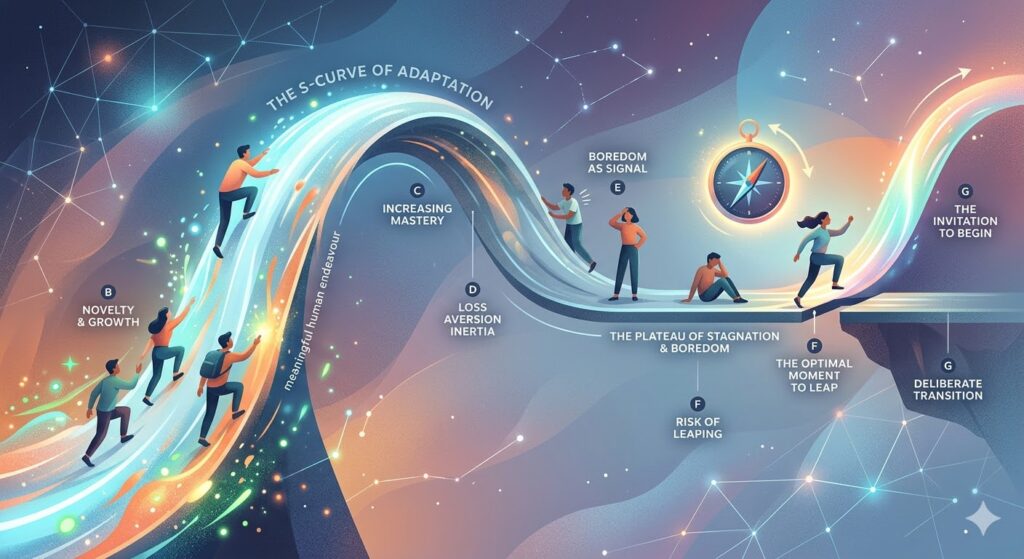
C. The concept of the S-curve — borrowed from the mathematics of logistic growth and popularised in the context of human development by author Whitney Johnson — offers a particularly illuminating framework for understanding the relationship between novelty, mastery, and boredom. In Johnson’s formulation, every new skill, role, or endeavour follows a characteristic trajectory: an initial phase of steep learning and high engagement, during which the challenge of the unfamiliar stimulates intense dopaminergic activity; a middle phase of accelerating competence and peak performance; and a terminal phase of plateau, during which mastery has been achieved, challenge has been extinguished, and the neurological conditions for boredom are fully established. Johnson’s central and most provocative insight is that the optimal moment to initiate a transition to a new S-curve is not at the plateau — when boredom has already taken hold — but just before it: at the inflection point where competence is high but challenge is beginning to wane, and the individual retains sufficient cognitive and emotional resources to navigate the vulnerability of a new beginning.
D. Yet the decision to abandon a current curve — however intellectually compelling the case for doing so — is rarely experienced as a clean, rational calculation. It is, for the overwhelming majority of individuals, a profoundly destabilising psychological event. Behavioural economists Daniel Kahneman and Amos Tversky’s foundational work on loss aversion established that the psychological pain of losing something of value is, on average, approximately twice as intense as the pleasure derived from gaining something of equivalent value. Applied to the context of career or life transitions, this asymmetry creates a powerful cognitive bias toward inertia: the known discomfort of stagnation is consistently underweighted relative to the imagined terror of relinquishing accumulated expertise, social status, and identity. The individual who intellectually recognises that they have outgrown their current curve frequently remains anchored to it not by genuine fulfilment, but by the gravitational pull of sunk cost — the irrational reluctance to abandon an investment of time, effort, and identity, regardless of its diminishing returns.
E. The phenomenology of boredom itself — its subjective texture and its functional significance — has been substantially reappraised in recent psychological literature. The traditional characterisation of boredom as a passive, vacuous state of mere disengagement has been systematically dismantled by researchers such as Dr. Sandi Mann of the University of Central Lancashire, whose work demonstrates that boredom is, in fact, a highly activated motivational state — an aversive signal generated by the brain to communicate that the current allocation of cognitive resources is misaligned with the individual’s capacity and potential. In this reframing, boredom is not the enemy of productivity; it is its most honest diagnostician. The restlessness, the wandering attention, the inexplicable dissatisfaction that characterise the experience of boredom at the plateau of an S-curve are not symptoms of a character deficiency — they are the neurological equivalent of a compass needle swinging toward magnetic north, insistently pointing the individual toward unexplored territory that their existing capabilities have equipped them to navigate.
F. The transition between curves, however, is not without its genuine perils, and a romantically uncritical embrace of perpetual novelty-seeking carries its own pathologies. Clinical psychologist Dr. Leon Seltzer identifies a phenomenon he terms chronic new-start syndrome — a compulsive pattern of initiating new endeavours at the first onset of difficulty or diminishing excitement, never remaining on any single curve long enough to develop the deep competence, meaningful relationships, or substantive contribution that only sustained commitment makes possible. This pattern, which superficially resembles courageous adaptability, is more accurately understood as a sophisticated avoidance strategy — a flight from the discomfort of the middle of the S-curve, where progress is slow, feedback is ambiguous, and the gap between aspiration and current performance is most acutely felt. The individual who perpetually chases the dopaminergic rush of new beginnings without enduring the arduous middle phase of any curve ultimately accumulates breadth without depth, novelty without mastery, and stimulation without meaning.
G. The wisdom that the evidence collectively points toward is neither the stoic endurance of stagnation nor the impulsive abandonment of commitment at the first whisper of boredom. It is, rather, the cultivation of what might be termed deliberate curve literacy — the metacognitive capacity to accurately locate oneself on one’s current S-curve, to distinguish between the productive discomfort of the challenging middle and the genuinely depleting stagnation of the plateau, and to time transitions with the intentionality of a skilled navigator rather than the reactivity of a restless passenger. The next curve, when approached with this quality of self-awareness, is not an escape from the present — it is its most natural and generative continuation. Boredom, understood in its fullest biological and psychological depth, is not the end of a story. It is the most insistent, most honest, and most generative invitation to begin the next one.
Audio
Volcabularies Recap
Click to expand …
| Term | Pronunciation | Root | Definition | Usage Example |
| Arc | /ɑːrk/ | Latin arcus (bow) | The progression or development of a story, career, or process. | The narrative arc of the film showed his growth from a cynic to a believer. |
| Endeavour | /ɪnˈdev.ər/ | Middle English endevor (to do one’s duty) | A strenuous effort or attempt to achieve a goal. | Scaling the mountain was a perilous endeavour, but the view was worth it. |
| Mundane | /mʌnˈdeɪn/ | Latin mundanus (of the world) | Lacking interest or excitement; dull or ordinary. | He escaped the mundane routine of office work by writing sci-fi novels at night. |
| Implications | /ˌɪm.plɪˈkeɪ.ʃənz/ | Latin implicare (to entwine) | The logical conclusions or consequences that follow from an action. | We must consider the long-term implications of this new environmental policy. |
| Ignited | /ɪɡˈnaɪ.tɪd/ | Latin ignis (fire) | Caught fire or caused to start burning; metaphorically, to spark an emotion. | Her speech ignited a sense of hope among the protesters. |
| Imperceptibly | /ˌɪm.pəˈsep.tɪ.bli/ | Latin percipere (to seize/understand) | In a way that is so slight or gradual as to not be noticed. | The sky darkened imperceptibly as evening approached. |
| Choreography | /ˌkɒr.iˈɒɡ.rə.fi/ | Greek khoreia (dance) + graphia (writing) | The sequence of steps and movements in dance or any highly coordinated activity. | The choreography of the surgical team was a marvel of efficiency. |
| Respective vantage points | /rɪˈspek.tɪv ˈvæn.tɪdʒ pɔɪnts/ | Latin respectus + Old French avantage | Particular positions or places that afford a specific view or perspective. | From their respective vantage points, the two observers saw very different events. |
| Invariably provokes | /ɪnˈveə.ri.ə.bli prəˈvəʊks/ | Latin varius (various) + provocare (to call forth) | Always results in or triggers a specific reaction. | Discussing politics invariably provokes a heated argument in this house. |
| Ingratitude | /ɪnˈɡræt.ɪ.tʃuːd/ | Latin ingratitudo | A lack of proper appreciation or thankfulness. | His ingratitude after receiving the scholarship shocked his mentors. |
| Circuitry | /ˈsɜː.kɪ.tri/ | Latin circuitus (a going around) | A system of electrical circuits; metaphorically, the “wiring” of the brain. | Modern computers have incredibly dense and complex circuitry. |
| Intimately | /ˈɪn.tɪ.mət.li/ | Latin intimus (inmost) | In a very close, detailed, or personal manner. | He knew the workings of the engine intimately after years of repair work. |
| Exquisitely | /ɪkˈskwɪz.ɪt.li/ | Latin exquirere (to search out) | In a highly intense, sharp, or beautiful manner. | The room was exquisitely decorated with hand-painted silk. |
| Progressive dulling | /prəˈɡres.ɪv ˈdʌl.ɪŋ/ | Latin progredi (go forward) + Germanic dul | A gradual loss of sharpness, interest, or sensitivity. | The progressive dulling of his senses made the music seem quieter than before. |
| Inflection point | /ɪnˈflek.ʃən pɔɪnt/ | Latin inflectere (to bend) | A time of significant change in a situation; a turning point. | The invention of the smartphone was a major inflection point for technology. |
| Competence | /ˈkɒm.pɪ.təns/ | Latin competere (to strive after) | The ability to do something successfully or efficiently. | Her competence in crisis management earned her a promotion. |
| Wane | /weɪn/ | Old English wanian (to lessen) | To decrease in vigor, power, or size; to become weaker. | Interest in the new app began to wane after the first month. |
| Destabilising | /ˌdiːˈsteɪ.bɪ.laɪ.zɪŋ/ | Latin stabilis (stable) | Making something unstable or upsetting the established order. | The sudden news had a destabilising effect on the stock market. |
| Loss aversion | /lɒs əˈvɜː.ʃən/ | Old French los + Latin aversio | A psychological tendency to prefer avoiding losses over acquiring equivalent gains. | Loss aversion kept him from investing, even though the potential rewards were high. |
| Asymmetry | /eɪˈsɪm.ə.tri/ | Greek asymmetria (lack of proportion) | Lack of equality or equivalence between parts or aspects of something. | There is a clear asymmetry in power between the large corporation and the intern. |
| Inertia | /ɪˈnɜː.ʃə/ | Latin iners (idle/lazy) | A tendency to do nothing or to remain unchanged. | Cultural inertia makes it difficult to change long-standing traditions. |
| Relinquishing | /rɪˈlɪŋ.kwɪ.ʃɪŋ/ | Latin relinquere (to leave behind) | Voluntarily ceasing to keep or claim; giving up. | Relinquishing control of the project was difficult for the founder. |
| Sunk cost | /sʌŋk kɒst/ | Germanic sincan + Latin constare | A cost that has already been incurred and cannot be recovered. | Don’t finish a bad book just because of the sunk cost of your time. |
| Irrational reluctance | /ɪˈræʃ.ən.əl rɪˈlʌk.təns/ | Latin ratio + reluctari (to struggle against) | An unwillingness to act that is not based on logic or reason. | He had an irrational reluctance to try any food that was green. |
| Vacuous state of mere disengagement | /ˈvæk.ju.əs steɪt/ | Latin vacuus (empty) | A condition of being empty-headed or lacking purpose, simply tuned out. | Staring at the TV for hours led him into a vacuous state of mere disengagement. |
| Dismantled | /dɪsˈmæn.təld/ | Old French desmanteler (to strip of a cloak) | Taken to pieces or pulled down. | The old factory was dismantled to make room for a park. |
| Restlessness | /ˈrest.ləs.nəs/ | Old English rest + leas | The inability to rest or relax as a result of anxiety or boredom. | A sense of restlessness prompted her to quit her job and travel. |
| Inexplicable dissatisfaction | /ˌɪn.ɪkˈsplɪk.ə.bəl/ | Latin explicare (to unfold/explain) | A feeling of unhappiness or lack of fulfillment that cannot be explained. | Despite his success, he felt an inexplicable dissatisfaction with life. |
| A character deficiency | /ˈkær.ək.tə dɪˈfɪʃ.ən.si/ | Greek kharakter + Latin deficere | A failing or shortcoming in someone’s personality or moral fiber. | Chronic lying was seen as a major character deficiency in the candidate. |
| Genuine perils | /ˈdʒen.ju.ɪn ˈper.əlz/ | Latin genuinus + periculum (danger) | Real and serious dangers or risks. | The arctic explorers faced genuine perils, including frostbite and starvation. |
| Uncritical embrace of perpetual novelty-seeking | /ʌnˈkrɪt.ɪ.kəl emˈbreɪs/ | Greek kritikos + Latin novus | Accepting new things constantly without questioning their value. | Our uncritical embrace of perpetual novelty-seeking leads to massive electronic waste. |
| Onset of difficulty | /ˈɒn.set əv ˈdɪf.ɪ.kəl.ti/ | Old English on + settan | The beginning or start of a problem or challenging period. | The onset of difficulty began when the main funding was withdrawn. |
| Ambiguous | /æmˈbɪɡ.ju.əs/ | Latin ambiguus (doubtful/wandering) | Open to more than one interpretation; having a double meaning. | The ending of the movie was purposely ambiguous to spark debate. |
| Perpetually | /pəˈpetʃ.u.ə.li/ | Latin perpetuus (continuous) | In a way that never ends or changes; constantly. | He seemed perpetually tired, no matter how much he slept. |
| Arduous | /ˈɑː.dʒu.əs/ | Latin arduus (steep/high) | Involving or requiring strenuous effort; difficult and tiring. | Writing a thesis is an arduous task that requires months of focus. |
| Deliberate curve literacy | /dɪˈlɪb.ər.ət kɜːv/ | Latin librare (to weigh/balance) | The conscious ability to understand and navigate the “learning curve” or “arc” of a process. | Developing deliberate curve literacy helps you stay calm during the “dip” in a new skill. |
| Metacognitive | /ˌmet.ə.kɒɡˈnɪ.tɪv/ | Greek meta (beyond) + Latin cognoscere | Relating to “thinking about thinking”—awareness of one’s own thought processes. | Using a journal is a metacognitive tool that improves learning. |
| Depleting stagnation | /dɪˈpliː.tɪŋ stæɡˈneɪ.ʃən/ | Latin deplere (empty out) + stagnare | A state of no growth or activity that drains one’s energy or spirit. | He felt trapped in the depleting stagnation of a dead-end job. |
English Vietnamese Translation
Click to expand …
The Generative Invitation: Reclaiming Boredom as a Biological Directive
A. There exists, in the arc of almost every meaningful human endeavour, a moment that is simultaneously mundane in its appearance and seismic in its implications — the moment when something that once ignited passion, curiosity, and a sense of boundless possibility begins, almost imperceptibly, to feel routine. The project that consumed one’s waking thoughts becomes a checklist. The relationship that once crackled with discovery settles into predictable choreography. The career that felt like a calling gradually assumes the texture of obligation. Psychologists, organisational theorists, and evolutionary biologists have each, from their respective vantage points, attempted to map this universal human experience — the transition from engagement to stagnation — and to answer the question that it invariably provokes: is the onset of boredom a signal of failure, a symptom of ingratitude, or, as a growing body of evidence provocatively suggests, a sophisticated biological directive to evolve?
B. To understand why humans become bored with mastery, one must first appreciate the neurological architecture of novelty and reward. The brain’s dopaminergic system — the neural circuitry most intimately associated with motivation, anticipation, and the experience of reward — is exquisitely calibrated not to the attainment of goals, but to the prediction of reward and the resolution of uncertainty. Neuroscientist Wolfram Schultz’s landmark research on dopamine neurons demonstrated that these cells fire most vigorously not when a reward is received, but when an unexpected reward is anticipated — and that once a reward becomes entirely predictable, dopaminergic activity diminishes to baseline. This neurological phenomenon, known as reward prediction error, provides a compelling biological explanation for the universal human experience of habituation: the progressive dulling of enthusiasm that accompanies the mastery of any domain, however intrinsically meaningful that domain may initially appear.
C. The concept of the S-curve — borrowed from the mathematics of logistic growth and popularised in the context of human development by author Whitney Johnson — offers a particularly illuminating framework for understanding the relationship between novelty, mastery, and boredom. In Johnson’s formulation, every new skill, role, or endeavour follows a characteristic trajectory: an initial phase of steep learning and high engagement, during which the challenge of the unfamiliar stimulates intense dopaminergic activity; a middle phase of accelerating competence and peak performance; and a terminal phase of plateau, during which mastery has been achieved, challenge has been extinguished, and the neurological conditions for boredom are fully established. Johnson’s central and most provocative insight is that the optimal moment to initiate a transition to a new S-curve is not at the plateau — when boredom has already taken hold — but just before it: at the inflection point where competence is high but challenge is beginning to wane, and the individual retains sufficient cognitive and emotional resources to navigate the vulnerability of a new beginning.
D. Yet the decision to abandon a current curve — however intellectually compelling the case for doing so — is rarely experienced as a clean, rational calculation. It is, for the overwhelming majority of individuals, a profoundly destabilising psychological event. Behavioural economists Daniel Kahneman and Amos Tversky’s foundational work on loss aversion established that the psychological pain of losing something of value is, on average, approximately twice as intense as the pleasure derived from gaining something of equivalent value. Applied to the context of career or life transitions, this asymmetry creates a powerful cognitive bias toward inertia: the known discomfort of stagnation is consistently underweighted relative to the imagined terror of relinquishing accumulated expertise, social status, and identity. The individual who intellectually recognises that they have outgrown their current curve frequently remains anchored to it not by genuine fulfilment, but by the gravitational pull of sunk cost — the irrational reluctance to abandon an investment of time, effort, and identity, regardless of its diminishing returns.
E. The phenomenology of boredom itself — its subjective texture and its functional significance — has been substantially reappraised in recent psychological literature. The traditional characterisation of boredom as a passive, vacuous state of mere disengagement has been systematically dismantled by researchers such as Dr. Sandi Mann of the University of Central Lancashire, whose work demonstrates that boredom is, in fact, a highly activated motivational state — an aversive signal generated by the brain to communicate that the current allocation of cognitive resources is misaligned with the individual’s capacity and potential. In this reframing, boredom is not the enemy of productivity; it is its most honest diagnostician. The restlessness, the wandering attention, the inexplicable dissatisfaction that characterise the experience of boredom at the plateau of an S-curve are not symptoms of a character deficiency — they are the neurological equivalent of a compass needle swinging toward magnetic north, insistently pointing the individual toward unexplored territory that their existing capabilities have equipped them to navigate.
F. The transition between curves, however, is not without its genuine perils, and a romantically uncritical embrace of perpetual novelty-seeking carries its own pathologies. Clinical psychologist Dr. Leon Seltzer identifies a phenomenon he terms chronic new-start syndrome — a compulsive pattern of initiating new endeavours at the first onset of difficulty or diminishing excitement, never remaining on any single curve long enough to develop the deep competence, meaningful relationships, or substantive contribution that only sustained commitment makes possible. This pattern, which superficially resembles courageous adaptability, is more accurately understood as a sophisticated avoidance strategy — a flight from the discomfort of the middle of the S-curve, where progress is slow, feedback is ambiguous, and the gap between aspiration and current performance is most acutely felt. The individual who perpetually chases the dopaminergic rush of new beginnings without enduring the arduous middle phase of any curve ultimately accumulates breadth without depth, novelty without mastery, and stimulation without meaning.
G. The wisdom that the evidence collectively points toward is neither the stoic endurance of stagnation nor the impulsive abandonment of commitment at the first whisper of boredom. It is, rather, the cultivation of what might be termed deliberate curve literacy — the metacognitive capacity to accurately locate oneself on one’s current S-curve, to distinguish between the productive discomfort of the challenging middle and the genuinely depleting stagnation of the plateau, and to time transitions with the intentionality of a skilled navigator rather than the reactivity of a restless passenger. The next curve, when approached with this quality of self-awareness, is not an escape from the present — it is its most natural and generative continuation. Boredom, understood in its fullest biological and psychological depth, is not the end of a story. It is the most insistent, most honest, and most generative invitation to begin the next one.
Lời Mời Gọi Kiến Tạo: Khôi Phục Vị Thế của Sự Chán Chường Như Một Chỉ Thị Sinh Học
A. Trong quỹ đạo của hầu hết mọi nỗ lực ý nghĩa của con người, luôn tồn tại một khoảnh khắc vừa tầm thường về diện mạo nhưng lại mang tính địa chấn về hệ quả — đó là khi thứ từng thắp lên đam mê, sự tò mò và cảm giác về những khả năng vô tận bắt đầu trở nên rập khuôn một cách vô hình. Dự án từng chiếm trọn tâm trí lúc thức giấc giờ trở thành một danh sách các đầu việc cần đánh dấu. Mối quan hệ từng rực cháy những khám phá mới mẻ dần rơi vào một “vũ điệu” có thể dự đoán trước. Sự nghiệp từng được coi là tiếng gọi của định mệnh nay dần mang dáng dấp của nghĩa vụ. Các nhà tâm lý học, các nhà lý thuyết tổ chức và các nhà sinh học tiến hóa, từ những góc nhìn riêng biệt, đã cố gắng phác thảo trải nghiệm phổ quát này của nhân loại — sự chuyển giao từ trạng thái gắn kết sang đình trệ — và để trả lời câu hỏi mà nó luôn khơi gợi: liệu sự khởi đầu của nỗi chán chường là tín hiệu của thất bại, triệu chứng của sự vô ơn, hay như một hệ thống bằng chứng ngày càng tăng đã gợi ý một cách đầy khiêu khích, đó là một chỉ thị sinh học tinh vi để tiến hóa?
B. Để hiểu tại sao con người trở nên chán chường với sự tinh thông (mastery), trước hết ta phải thấu hiểu cấu trúc thần kinh của sự mới lạ và phần thưởng. Hệ thống dopamine của não bộ — mạng lưới thần kinh liên kết chặt chẽ nhất với động lực, sự kỳ vọng và trải nghiệm phần thưởng — được hiệu chỉnh một cách tinh vi không phải để hướng tới việc đạt được mục tiêu, mà là để dự đoán phần thưởng và giải quyết sự mơ hồ. Nghiên cứu mang tính cột mốc của nhà thần kinh học Wolfram Schultz về các tế bào thần kinh dopamine đã chứng minh rằng các tế bào này hoạt động mạnh mẽ nhất không phải khi nhận được phần thưởng, mà khi một phần thưởng bất ngờ được kỳ vọng — và một khi phần thưởng trở nên hoàn toàn có thể dự đoán được, hoạt động của dopamine sẽ giảm xuống mức cơ bản. Hiện tượng thần kinh này, được gọi là sai số dự đoán phần thưởng (reward prediction error), cung cấp một lời giải thích sinh học thuyết phục cho trải nghiệm thích nghi phổ quát của con người: sự mai một dần nhiệt huyết đi kèm với việc làm chủ bất kỳ lĩnh vực nào, dù lĩnh vực đó ban đầu có ý nghĩa nội tại đến đâu.
C. Khái niệm Đường cong S (S-curve) — mượn từ toán học về tăng trưởng logistic và được tác giả Whitney Johnson phổ biến trong bối cảnh phát triển con người — cung cấp một khung tham chiếu đặc biệt sáng tỏ để hiểu mối quan hệ giữa sự mới lạ, sự tinh thông và nỗi chán chường. Trong công thức của Johnson, mọi kỹ năng, vai trò hoặc nỗ lực mới đều tuân theo một quỹ đạo đặc trưng:
- Giai đoạn đầu: Học hỏi dồn dập và gắn kết cao, khi đó thử thách từ những điều lạ lẫm kích thích hoạt động dopamine mạnh mẽ.
- Giai đoạn giữa: Tăng tốc năng lực và đạt đỉnh cao hiệu suất.
- Giai đoạn cuối (vùng bình nguyên): Khi sự tinh thông đã đạt được, thử thách đã bị dập tắt, và các điều kiện thần kinh cho nỗi chán chường được thiết lập đầy đủ.
Phát hiện trung tâm và táo bạo nhất của Johnson là: thời điểm tối ưu để bắt đầu chuyển sang một Đường cong S mới không phải là khi ở vùng bình nguyên — khi nỗi chán chường đã chiếm hữu — mà là ngay trước đó: tại điểm uốn nơi năng lực đang ở mức cao nhưng thử thách bắt đầu suy giảm, và cá nhân vẫn còn đủ nguồn lực nhận thức lẫn cảm xúc để chế ngự sự bấp bênh của một khởi đầu mới.
D. Tuy nhiên, quyết định từ bỏ “đường cong” hiện tại — dù lý trí có thuyết phục đến đâu — hiếm khi được coi là một phép tính thuần túy lý tính. Đối với đại đa số cá nhân, đó là một sự kiện tâm lý gây bất ổn sâu sắc. Công trình nền tảng của các nhà kinh tế học hành vi Daniel Kahneman và Amos Tversky về tâm lý ngại mất mát (loss aversion) đã xác lập rằng nỗi đau tâm lý khi mất đi thứ gì đó có giá trị, trung bình, mãnh liệt gấp đôi so với niềm vui có được từ thứ có giá trị tương đương. Áp dụng vào bối cảnh chuyển đổi sự nghiệp hay cuộc sống, sự bất đối xứng này tạo ra một thiên kiến nhận thức mạnh mẽ hướng tới sự trì trệ: cảm giác khó chịu đã biết của sự đình trệ luôn bị xem nhẹ so với nỗi khiếp sợ tưởng tượng khi phải từ bỏ chuyên môn tích lũy, địa vị xã hội và bản sắc cá nhân. Người nhận thức được bằng lý trí rằng mình đã “vượt ngưỡng” đường cong hiện tại thường vẫn bám trụ lại, không phải vì sự thỏa nguyện thực sự, mà bởi lực hấp dẫn của chi phí chìm (sunk cost) — sự miễn cưỡng phi lý khi từ bỏ một khoản đầu tư về thời gian, nỗ lực và bản sắc, bất kể lợi nhuận từ nó đang giảm dần.
E. Hiện tượng học về chính nỗi chán chường — kết cấu chủ quan và ý nghĩa chức năng của nó — đã được đánh giá lại đáng kể trong các tài liệu tâm lý học gần đây. Cách mô tả truyền thống về sự chán chường như một trạng thái thụ động, trống rỗng của sự mất gắn kết thuần túy đã bị dỡ bỏ một cách hệ thống bởi các nhà nghiên cứu như Tiến sĩ Sandi Mann. Công trình của bà chứng minh rằng sự chán chường thực chất là một trạng thái động lực được kích hoạt cao độ — một tín hiệu khó chịu được não bộ tạo ra để thông báo rằng việc phân bổ nguồn lực nhận thức hiện tại đang không tương xứng với năng lực và tiềm năng của cá nhân. Trong cách nhìn nhận mới này, chán chường không phải là kẻ thù của năng suất; nó là nhà chẩn đoán trung thực nhất. Sự bồn chồn, sự xao nhãng, nỗi bất mãn không thể giải thích được đặc trưng cho trải nghiệm chán chường ở vùng bình nguyên của Đường cong S không phải là triệu chứng của sự khiếm khuyết nhân cách — chúng là sự tương đương về mặt thần kinh của một kim la bàn đang xoay về hướng Bắc cực từ tính, kiên trì chỉ hướng cho cá nhân tới những vùng lãnh thổ chưa được khám phá mà năng lực hiện tại của họ đã đủ sức để lèo lái.
F. Tuy nhiên, sự chuyển đổi giữa các đường cong không phải là không có những hiểm họa thực sự, và việc đón nhận một cách mù quáng vẻ lãng mạn của việc tìm kiếm sự mới lạ vĩnh cửu cũng mang theo những bệnh lý riêng. Nhà tâm lý học lâm sàng, Tiến sĩ Leon Seltzer, xác định một hiện tượng mà ông gọi là hội chứng khởi đầu mới mãn tính (chronic new-start syndrome) — một kiểu hành vi cưỡng chế luôn bắt đầu những nỗ lực mới ngay khi xuất hiện khó khăn đầu tiên hoặc khi sự hào hứng giảm sút. Họ không bao giờ ở lại trên bất kỳ đường cong đơn lẻ nào đủ lâu để phát triển năng lực chuyên sâu, các mối quan hệ có ý nghĩa, hoặc những đóng góp thực chất mà chỉ có sự cam kết bền bỉ mới làm được. Kiểu hành vi này, dù bề ngoài trông giống như khả năng thích nghi dũng cảm, thực chất được hiểu chính xác hơn như một chiến lược né tránh tinh vi — một cuộc tháo chạy khỏi sự khó chịu ở giai đoạn giữa của Đường cong S, nơi tiến độ chậm chạp, phản hồi mơ hồ và khoảng cách giữa khát vọng với hiệu suất hiện tại được cảm nhận rõ rệt nhất. Kẻ vĩnh viễn đuổi theo sự bùng nổ dopamine của những khởi đầu mới mà không chịu đựng giai đoạn giữa gian khổ sẽ cuối cùng chỉ tích lũy được bề rộng mà thiếu bề sâu, sự mới lạ mà thiếu sự tinh thông, và sự kích thích mà thiếu đi ý nghĩa.
G. Trí tuệ mà các bằng chứng này cùng hướng tới không phải là sự cam chịu khắc kỷ trước sự đình trệ, cũng không phải là sự từ bỏ bốc đồng khi nỗi chán chường vừa chớm nở. Thay vào đó, đó là việc trau dồi cái gọi là năng lực thấu hiểu đường cong có chủ đích (deliberate curve literacy) — khả năng siêu nhận thức để xác định chính xác vị trí của bản thân trên Đường cong S hiện tại, để phân biệt giữa sự khó chịu tích cực của giai đoạn giữa đầy thử thách và sự đình trệ thực sự làm kiệt quệ của vùng bình nguyên, và để định thời điểm chuyển đổi với sự chủ động của một người dẫn đường lành nghề thay vì sự phản ứng của một hành khách bồn chồn. Đường cong tiếp theo, khi được tiếp cận bằng phẩm chất tự nhận thức này, không phải là một cuộc trốn chạy khỏi hiện tại — mà là sự tiếp nối tự nhiên và mang tính kiến tạo nhất. Sự chán chường, khi được hiểu trong toàn bộ chiều sâu sinh học và tâm lý của nó, không phải là kết thúc của một câu chuyện. Nó là lời mời gọi kiên trì nhất, trung thực nhất và mang tính kiến tạo nhất để bắt đầu một chương tiếp theo.