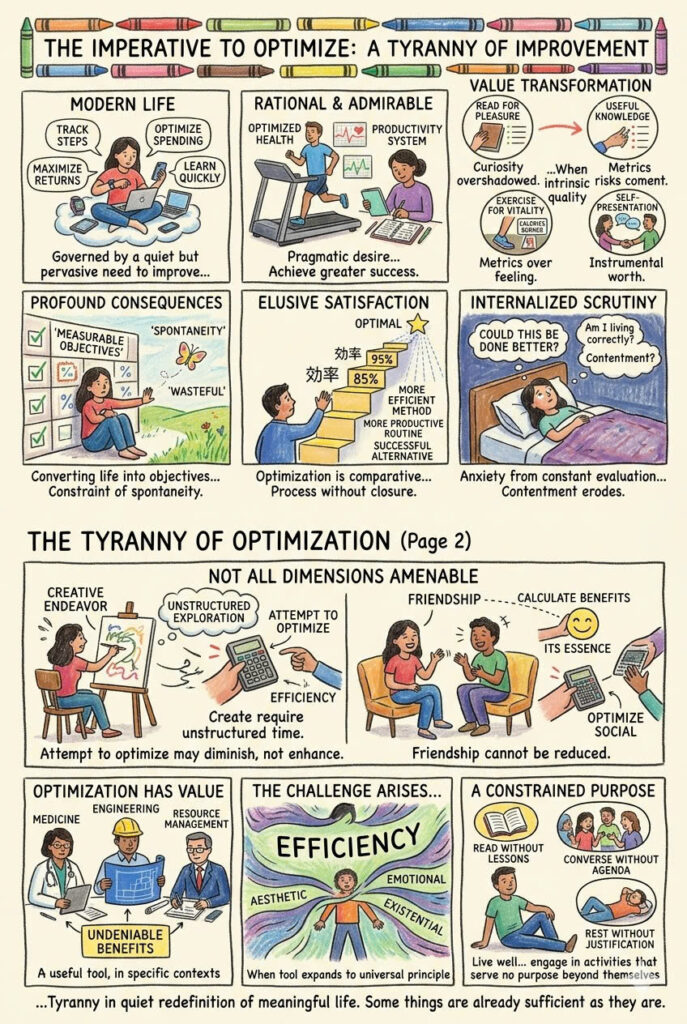
Modern life is increasingly governed by a quiet but pervasive imperative: the need to optimize. From productivity systems and financial planning to health tracking and personal development, individuals are encouraged to refine every aspect of their existence. Time must be used efficiently, decisions must maximize returns, and even leisure is often evaluated in terms of its utility — whether it restores energy, enhances skills, or contributes to long-term goals. What emerges is a worldview in which life itself is treated as a project to be continuously improved.
At first glance, this orientation appears rational, even admirable. The desire to make better use of limited resources — time, energy, attention — reflects a fundamentally pragmatic impulse. In a world characterized by competition and rapid change, those who optimize may indeed achieve greater success, at least by conventional measures. However, the pursuit of optimization carries with it a subtle transformation in how value is perceived.
When every activity is subjected to evaluation, its intrinsic qualities risk being overshadowed by its instrumental worth. Reading a book, for instance, may no longer be an act of curiosity or pleasure, but a means of acquiring knowledge deemed useful. Exercise becomes less about physical vitality and more about measurable outcomes: calories burned, metrics improved, performance enhanced. Even social interactions can be reframed as opportunities for networking or self-presentation, rather than genuine connection.
This shift has profound psychological consequences. By converting life into a series of measurable objectives, individuals may inadvertently narrow the scope of their experience. Activities that cannot be easily quantified or justified in terms of efficiency begin to feel indulgent or even wasteful. As a result, spontaneity — once a natural feature of human existence — becomes constrained by the need for purpose and productivity.
Paradoxically, the more one strives to optimize, the more elusive satisfaction can become. Optimization is inherently comparative; it requires a standard against which improvement is measured. Yet in a world of infinite possibilities, such standards are constantly shifting. There is always a more efficient method, a more productive routine, a more successful alternative. The endpoint recedes indefinitely, transforming optimization into a process without closure.
This dynamic gives rise to a subtle form of anxiety. The individual is no longer merely living but continuously evaluating whether they are living correctly. Each moment carries an implicit question: could this be done better? Over time, this internalized scrutiny can erode the capacity for contentment. Instead of experiencing life directly, one becomes preoccupied with assessing its quality.
Critics of this mindset argue that not all dimensions of life are amenable to optimization. Certain experiences derive their value precisely from their resistance to calculation. Friendship, for example, cannot be reduced to efficiency without losing its essence. Similarly, creative endeavors often require periods of unstructured exploration that defy systematic improvement. In such cases, the attempt to optimize may not enhance the experience but diminish it.
This is not to suggest that optimization is inherently misguided. In many domains — medicine, engineering, resource management — it has produced undeniable benefits. The challenge arises when a tool designed for specific contexts expands into a universal principle governing all aspects of life. When efficiency becomes the dominant criterion, other forms of value — aesthetic, emotional, existential — risk being marginalized.
Ultimately, the question is not whether optimization should be abandoned, but whether it should be constrained. A life oriented entirely around improvement may achieve impressive results, yet still feel curiously incomplete. To live well may require the willingness to engage in activities that serve no purpose beyond themselves — to read without extracting lessons, to converse without agenda, to rest without justification.
In this light, the tyranny of optimization lies not in its demands, but in its quiet redefinition of what it means to live a meaningful life. By insisting that everything must be improved, it risks obscuring the possibility that some things are already sufficient as they are.