The Continuity of Surplus
Throughout history, human societies have organized themselves around systems of production that determine not only how goods are created but also how their benefits are distributed. Although these systems have changed dramatically across centuries, a recurring pattern can be observed beneath their surface differences: the extraction of surplus value from one group of people for the benefit of another.
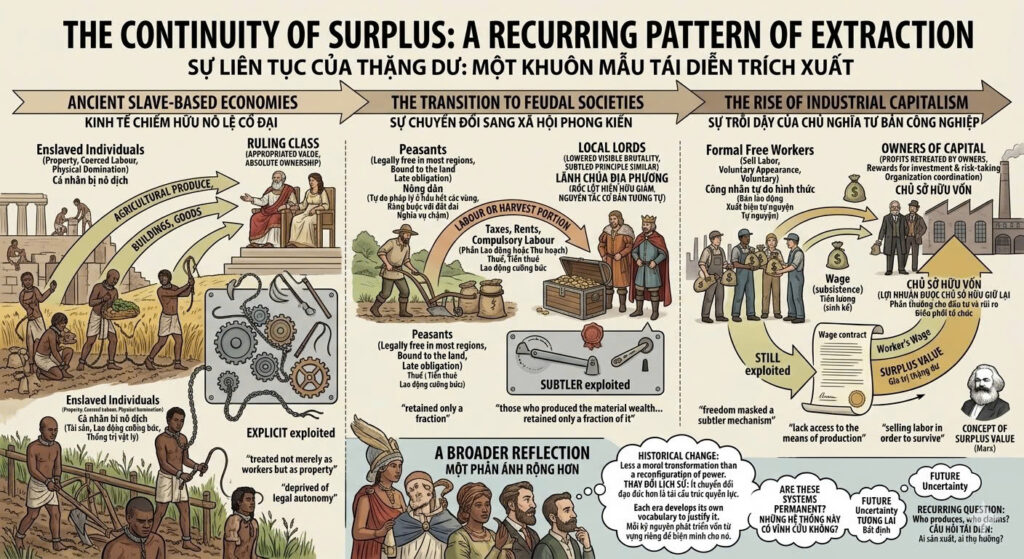
In ancient slave-based economies, this dynamic was starkly visible. Enslaved individuals were treated not merely as workers but as property, deprived of legal autonomy and compelled to labor for their owners. The fruits of their work — agricultural produce, constructed buildings, and manufactured goods — were appropriated almost entirely by the ruling class. The mechanism of exploitation was explicit: coercion enforced by physical domination.
The transition to feudal societies did not eliminate this structure so much as transform its appearance. Under feudalism, peasants were no longer legally owned as chattel in most regions, yet they remained bound to the land and obligated to deliver a portion of their labor or harvest to local lords. This obligation might take the form of taxes, rents, or compulsory labor on the lord’s estate. Though less visibly brutal than slavery, the underlying principle remained similar: those who produced the material wealth of society retained only a fraction of it.
With the rise of industrial capitalism, another transformation occurred. The legal status of workers changed significantly; individuals were formally free to sell their labor on the market. However, critics argue that this freedom masked a subtler mechanism of surplus extraction. In capitalist production, workers receive wages that correspond roughly to the value required for their subsistence, while the additional value generated through their labor is retained as profit by the owners of capital.
This concept of surplus value is most famously associated with the work of Karl Marx, whose analysis framed capitalism as a system in which exploitation persists despite the formal equality of market exchange. From this perspective, the wage contract conceals a structural imbalance: although workers appear to participate voluntarily, they lack access to the means of production and therefore must sell their labor in order to survive.
Supporters of capitalism often contest this interpretation. They argue that profit reflects not exploitation but the rewards of investment, risk-taking, and organizational coordination. In their view, economic systems evolve toward greater efficiency and prosperity, enabling rising living standards for broad populations rather than concentrating wealth exclusively among elites.
Nevertheless, the historical comparison remains provocative. Across slavery, feudalism, and capitalism, the institutional arrangements differ dramatically, yet each system establishes mechanisms through which a portion of the value created by producers is transferred upward. What changes is not the existence of surplus extraction but the legal, political, and ideological frameworks that justify it.
This observation invites a broader reflection on the nature of economic progress. If successive systems retain a similar underlying dynamic, then historical change may represent less a moral transformation than a reconfiguration of power. Each era develops its own vocabulary to explain why such arrangements are necessary or inevitable.
Yet history also reveals that these systems are neither permanent nor immutable. Social movements, technological changes, and political struggles continually reshape the balance between labor and power. The future of economic organization remains uncertain, but the recurring question endures: who produces society’s wealth, and who ultimately claims it?