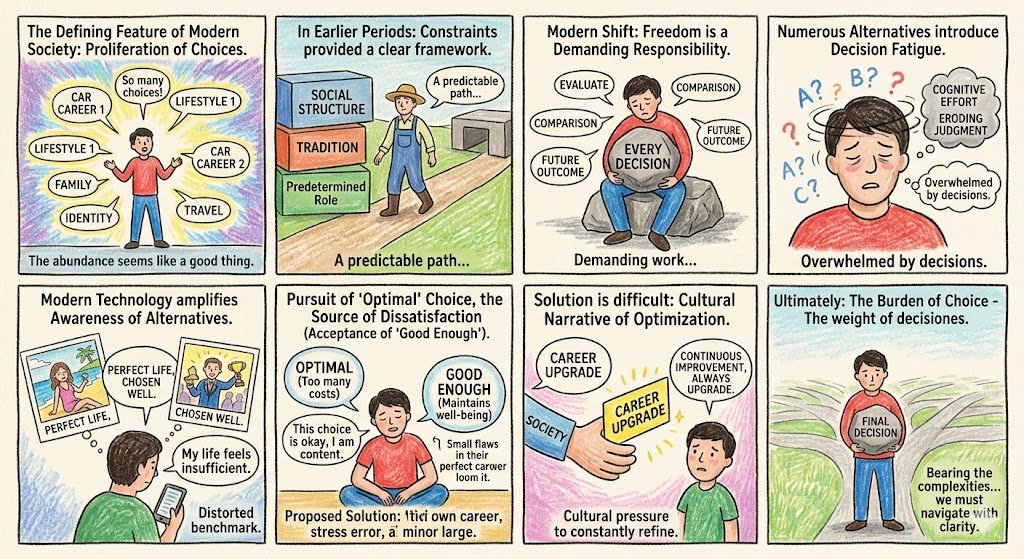
One of the defining features of modern society is not merely the abundance of resources, but the proliferation of choices. Individuals today are confronted with an unprecedented range of possibilities in nearly every domain of life: careers, lifestyles, relationships, and even identities. At first glance, this expansion of choice appears to be an unambiguous good — a sign of progress and personal freedom. Yet a closer examination reveals that this abundance may carry an unexpected psychological cost.
In earlier periods of history, life trajectories were often constrained by social structures, economic necessity, and cultural expectations. While such constraints limited individual freedom, they also provided a clear framework within which decisions were made. One’s role in society, though restrictive, was largely predetermined, reducing the burden of constant deliberation. By contrast, the modern individual must navigate a landscape in which few paths are fixed and nearly all decisions are subject to personal choice.
This shift has transformed freedom from a liberating condition into a demanding responsibility. Each decision — whether trivial or consequential — requires evaluation, comparison, and anticipation of future outcomes. Over time, this process can lead to decision fatigue, a state in which the cognitive effort required to make choices begins to erode one’s capacity for judgment. What initially appears as empowerment gradually becomes a source of anxiety.
Moreover, the presence of numerous alternatives introduces the persistent possibility of regret. When only a limited number of options exist, the consequences of a decision are easier to accept as inevitable. However, in a context of abundance, every choice implicitly excludes a multitude of others. The individual is left to wonder whether a different path might have yielded greater satisfaction. This counterfactual thinking — imagining what could have been — can undermine contentment, even when the chosen outcome is objectively favorable.
Compounding this issue is the role of modern technology, which amplifies awareness of alternative lifestyles. Through digital platforms, individuals are continuously exposed to curated representations of other people’s successes, experiences, and achievements. These representations, often idealized, create a distorted benchmark against which one’s own life is measured. The result is a heightened sense of insufficiency, as the gap between reality and perceived possibility appears to widen.
Paradoxically, the pursuit of the “optimal” choice may itself be the source of dissatisfaction. When individuals approach decisions with the expectation that there exists a perfect outcome, they are more likely to experience disappointment. Even minor imperfections become magnified, as they signal a deviation from the imagined ideal. In this sense, the problem lies not in the number of choices per se, but in the mindset with which those choices are approached.
Some theorists argue that a more sustainable approach involves embracing what might be termed “bounded satisfaction” — the acceptance that decisions need only be good enough rather than optimal. This perspective shifts the focus from maximizing outcomes to maintaining psychological well-being. By relinquishing the need for perfection, individuals can reduce the cognitive and emotional burden associated with decision-making.
Nevertheless, this solution is not easily implemented. The cultural narrative of modernity continues to equate success with optimization, encouraging individuals to constantly refine, improve, and upgrade their choices. From career advancement to personal relationships, the expectation of continuous improvement permeates all aspects of life. In such an environment, settling for “good enough” may feel like a form of failure rather than a pragmatic adaptation.
Ultimately, the burden of choice reflects a deeper tension within modern existence. Freedom, while undeniably valuable, is not without its complexities. The same conditions that enable individuals to shape their own lives also require them to bear the weight of those decisions. In this light, the challenge of modern life may not be how to expand choice further, but how to navigate it with a sense of clarity, restraint, and acceptance.