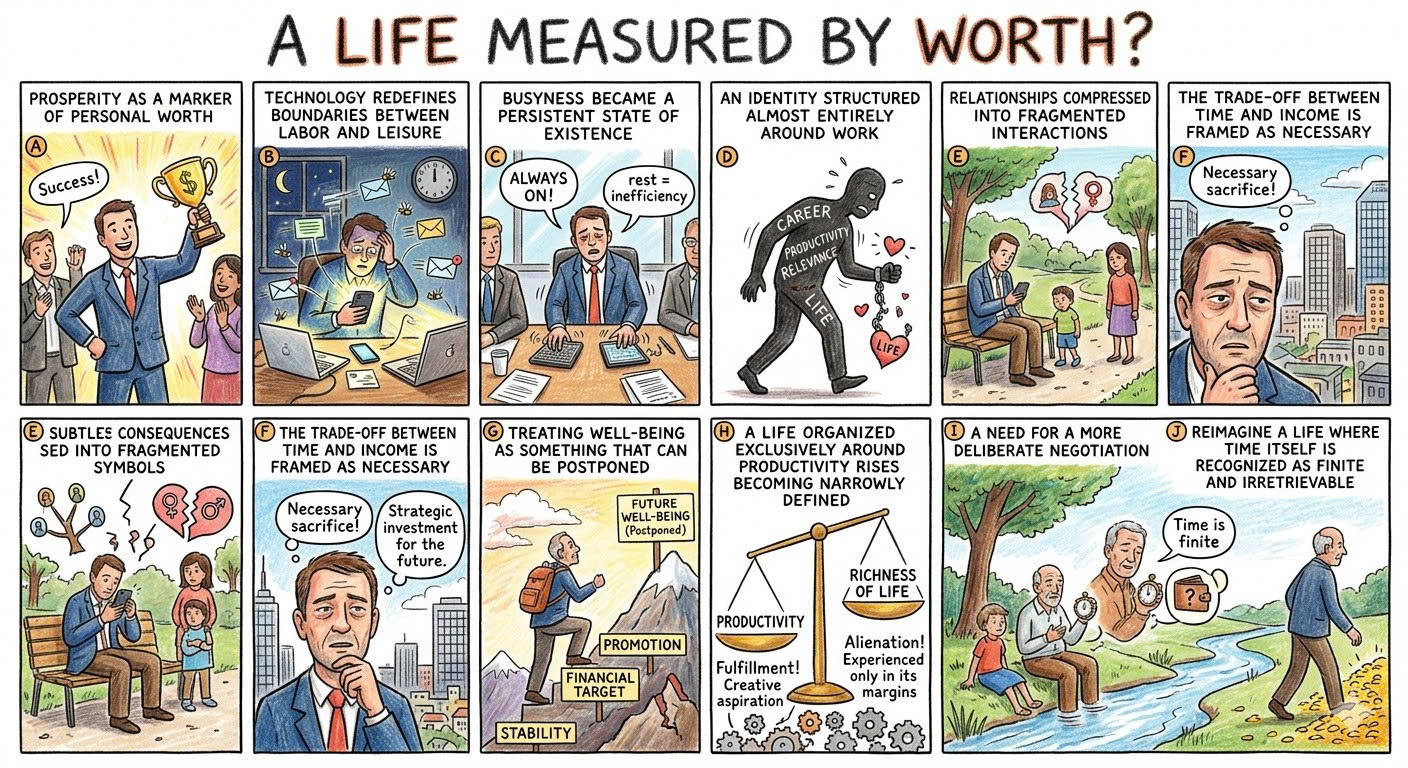
In contemporary society, few ideals are as widely admired as professional success. A demanding career, particularly one that yields a high income, is often regarded not merely as an economic achievement but as a marker of personal worth. Long hours, constant availability, and relentless productivity are worn almost as badges of honor — evidence of ambition, discipline, and relevance in an increasingly competitive world. Yet beneath this cultural narrative lies an unsettling question: at what point does a successful career cease to serve one’s life and begin, instead, to consume it?
The modern workplace has redefined the boundaries between labor and leisure to an unprecedented degree. Advances in technology, once heralded as tools of liberation, have rendered individuals perpetually reachable. Emails arrive late into the evening, messages demand immediate replies, and the distinction between “working hours” and personal time has become increasingly porous. In such an environment, busyness is no longer a temporary condition but a persistent state of existence.
Paradoxically, this state is often self-reinforcing. High-income professions tend to reward not only output but visibility — the appearance of constant engagement. Employees internalize these expectations, equating rest with inefficiency and stillness with stagnation. Over time, the pursuit of financial security and professional recognition evolves into something more insidious: an identity structured almost entirely around work.
This transformation carries subtle but profound consequences. Relationships, once sustained through shared time and attention, become compressed into fragmented interactions. Leisure, rather than offering genuine restoration, is reduced to brief intervals of passive consumption — a series of distractions designed to alleviate fatigue without addressing its underlying causes. Even physical health may deteriorate, as sedentary routines and chronic stress gradually erode the body’s resilience.
What makes this dynamic particularly difficult to confront is its apparent rationality. The trade-off between time and income is often framed as a necessary sacrifice, especially in urban environments where living costs are high and social expectations are demanding. From this perspective, the loss of personal time appears not as a failure but as a strategic decision — an investment in future security.
However, this logic assumes that life can be deferred indefinitely. It treats well-being as something that can be postponed until after certain milestones are achieved: a promotion, a financial target, a moment of stability that perpetually recedes into the future. In reality, the passage of time imposes its own constraints. Relationships evolve or fade, health declines or strengthens, and opportunities for meaningful experience are often bound to specific stages of life.
Critics of the culture of busyness argue that the issue is not simply one of time management but of value orientation. A life organized exclusively around productivity risks becoming narrowly defined, its richness reduced to measurable outputs. The question, then, is not whether work is important — it undeniably is — but whether it has been granted a disproportionate role in shaping human existence.
This does not imply that ambition or financial success should be rejected. Rather, it suggests the need for a more deliberate negotiation between professional demands and personal priorities. Some individuals may indeed find fulfillment in highly demanding careers, particularly when their work aligns with deeply held values or creative aspirations. For others, however, the same conditions may produce a gradual sense of alienation — a feeling that life is being experienced only in its margins.
Ultimately, the problem may lie in the way success is defined. If a high income is achieved at the expense of time, health, and relationships, then its value becomes ambiguous. The modern individual is thus confronted with a dilemma that is both practical and philosophical: whether to continue pursuing a model of success that equates busyness with worth, or to reimagine a life in which time itself is recognized as the most finite and irretrievable resource.
In this light, the question is not merely whether a busy job takes away one’s life, but whether one has consciously chosen the terms under which that life is lived.