Pursuing Happiness
Few ideas are as deeply embedded in modern culture as the belief that happiness is something to be actively pursued. From self-help literature to social expectations, individuals are encouraged to identify what makes them happy and to organize their lives accordingly. Happiness, in this framework, is treated almost as a destination — a state that can be reached through the right combination of choices, habits, and achievements. Yet this assumption raises a subtle but important question: what if the very act of pursuing happiness undermines the possibility of attaining it?
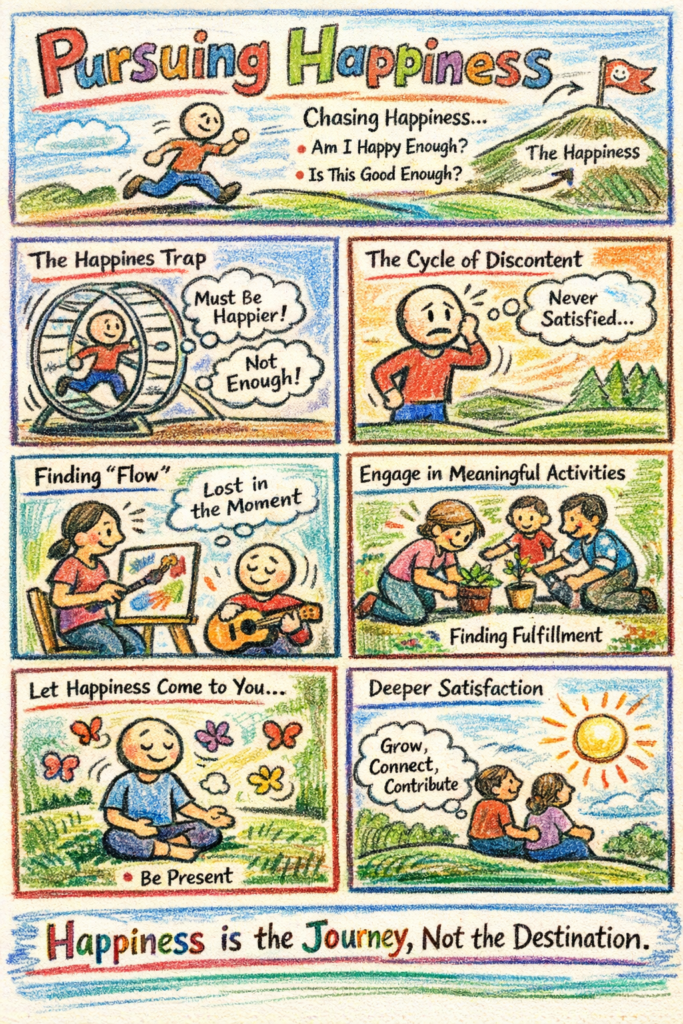
At the core of this paradox lies the nature of happiness itself. Unlike tangible goals, happiness is not a stable or directly controllable outcome. It is better understood as an emergent state — something that arises under certain conditions but cannot be forced into existence. When individuals attempt to pursue happiness as an explicit objective, they often shift their attention away from the activities and experiences that might naturally generate it. Instead of being immersed in the present moment, they begin to evaluate it: Am I happy enough? Could this be better?
This constant evaluation introduces a form of psychological friction. By measuring experience against an idealized standard of happiness, individuals create a gap between what is and what is expected. Even positive experiences may feel insufficient when judged in this way. The result is a self-reinforcing cycle: the more one strives to maximize happiness, the more one becomes aware of its absence.
An alternative perspective suggests that happiness is more likely to emerge as a byproduct of meaningful engagement rather than as a direct aim. Activities that demand attention — whether intellectual, creative, or relational — tend to absorb the individual, reducing self-conscious reflection. In such states, often described as forms of “flow,” the question of happiness becomes temporarily irrelevant. Paradoxically, it is precisely in these moments of non-pursuit that individuals often report feeling most content.
This insight does not imply that happiness is irrelevant or undesirable. Rather, it challenges the assumption that it should function as the primary organizing principle of life. When happiness becomes the central goal, other values — such as responsibility, growth, or contribution — may be subordinated to it. Yet these very values are often the conditions under which deeper and more durable forms of satisfaction arise.
There is also a temporal dimension to consider. The pursuit of happiness tends to focus on immediate emotional states, encouraging individuals to seek experiences that produce rapid gratification. However, many aspects of a fulfilling life involve delayed rewards, effort, and even discomfort. Relationships require patience, mastery requires discipline, and meaningful achievements often emerge only after sustained struggle. If happiness is defined narrowly as the avoidance of discomfort, these experiences may be prematurely abandoned.
From this perspective, the idea of “letting happiness pursue us” can be understood as a shift in orientation. Instead of directly seeking happiness, individuals focus on cultivating the conditions that make it possible: engaging in meaningful work, developing relationships, and aligning actions with values. Happiness, in this model, is not the target but the consequence.
Nevertheless, this approach is not without its own ambiguities. It offers no guarantee of happiness, nor does it eliminate the complexities of human emotion. Life remains subject to uncertainty, loss, and fluctuation. What it does offer, however, is a different relationship to these experiences — one in which happiness is not demanded at every moment, but allowed to arise intermittently and without coercion.
Ultimately, the question is not whether happiness should matter, but how it should be situated within the broader context of a life. To pursue it directly may be to misunderstand its nature; to ignore it entirely may be equally misguided. Between these extremes lies a more nuanced possibility: that happiness is something best approached indirectly, emerging not from the intensity of our desire for it, but from the depth of our engagement with life itself.