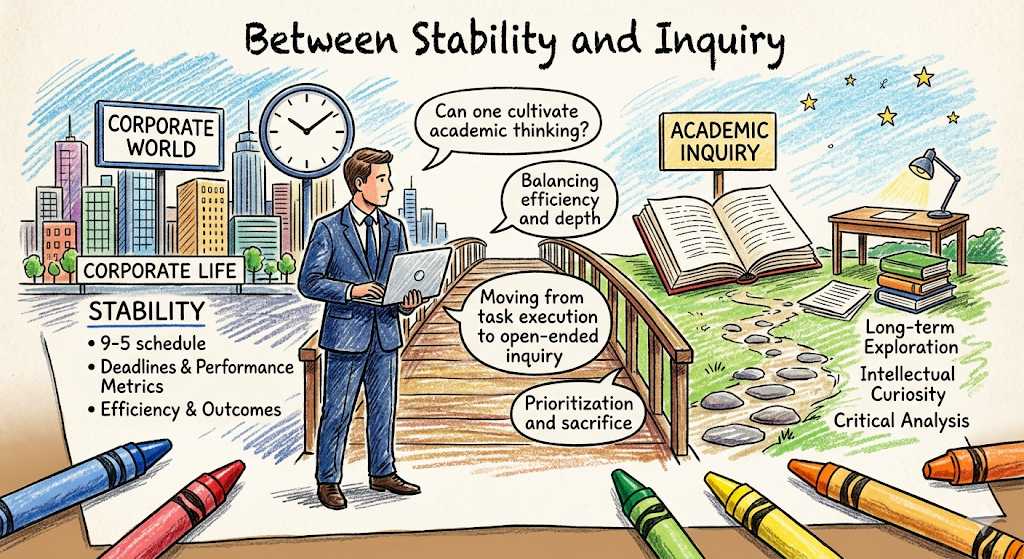
The division between corporate life and academic pursuit is often perceived as both structural and psychological. On one side stands the world of the 9–5 employee: defined by deadlines, performance metrics, and organizational hierarchies. On the other lies academia, associated with intellectual autonomy, prolonged inquiry, and the pursuit of knowledge for its own sake. These domains are frequently treated as mutually exclusive, as though the demands of one necessarily preclude meaningful engagement with the other. Yet this assumption warrants closer examination.
At a practical level, the challenge is undeniable. Academic work — particularly at an advanced level — requires sustained concentration, extensive reading, and the capacity to engage deeply with complex ideas. Such activities are not easily accommodated within the fragmented intervals of time that remain after a full working day. Cognitive fatigue, accumulated through hours of professional obligation, often diminishes the quality of intellectual engagement. Under these conditions, the aspiration to pursue an academic path may appear less like a viable project and more like an idealized abstraction.
However, to conclude that such a pursuit is impossible would be to overlook the evolving nature of both work and education. The traditional model of academia — confined to universities and structured through rigid timelines — has begun to diversify. Digital resources, open-access journals, and remote learning platforms have lowered the barriers to entry, allowing individuals to engage with academic material outside formal institutional settings. While this does not eliminate the challenges, it does expand the range of possibilities.
More fundamentally, the question may not be whether one can replicate the experience of a full-time academic, but whether one can cultivate an academic mode of thinking within the constraints of a different lifestyle. Academic engagement is not solely defined by institutional affiliation; it is also characterized by habits of mind: critical analysis, intellectual curiosity, and the willingness to interrogate assumptions. These qualities can, in principle, be developed incrementally, even within limited timeframes.
Yet this reframing introduces its own tensions. The corporate environment often prioritizes efficiency and immediate outcomes, whereas academic inquiry tends to value depth, ambiguity, and long-term exploration. To inhabit both worlds simultaneously may require a continual negotiation between competing modes of thought. The individual must learn to transition between contexts — to move from task-oriented execution during working hours to reflective, open-ended inquiry in personal time.
There is also the question of motivation. Pursuing an academic path alongside a full-time job demands a level of intrinsic commitment that exceeds that required in more structured environments. Without external deadlines or institutional pressure, progress depends largely on self-discipline and sustained interest. In this sense, the endeavor is less about capacity and more about prioritization: what one is willing to sacrifice in order to create space for intellectual growth.
Critically, the notion of “pursuing an academic path” itself may need to be reconsidered. If it is defined narrowly — as obtaining advanced degrees or securing a position within academia — then the obstacles are considerable. However, if it is understood more broadly as engaging seriously with ideas, contributing to discourse, and developing expertise over time, then the boundaries become more permeable.
Ultimately, the feasibility of this dual pursuit depends less on structural constraints than on the alignment between one’s aspirations and one’s tolerance for limitation. A corporate employee may never experience the full immersion of academic life, yet they may still achieve a form of intellectual fulfillment that is both meaningful and sustainable. The path, in this case, is unlikely to be linear or conventional. It will be shaped by compromise, persistence, and the gradual accumulation of effort.
In this light, the question is not simply whether such a pursuit is possible, but what form it must take to remain viable. The answer, inevitably, varies from one individual to another. What remains constant, however, is the recognition that intellectual life is not confined to a single institutional framework. It can emerge, often quietly, wherever there is sustained curiosity and the willingness to pursue it.