A Small Flame Against the Void
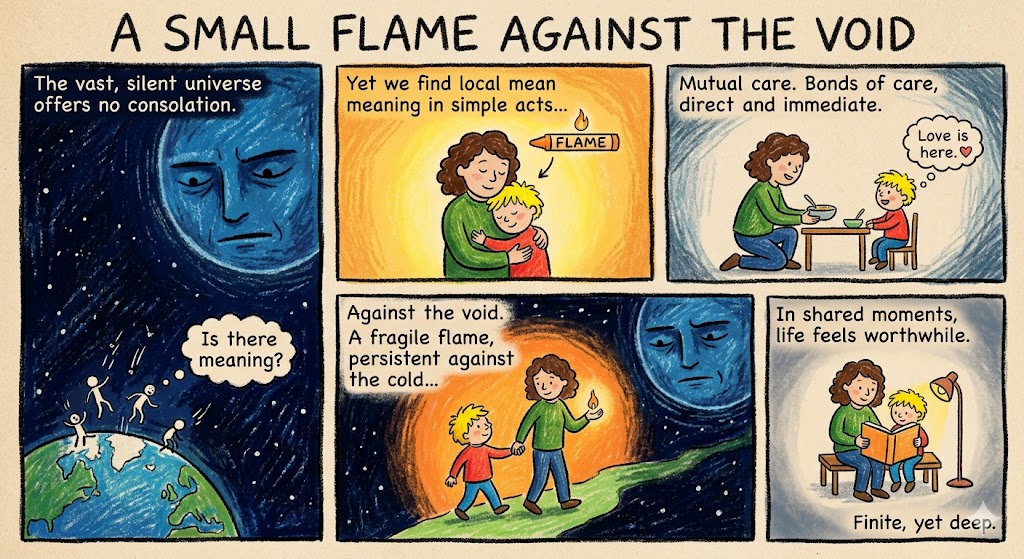
There is a long-standing philosophical intuition that the universe, in its vastness and indifference, offers no inherent consolation to human existence. It neither responds to suffering nor validates aspiration. Stars collapse, civilizations rise and fall, and yet the cosmos remains unmoved — silent, expansive, and fundamentally unconcerned with the fragile narratives that define individual lives. Within such a framework, the notion of meaning appears precarious, if not entirely illusory.
This perspective has often been described as a confrontation with the absurd: the tension between humanity’s persistent search for significance and a world that provides no clear answer. The recognition of this condition can give rise to a particular kind of existential unease. If the universe is, at its core, indifferent, then the structures through which people derive purpose — success, achievement, even legacy — may seem contingent and ultimately ephemeral.
Yet it is precisely within this apparent absence of meaning that certain forms of value acquire greater intensity. Among these, the bonds of familial love occupy a distinctive position. Unlike abstract ideals or distant ambitions, the relationship between parent and child is immediate, embodied, and sustained through time. It is not justified by cosmic significance, but by presence, care, and mutual dependence.
To describe this love as a “flame” is to emphasize both its fragility and its resilience. A flame is easily extinguished, yet it also possesses the capacity to illuminate and to warm. In the context of an indifferent universe, familial love does not negate the vastness or coldness of existence. Rather, it creates a localized sphere within which meaning can be experienced directly. It transforms the abstract problem of existence into a concrete act of care.
This transformation is not merely emotional but existential. When individuals direct their attention toward the well-being of those closest to them, the question of ultimate meaning becomes less pressing. The act of caring — of providing, protecting, and remaining present — constitutes a form of purpose that does not depend on external validation. It is self-justifying in a way that more abstract pursuits often are not.
However, this does not imply that familial love resolves the problem of the absurd. The larger conditions remain unchanged. Loss, suffering, and mortality continue to define the limits of human life. The flame does not dispel the darkness entirely; it coexists with it. What it offers is not a solution, but a counterbalance — a way of inhabiting a world that cannot be fully explained or controlled.
There is also a subtle reciprocity in this dynamic. While individuals may perceive themselves as “saving” their parents or family from a harsh existence, they are simultaneously sustained by the very relationships they seek to protect. The act of giving care becomes intertwined with the experience of receiving it. In this sense, the flame is not a one-directional gesture, but a shared source of warmth that binds individuals together.
Critically, this perspective reframes the idea of salvation. Rather than seeking transcendence or ultimate answers, it locates meaning within finite, everyday interactions. Preparing a meal, offering support, maintaining connection — these acts, though modest, acquire significance precisely because they occur within a world that does not guarantee it. Their value is not diminished by the absence of cosmic purpose; it is, in a sense, intensified by it.
Ultimately, the recognition of an indifferent universe does not necessitate despair. It may instead invite a shift in focus — from the search for universal meaning to the cultivation of particular, lived relationships. In this light, familial love becomes not a denial of the world’s harshness, but a response to it. A small flame, perhaps, but one that persists nonetheless, illuminating a space in which life, however fragile, can still be experienced as worthwhile.