The Fragmented Self
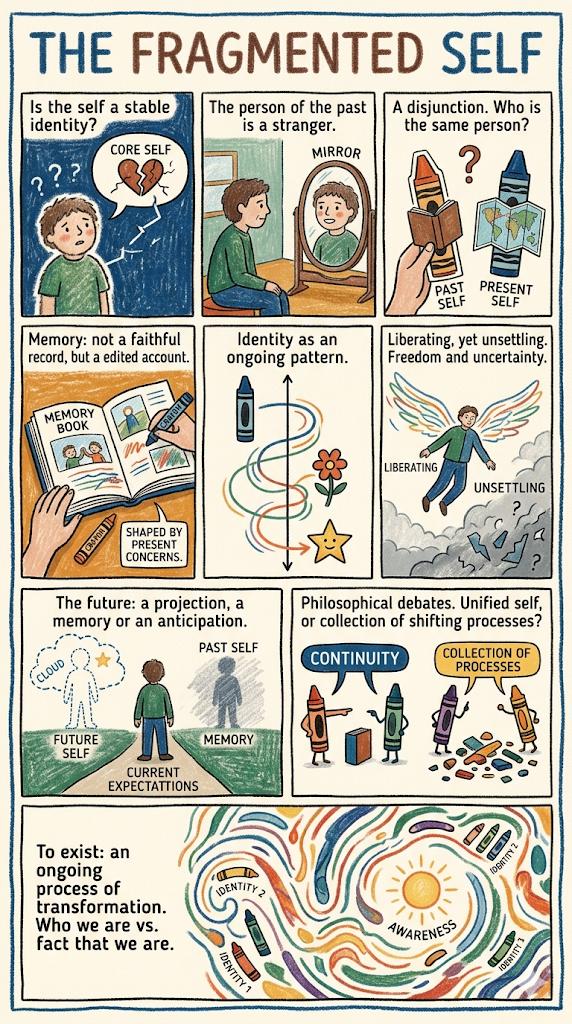
It is a common intuition to think of the self as something continuous — a stable identity that persists through time, binding past experiences to present awareness. We speak of “who we are” as though this were a fixed entity, an enduring core that remains unchanged despite the passage of years. Yet upon closer examination, this assumption begins to unravel. The person one was in the past often appears, in retrospect, as almost a stranger: shaped by different beliefs, driven by different desires, and constrained by a different understanding of the world.
This disjunction raises a fundamental question: if the past self and the present self differ so profoundly, in what sense can they be said to be the same person at all? Memory is often invoked as the mechanism that preserves identity, linking earlier experiences to current consciousness. However, memory itself is neither complete nor stable. It is selective, interpretive, and subject to revision. The narrative we construct about our past is less a faithful record than a continually edited account, shaped by present concerns.
From this perspective, identity begins to resemble a process rather than a substance. The self is not a fixed object that persists unchanged, but an ongoing reconstruction — a dynamic pattern that evolves over time. Each new experience modifies this pattern, sometimes subtly, sometimes in ways that render earlier versions of the self almost unrecognizable. The continuity we perceive may therefore be less an inherent property of the self and more a cognitive strategy: a way of imposing coherence on an otherwise fluid existence.
This fluidity can be both liberating and unsettling. On the one hand, it suggests that individuals are not bound by their past. If the self is continually reconstructed, then change is not only possible but inevitable. One is not condemned to remain the person one once was. On the other hand, the absence of a stable core introduces a sense of uncertainty. If there is no fixed identity, then what, if anything, anchors existence?
The question becomes even more complex when considered in relation to time. The present self is always in the process of becoming the past self, just as the future self remains a projection shaped by current expectations. At no point does the self exist as a fully stable entity; it is always either a memory or an anticipation. Existence, in this sense, is not a state but a movement — a continuous transition that resists final definition.
Philosophical traditions have approached this problem in different ways. Some emphasize continuity, arguing that identity lies in the persistence of certain underlying structures — whether psychological, biological, or narrative. Others reject the notion of a unified self altogether, proposing instead that what we call the “self” is merely a convenient label for a collection of shifting processes. In this view, the feeling of a stable identity is itself a kind of illusion, produced by the mind’s tendency to seek patterns and coherence.
Yet even if the self is fragmented, the experience of being remains undeniable. There is a sense of presence — an awareness that persists, even as its content changes. Thoughts, emotions, and perceptions arise and pass, but the fact of experiencing them continues. This raises a deeper question: is the essence of existence to be found not in the identity of the self, but in the capacity to experience at all?
If so, then the nature of existence may not depend on who we are, but on the fact that we are. Identity, with all its variations and inconsistencies, becomes secondary to the more fundamental phenomenon of awareness. The self, rather than being a stable entity, is the shifting expression of this underlying capacity — a narrative constructed within a field of experience that itself remains elusive.
Ultimately, the recognition that the past self and the present self are not identical does not necessarily undermine the meaning of existence. Instead, it invites a different understanding: that to exist is not to possess a fixed identity, but to participate in an ongoing process of transformation. The self is not something one has, but something one continually becomes — a fluid, evolving pattern within the broader mystery of being itself.