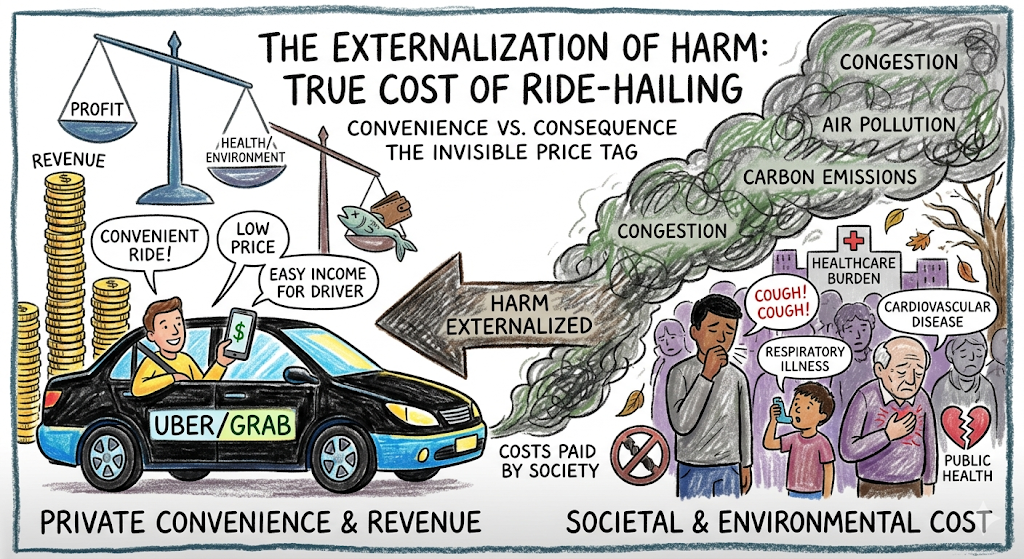
The rapid expansion of ride-hailing platforms such as Uber and Grab has been widely celebrated as a triumph of technological innovation. By offering convenient, on-demand mobility, these services have reshaped urban transportation, providing flexible income opportunities for drivers and increased accessibility for passengers. Yet beneath this narrative of efficiency and convenience lies a more complex and less frequently examined reality: the environmental and public health costs that accompany such models of growth.
At the center of this issue is the concept of externalization — the shifting of costs from private entities onto society at large. While ride-hailing companies generate revenue through each completed journey, the broader consequences of increased traffic congestion, air pollution, and carbon emissions are dispersed across urban populations. These costs are not reflected in the price of a ride, nor are they directly borne by the companies themselves. Instead, they manifest in deteriorating air quality, rising healthcare burdens, and the gradual erosion of urban livability.
The health implications of such environmental degradation are neither abstract nor negligible. Prolonged exposure to polluted air has been linked to respiratory illnesses, cardiovascular disease, and reduced life expectancy. In densely populated cities, where ride-hailing services are most prevalent, the cumulative effect of thousands of additional vehicles contributes to an invisible yet pervasive strain on public health systems. The convenience of a single journey, when multiplied at scale, becomes part of a systemic problem.
Defenders of these platforms often argue that they merely respond to existing demand rather than create it. However, this perspective overlooks the ways in which convenience reshapes behavior. By lowering the barriers to private transport, ride-hailing services can displace more sustainable modes of mobility, such as public transit, cycling, or walking. What begins as a supplement to existing infrastructure may gradually become a substitute, increasing overall vehicle usage rather than reducing it.
A further complication arises from the structure of the business model itself. Ride-hailing companies typically position themselves as intermediaries rather than transport providers, thereby limiting their formal responsibility for the environmental impact of the vehicles operating within their networks. Drivers, classified as independent contractors, bear the immediate costs of vehicle ownership and maintenance, while the long-term societal costs remain unaccounted for within the platform’s economic framework.
This fragmentation of responsibility creates a moral ambiguity. If no single actor is fully accountable, then the burden of addressing the consequences becomes diffused. Governments may attempt to regulate emissions or traffic, individuals may make more conscious transport choices, but the underlying incentives that drive platform expansion remain largely intact. Profit is maximized through increased usage, while the negative externalities are distributed across the collective.
To characterize this dynamic as mere negligence, however, may be overly simplistic. The prioritization of profit is not unique to any one company; it is a structural feature of competitive markets. Firms that fail to optimize for growth risk being displaced by those that do. In this sense, the issue extends beyond individual corporate ethics to the broader logic within which these companies operate.
Nevertheless, this does not absolve them of responsibility. As influential actors in urban ecosystems, ride-hailing platforms possess both the capacity and the leverage to shape more sustainable practices. Investments in electric vehicles, incentives for shared rides, and collaboration with public transport systems represent potential avenues for mitigating harm. The question is not whether such measures are possible, but whether they align sufficiently with the imperatives of profit to be pursued at scale.
Ultimately, the tension between convenience and consequence reflects a deeper dilemma of modern urban life. The systems that make daily existence more efficient often do so by obscuring the costs they generate. To confront these costs requires not only technological solutions, but a re-evaluation of the values that guide economic activity. If profitability remains the sole metric of success, then the health of both individuals and environments may continue to be treated as secondary considerations.
In this light, the true cost of a ride extends far beyond its price. It is measured in the quality of the air that is breathed, the resilience of the communities that are affected, and the extent to which economic innovation can be reconciled with the preservation of human well-being.