“Never say of anything, ‘I have lost it’; but, ‘I have returned it.’ Is your child dead? It is returned. Is your wife dead? She is returned. Is your estate taken away? Well, and is not that likewise returned?” — Epictetus
The Transience of Belonging
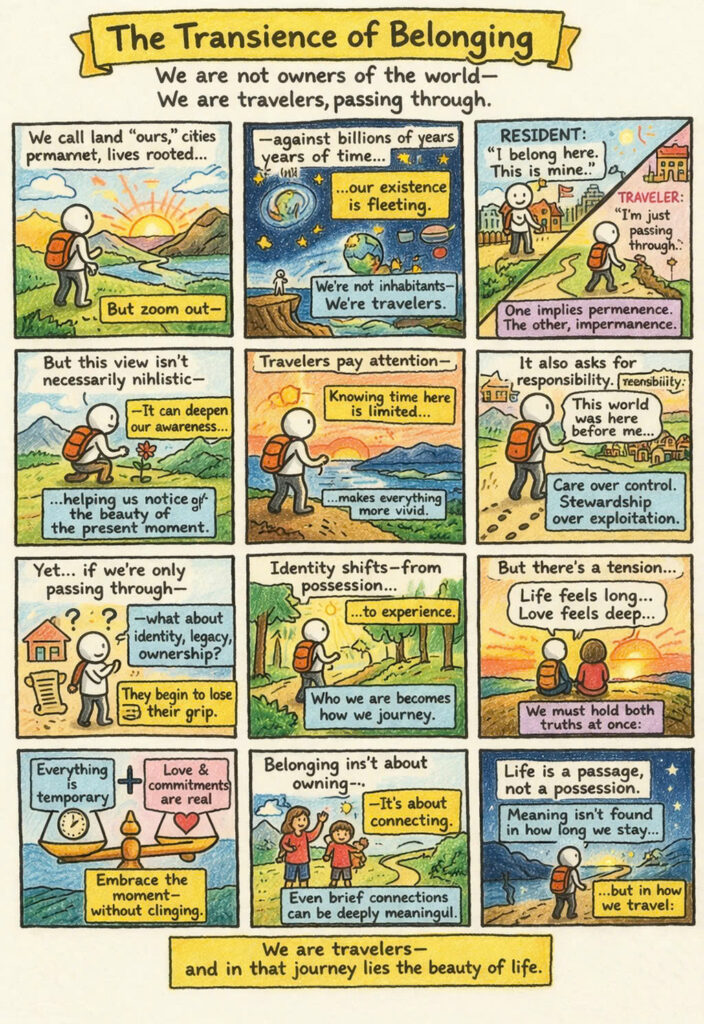
There is a persistent tendency in human thought to assume a form of ownership over the world — to speak of land as “ours,” of cities as permanent, and of lives as though they were firmly rooted in place and time. Yet such assumptions, when examined closely, begin to dissolve. Against the vast backdrop of geological time and cosmic scale, human existence appears fleeting, almost incidental. In this sense, it may be more accurate to regard human beings not as inhabitants in any permanent sense, but as transient travelers — passing through a world that precedes and outlasts them.
This perspective challenges deeply ingrained notions of stability and belonging. To see oneself as a “resident” implies a degree of permanence, a claim to continuity that extends beyond the individual lifespan. By contrast, the idea of being a “traveler” introduces impermanence at the core of identity. One does not possess the world; one moves through it, briefly encountering its landscapes, its people, and its moments before inevitably departing.
Such a view need not lead to nihilism. On the contrary, it can generate a heightened awareness of the present. Travelers, aware of the limits of their time in a given place, often experience their surroundings with greater attentiveness. They notice details that might otherwise be overlooked, precisely because they recognize that their encounter with them is temporary. If human life is approached in a similar manner, then transience becomes not a deficiency, but a condition that intensifies perception.
At the same time, the metaphor of the traveler introduces a subtle ethical dimension. To move through a place without owning it implies a form of responsibility. Travelers do not create the environments they enter; they inherit them, if only briefly. In this sense, to live as a “visitor” to the world may encourage a more restrained relationship with it — one that emphasizes care over control, preservation over exploitation. The recognition that one’s presence is temporary can foster a sense of stewardship rather than domination.
However, this perspective also destabilizes the search for lasting identity. If one is merely passing through, then the structures through which identity is often constructed — property, status, even legacy — begin to lose their permanence. The question of “who one is” becomes less tied to fixed achievements and more to the manner in which one engages with the world during one’s passage through it. Identity shifts from possession to experience.
There is, nevertheless, a tension inherent in this view. Human beings do not experience their lives as momentary in the abstract. Within the scale of individual existence, time feels extended, relationships feel enduring, and attachments feel deeply rooted. To live entirely as a traveler would risk detachment from these meaningful bonds. The challenge, then, is to hold both perspectives simultaneously: to recognize the temporary nature of existence while still investing fully in the relationships and commitments that give it substance.
In this light, the metaphor of the traveler does not negate belonging but reframes it. One may belong not by owning or controlling, but by participating — by forming connections that, while finite, are nonetheless real. The value of these connections does not depend on their permanence, but on their intensity and sincerity.
Ultimately, to see human beings as travelers is to confront the limits of their presence in the world. It is to acknowledge that life is not a state of possession, but a passage — a movement through time and space that cannot be prolonged indefinitely. Yet within this passage lies the possibility of meaning: not as something fixed or enduring, but as something created through the way one moves, observes, and relates.
In this sense, the significance of human life may lie not in how long one remains, but in how one travels.