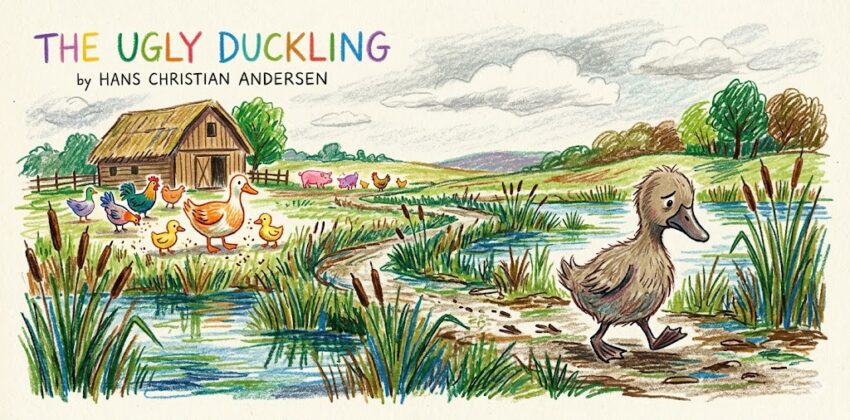
The Ugly Duckling — Chú Vịt Con Xấu Xí
IT was lovely summer weather in the country, and the golden corn, the green oats, and the haystacks piled up in the meadows looked beautiful. The stork walking about on his long red legs chattered in the Egyptian language, which he had learnt from his mother.
Thời tiết mùa hè thật tươi đẹp ở miền quê, những cánh đồng lúa vàng óng, yến mạch xanh mướt và những đống cỏ khô chất cao trong đồng cỏ trông thật đẹp mắt. Con cò đi lại trên đôi chân đỏ dài của mình, líu lo bằng thứ tiếng Ai Cập mà nó học được từ mẹ.
The corn-fields and meadows were surrounded by large forests, in the midst of which were deep pools. It was, indeed, delightful to walk about in the country. In a sunny spot stood a pleasant old farm-house close by a deep river, and from the house down to the water side grew great burdock leaves, so high, that under the tallest of them a little child could stand upright.
Những cánh đồng và bãi cỏ được bao quanh bởi những khu rừng lớn, giữa đó có những hồ nước sâu. Thật sự rất thú vị khi dạo bước trong vùng quê ấy. Ở một góc nắng ấm, có một ngôi nhà nông trại cũ kỹ dễ chịu nằm sát bên một con sông sâu, và từ nhà xuống mép nước mọc đầy những lá ngưu bàng to lớn, cao đến mức một đứa trẻ nhỏ có thể đứng thẳng người dưới chiếc lá cao nhất.
The spot was as wild as the centre of a thick wood. In this snug retreat sat a duck on her nest, watching for her young brood to hatch; she was beginning to get tired of her task, for the little ones were a long time coming out of their shells, and she seldom had any visitors.
Nơi đó hoang sơ như giữa một khu rừng rậm. Trong góc khuất yên tĩnh ấy, một con vịt mẹ đang ngồi trên ổ trứng, chờ đợi những con nhỏ nở ra; bà bắt đầu thấy mệt mỏi với công việc này, vì những con nhỏ cứ mãi không chịu chui ra khỏi vỏ, và hiếm khi có ai đến thăm bà.
The other ducks liked much better to swim about in the river than to climb the slippery banks, and sit under a burdock leaf, to have a gossip with her. At length one shell cracked, and then another, and from each egg came a living creature that lifted its head and cried, “Peep, peep.”
Những con vịt khác thích bơi lội trên sông hơn là leo lên những bờ trơn trượt để ngồi dưới tán lá ngưu bàng tám chuyện với bà. Cuối cùng, một cái vỏ trứng nứt ra, rồi một cái nữa, và từ mỗi quả trứng chui ra một sinh linh bé nhỏ ngước đầu lên kêu “chiếp chiếp.”
“Quack, quack,” said the mother, and then they all quacked as well as they could, and looked about them on every side at the large green leaves. Their mother allowed them to look as much as they liked, because green is good for the eyes. “How large the world is,” said the young ducks, when they found how much more room they now had than while they were inside the egg-shell.
“Quạc quạc,” vịt mẹ nói, rồi tất cả những con nhỏ cũng quạc to hết sức và nhìn quanh ngắm những chiếc lá xanh to. Mẹ chúng để chúng nhìn thoải mái, vì màu xanh tốt cho mắt. “Thế giới thật rộng lớn,” những chú vịt con nói, khi chúng nhận ra mình có nhiều không gian hơn hẳn lúc còn nằm trong vỏ trứng.
“Do you imagine this is the whole world?” asked the mother; “Wait till you have seen the garden; it stretches far beyond that to the parson’s field, but I have never ventured to such a distance. Are you all out?” she continued, rising; “No, I declare, the largest egg lies there still. I wonder how long this is to last, I am quite tired of it;” and she seated herself again on the nest.
“Con tưởng đây là cả thế giới sao?” mẹ hỏi. “Hãy đợi đến khi con thấy khu vườn; nó trải dài đến tận cánh đồng của cha xứ, nhưng mẹ chưa bao giờ đi xa đến vậy. Tất cả đã ra chưa?” bà tiếp tục, đứng dậy nhìn. “Không, quả trứng to nhất vẫn còn đó. Không biết còn lâu đến bao giờ, mẹ mệt quá rồi;” rồi bà lại ngồi xuống ổ.
“Well, how are you getting on?” asked an old duck, who paid her a visit. “One egg is not hatched yet,” said the duck, “it will not break. But just look at all the others, are they not the prettiest little ducklings you ever saw? They are the image of their father, who is so unkind, he never comes to see.”
“Thế nào rồi?” một con vịt già đến thăm hỏi. “Còn một quả trứng chưa nở,” vịt mẹ nói, “nó cứ không chịu vỡ. Nhưng hãy nhìn những con kia xem, chúng có phải là những chú vịt con dễ thương nhất mà bạn từng thấy không? Chúng giống hệt bố chúng, người chẳng bao giờ thèm đến thăm.”
“Let me see the egg that will not break,” said the duck; “I have no doubt it is a turkey’s egg. I was persuaded to hatch some once, and after all my care and trouble with the young ones, they were afraid of the water. I quacked and clucked, but all to no purpose. I could not get them to venture in. Let me look at the egg. Yes, that is a turkey’s egg; take my advice, leave it where it is and teach the other children to swim.”
“Cho tôi xem quả trứng không chịu vỡ đó,” vịt già nói. “Tôi chắc chắn đó là trứng gà tây. Tôi từng bị thuyết phục ấp một lần, và sau bao công chăm sóc, lũ nhỏ đó lại sợ nước. Tôi quạc mãi mà vô ích. Không tài nào dỗ chúng xuống nước được. Để tôi xem nào. Đúng rồi, trứng gà tây đấy; hãy nghe lời tôi, bỏ nó đó và dạy những con kia bơi đi.”
“I think I will sit on it a little while longer,” said the duck; “as I have sat so long already, a few days will be nothing.” “Please yourself,” said the old duck, and she went away.
“Tôi nghĩ tôi sẽ ngồi thêm một lúc nữa,” vịt mẹ nói, “vì đã ngồi lâu thế này rồi, thêm vài ngày cũng chẳng là gì.” “Tùy bạn thôi,” vịt già nói rồi bỏ đi.
At last the large egg broke, and a young one crept forth crying, “Peep, peep.” It was very large and ugly. The duck stared at it and exclaimed, “It is very large and not at all like the others. I wonder if it really is a turkey. We shall soon find it out, however when we go to the water. It must go in, if I have to push it myself.”
Cuối cùng quả trứng to cũng vỡ, và một con nhỏ chui ra kêu “chiếp chiếp.” Nó to và xấu lắm. Vịt mẹ nhìn chằm chằm vào nó và thốt lên: “To quá và chẳng giống những con kia chút nào. Không biết có phải gà tây thật không. Thôi sẽ biết khi ra đến nước. Dù thế nào cũng phải xuống nước, cần thì tôi đẩy vào vậy.”
On the next day the weather was delightful, and the sun shone brightly on the green burdock leaves, so the mother duck took her young brood down to the water, and jumped in with a splash. “Quack, quack,” cried she, and one after another the little ducklings jumped in. The water closed over their heads, but they came up again in an instant, and swam about quite prettily with their legs paddling under them as easily as possible, and the ugly duckling was also in the water swimming with them.
Ngày hôm sau trời thật đẹp, nắng chiếu sáng lên những chiếc lá ngưu bàng xanh, vịt mẹ dẫn đàn con xuống nước và nhảy tõm xuống. “Quạc quạc,” bà kêu, rồi từng con nhỏ nhảy theo. Nước phủ lên đầu chúng nhưng chúng nổi lên ngay, bơi thoăn thoắt với những đôi chân chèo phía dưới, và chú vịt xấu xí cũng bơi cùng với chúng.
“Oh,” said the mother, “that is not a turkey; how well he uses his legs, and how upright he holds himself! He is my own child, and he is not so very ugly after all if you look at him properly. Quack, quack! come with me now, I will take you into grand society, and introduce you to the farmyard, but you must keep close to me or you may be trodden upon; and, above all, beware of the cat.”
“Ồ,” mẹ nói, “không phải gà tây đâu; nó dùng chân khéo thật, và trông đứng đắn quá! Đó là con của mẹ, và nhìn kỹ thì cũng không xấu đến thế. Quạc quạc! Theo mẹ nào, mẹ sẽ đưa các con vào xã hội lớn, giới thiệu các con với sân trại, nhưng phải đi sát mẹ kẻo bị giẫm lên; và trên hết, hãy coi chừng con mèo.”
When they reached the farmyard, there was a great disturbance, two families were fighting for an eel’s head, which, after all, was carried off by the cat. “See, children, that is the way of the world,” said the mother duck, whetting her beak, for she would have liked the eel’s head herself. “Come, now, use your legs, and let me see how well you can behave. You must bow your heads prettily to that old duck yonder; she is the highest born of them all, and has Spanish blood, therefore, she is well off. Don’t you see she has a red flag tied to her leg, which is something very grand, and a great honor for a duck; it shows that every one is anxious not to lose her, as she can be recognized both by man and beast. Come, now, don’t turn your toes, a well-bred duckling spreads his feet wide apart, just like his father and mother, in this way; now bend your neck, and say ‘quack.'”
Khi đến sân trại, nơi đó đang ồn ào náo loạn, hai gia đình đang tranh nhau cái đầu con lươn, rốt cuộc con mèo tha đi mất. “Xem đó, các con, đó là lẽ đời,” vịt mẹ nói, mài mỏ, vì bà cũng thèm cái đầu lươn ấy. “Thôi nào, bước đi đi, để mẹ xem các con cư xử thế nào. Các con phải cúi đầu thật duyên dáng chào con vịt già kia; nó là dòng dõi cao quý nhất ở đây, có dòng máu Tây Ban Nha, nên sống rất sung túc. Không thấy sao, nó có một mảnh vải đỏ buộc ở chân, đó là điều rất oai và là vinh dự lớn cho một con vịt; nghĩa là ai cũng sợ mất nó, vì cả người lẫn thú vật đều nhận ra nó. Thôi nào, đừng quặp ngón chân vào, vịt con ngoan phải xòe chân ra rộng, giống bố mẹ; rồi cúi cổ xuống và kêu ‘quạc.'”
The ducklings did as they were bid, but the other duck stared, and said, “Look, here comes another brood, as if there were not enough of us already! and what a queer looking object one of them is; we don’t want him here,” and then one flew out and bit him in the neck.
Đàn vịt con làm theo lời mẹ, nhưng những con vịt khác trố mắt nhìn và nói: “Kìa, thêm một đàn nữa, như thể đây chưa đủ chỗ! Và cái con nào trông kỳ cục thế kia; chúng tôi không muốn nó ở đây,” rồi một con bay ra cắn vào cổ chú vịt xấu xí.
“Let him alone,” said the mother; “he is not doing any harm.” “Yes, but he is so big and ugly,” said the spiteful duck, “and therefore he must be turned out.” “The others are very pretty children,” said the old duck, with the rag on her leg, “all but that one; I wish his mother could improve him a little.”
“Để nó yên,” mẹ nói, “nó không làm hại ai cả.” “Nhưng nó to và xấu quá,” con vịt độc ác kia nói, “nên phải đuổi nó đi.” “Những con kia đều dễ thương cả,” con vịt già có mảnh vải đỏ ở chân nói, “trừ con đó; giá mà mẹ nó sửa được nó một chút thì tốt.”
“That is impossible, your grace,” replied the mother; “he is not pretty; but he has a very good disposition, and swims as well or even better than the others. I think he will grow up pretty, and perhaps be smaller; he has remained too long in the egg, and therefore his figure is not properly formed;” and then she stroked his neck and smoothed the feathers, saying, “It is a drake, and therefore not of so much consequence. I think he will grow up strong, and able to take care of himself.”
“Điều đó không thể được, thưa bà,” mẹ đáp, “nó không đẹp; nhưng nó có tính tình rất tốt, và bơi giỏi chẳng kém, thậm chí hơn những con kia. Tôi nghĩ nó sẽ lớn lên đẹp hơn, và có thể nhỏ lại hơn; nó nằm trong trứng quá lâu nên thân hình chưa phát triển đúng cách;” rồi bà vuốt cổ và xoa phẳng lông nó, nói, “Đây là vịt đực, nên cũng không quá quan trọng. Tôi nghĩ nó sẽ lớn lên khỏe mạnh và biết tự lo cho mình.”
“The other ducklings are graceful enough,” said the old duck. “Now make yourself at home, and if you can find an eel’s head, you can bring it to me.”
“Những con kia đều khéo léo rồi,” con vịt già nói. “Thôi cứ tự nhiên đi, và nếu tìm được đầu con lươn nào thì mang cho tôi nhé.”
And so they made themselves comfortable; but the poor duckling, who had crept out of his shell last of all, and looked so ugly, was bitten and pushed and made fun of, not only by the ducks, but by all the poultry. “He is too big,” they all said, and the turkey cock, who had been born into the world with spurs, and fancied himself really an emperor, puffed himself out like a vessel in full sail, and flew at the duckling, and became quite red in the head with passion, so that the poor little thing did not know where to go, and was quite miserable because he was so ugly and laughed at by the whole farmyard.
Thế là mọi người yên ổn; nhưng chú vịt con tội nghiệp, kẻ chui ra khỏi vỏ trứng sau cùng và trông xấu xí như vậy, bị cắn, bị xô đẩy và bị trêu chọc không chỉ bởi đàn vịt mà bởi tất cả gia cầm. “Nó to quá,” tất cả đều nói, và con gà tây trống, kẻ sinh ra đời đã có cựa và tự cho mình là hoàng đế, phồng ngực lên như chiếc thuyền căng buồm, lao vào chú vịt, mặt đỏ bừng vì tức giận, khiến chú vịt tội nghiệp không biết trốn đi đâu, thật khổ sở vì mình xấu xí và bị cả sân trại cười nhạo.
So it went on from day to day till it got worse and worse. The poor duckling was driven about by every one; even his brothers and sisters were unkind to him, and would say, “Ah, you ugly creature, I wish the cat would get you,” and his mother said she wished he had never been born. The ducks pecked him, the chickens beat him, and the girl who fed the poultry kicked him with her feet. So at last he ran away, frightening the little birds in the hedge as he flew over the palings.
Cứ thế ngày qua ngày càng tệ hơn. Chú vịt tội nghiệp bị mọi người xua đuổi; ngay cả anh chị em ruột cũng đối xử tệ với nó và nói: “Ôi, con vật xấu xí kia, ước gì con mèo bắt mày đi,” và mẹ nó cũng nói ước gì nó đừng bao giờ được sinh ra. Đàn vịt mổ nó, đàn gà đánh nó, và cô bé chăn gia cầm đá nó bằng chân. Cuối cùng nó bỏ chạy, làm những con chim nhỏ trên hàng rào hoảng sợ khi nó bay qua hàng cọc.
“They are afraid of me because I am ugly,” he said. So he closed his eyes, and flew still farther, until he came out on a large moor, inhabited by wild ducks. Here he remained the whole night, feeling very tired and sorrowful.
“Chúng sợ mình vì mình xấu,” nó nói. Rồi nó nhắm mắt lại và bay tiếp, cho đến khi đến một vùng đồng lầy rộng lớn, nơi sinh sống của những con vịt trời. Nó ở đó suốt đêm, mệt mỏi và buồn bã vô cùng.
In the morning, when the wild ducks rose in the air, they stared at their new comrade. “What sort of a duck are you?” they all said, coming round him. He bowed to them, and was as polite as he could be, but he did not reply to their question. “You are exceedingly ugly,” said the wild ducks, “but that will not matter if you do not want to marry one of our family.”
Sáng hôm sau, khi đàn vịt trời bay lên, chúng nhìn chằm chằm vào người bạn mới. “Mày là vịt gì vậy?” chúng vây quanh hỏi. Chú vịt cúi chào và cố tỏ ra lịch sự nhất có thể, nhưng không trả lời câu hỏi của chúng. “Mày xấu lắm đấy,” đàn vịt trời nói, “nhưng không sao, miễn là mày không có ý định lấy ai trong gia đình tao.”
Poor thing! he had no thoughts of marriage; all he wanted was permission to lie among the rushes, and drink some of the water on the moor. After he had been on the moor two days, there came two wild geese, or rather goslings, for they had not been out of the egg long, and were very saucy. “Listen, friend,” said one of them to the duckling, “you are so ugly, that we like you very well. Will you go with us, and become a bird of passage? Not far from here is another moor, in which there are some pretty wild geese, all unmarried. It is a chance for you to get a wife; you may be lucky, ugly as you are.”
Tội nghiệp nó! Nó chẳng nghĩ gì đến chuyện lấy vợ; tất cả những gì nó muốn là được phép nằm giữa đám sậy và uống ít nước trong vùng đầm. Sau hai ngày ở đầm, có hai con ngỗng trời đến, hay đúng hơn là ngỗng con, vì chúng mới nở không lâu và rất hỗn láo. “Này bạn,” một con nói với chú vịt, “mày xấu đến mức tao lại thấy thích mày. Đi với bọn tao và trở thành chim di trú đi? Gần đây có một đầm lầy khác, có mấy con ngỗng trời xinh đẹp, đều chưa chồng. Đây là cơ hội để mày kiếm vợ; may ra mày được đó, dù xấu như vậy.”
“Pop, pop,” sounded in the air, and the two wild geese fell dead among the rushes, and the water was tinged with blood. “Pop, pop,” echoed far and wide in the distance, and whole flocks of wild geese rose up from the rushes. The sound continued from every direction, for the sportsmen surrounded the moor, and some were even seated on branches of trees, overlooking the rushes. The blue smoke from the guns rose like clouds over the dark trees, and as it floated away across the water, a number of sporting dogs bounded in among the rushes, which bent beneath them wherever they went.
“Đùng, đùng,” tiếng súng nổ trên không, và hai con ngỗng ngã xuống chết giữa đám sậy, nước loang đỏ máu. “Đùng, đùng,” tiếng vọng lan xa, và từng đàn ngỗng trời vùng bay lên khỏi đám sậy. Tiếng súng nổ từ khắp nơi, vì những người thợ săn đã bao vây đầm lầy, một số còn ngồi trên cành cây nhìn xuống đám sậy. Khói xanh từ những họng súng bốc lên như mây phủ trên những cây tối sẫm, và khi làn khói tan ra trên mặt nước, một đàn chó săn lao vào đám sậy, làm chúng rạp xuống bất cứ chỗ nào chúng chạy qua.
How they terrified the poor duckling! He turned away his head to hide it under his wing, and at the same moment a large terrible dog passed quite near him. His jaws were open, his tongue hung from his mouth, and his eyes glared fearfully. He thrust his nose close to the duckling, showing his sharp teeth, and then, “splash, splash,” he went into the water without touching him, “Oh,” sighed the duckling, “how thankful I am for being so ugly; even a dog will not bite me.”
Chú vịt tội nghiệp hoảng sợ đến nhường nào! Nó quay đầu lại giấu dưới cánh, và ngay lúc đó một con chó to lớn dữ tợn chạy sát bên nó. Hàm nó há to, lưỡi thõng ra, mắt trợn trừng đáng sợ. Nó thọc mũi gần sát mặt chú vịt, để lộ hàm răng nhọn, rồi “ùm ùm,” nó lao xuống nước mà không đụng đến nó. “Ôi,” chú vịt thở dài, “thật may mình xấu quá; ngay cả chó cũng không thèm cắn mình.”
And so he lay quite still, while the shot rattled through the rushes, and gun after gun was fired over him. It was late in the day before all became quiet, but even then the poor young thing did not dare to move. He waited quietly for several hours, and then, after looking carefully around him, hastened away from the moor as fast as he could. He ran over field and meadow till a storm arose, and he could hardly struggle against it.
Thế là nó nằm im thin thít, trong khi đạn rít qua đám sậy và tiếng súng nổ liên hồi phía trên. Mãi đến chiều tối mọi thứ mới yên lặng, nhưng ngay cả khi đó chú vịt tội nghiệp cũng không dám cử động. Nó nằm yên thêm vài tiếng đồng hồ, rồi nhìn quanh thật kỹ trước khi chạy thật nhanh khỏi vùng đầm. Nó chạy qua đồng ruộng và bãi cỏ cho đến khi một cơn bão nổi lên, và nó hầu như không thể chống chọi được nữa.
Towards evening, he reached a poor little cottage that seemed ready to fall, and only remained standing because it could not decide on which side to fall first. The storm continued so violent, that the duckling could go no farther; he sat down by the cottage, and then he noticed that the door was not quite closed in consequence of one of the hinges having given way. There was therefore a narrow opening near the bottom large enough for him to slip through, which he did very quietly, and got a shelter for the night.
Về chiều, nó đến một túp lều tồi tàn trông như sắp đổ, chỉ còn đứng vì không biết nên ngã về phía nào trước. Bão vẫn còn dữ lắm, chú vịt không thể đi tiếp; nó ngồi xuống bên túp lều và nhận ra cánh cửa không đóng hẳn vì một bản lề bị hỏng. Vì vậy có một khe hở nhỏ ở phía dưới đủ để nó chui qua, và nó lặng lẽ chui vào, tìm được chỗ trú qua đêm.
A woman, a tom cat, and a hen lived in this cottage. The tom cat, whom the mistress called, “My little son,” was a great favorite; he could raise his back, and purr, and could even throw out sparks from his fur if it were stroked the wrong way. The hen had very short legs, so she was called “Chickie short legs.” She laid good eggs, and her mistress loved her as if she had been her own child.
Một bà lão, một con mèo đực và một con gà mái sống trong túp lều này. Con mèo đực, mà bà chủ gọi là “Con trai bé của mẹ,” được cưng chiều lắm; nó có thể cong lưng, kêu gừ gừ, và thậm chí tóe lửa từ bộ lông nếu bị vuốt ngược chiều. Con gà mái có đôi chân rất ngắn nên được gọi là “Gà chân ngắn.” Nó đẻ trứng tốt và bà chủ yêu nó như con ruột.
In the morning, the strange visitor was discovered, and the tom cat began to purr, and the hen to cluck. “What is that noise about?” said the old woman, looking round the room, but her sight was not very good; therefore, when she saw the duckling she thought it must be a fat duck, that had strayed from home. “Oh what a prize!” she exclaimed, “I hope it is not a drake, for then I shall have some duck’s eggs. I must wait and see.” So the duckling was allowed to remain on trial for three weeks, but there were no eggs.
Sáng hôm sau, người khách lạ bị phát hiện, con mèo bắt đầu gừ gừ và gà mái bắt đầu cục tác. “Tiếng gì thế?” bà lão hỏi, nhìn quanh phòng, nhưng mắt bà không tốt lắm; thế nên khi thấy chú vịt bà nghĩ đó là một con vịt béo lạc nhà. “Ôi, thật may mắn!” bà thốt lên, “Mong sao nó không phải vịt đực, thì tao sẽ có trứng vịt. Hãy chờ xem đã.” Thế là chú vịt được ở lại thử trong ba tuần, nhưng chẳng có quả trứng nào.
Now the tom cat was the master of the house, and the hen was mistress, and they always said, “We and the world,” for they believed themselves to be half the world, and the better half too. The duckling thought that others might hold a different opinion on the subject, but the hen would not listen to such doubts. “Can you lay eggs?” she asked. “No.” “Then have the goodness to hold your tongue.” “Can you raise your back, or purr, or throw out sparks?” said the tom cat. “No.” “Then you have no right to express an opinion when sensible people are speaking.”
Mèo đực là chủ nhà, gà mái là chủ bà, và chúng luôn nói “Chúng ta và cả thế giới,” vì chúng tin mình chiếm nửa thế giới, và là nửa tốt hơn nữa. Chú vịt nghĩ có thể người khác sẽ không đồng ý, nhưng gà mái không nghe những ý kiến như vậy. “Mày có biết đẻ trứng không?” nó hỏi. “Không.” “Vậy thì im miệng đi.” “Mày có biết cong lưng, gừ gừ hay tóe lửa không?” mèo đực hỏi. “Không.” “Thì mày không có quyền phát biểu khi người khôn ngoan đang nói chuyện.”
So the duckling sat in a corner, feeling very low spirited, till the sunshine and the fresh air came into the room through the open door, and then he began to feel such a great longing for a swim on the water, that he could not help telling the hen.
Thế là chú vịt ngồi ở một góc, tâm trạng thật tệ, cho đến khi ánh nắng và không khí trong lành ùa vào qua cánh cửa mở, và lúc đó nó bắt đầu khao khát được bơi trên mặt nước đến mức không thể không nói với gà mái.
“What an absurd idea,” said the hen. “You have nothing else to do, therefore you have foolish fancies. If you could purr or lay eggs, they would pass away.”
“Ý nghĩ vớ vẩn thật,” gà mái nói. “Mày chẳng có việc gì làm nên mới nghĩ ngớ ngẩn vậy. Nếu mày biết gừ gừ hay đẻ trứng thì những ý nghĩ đó sẽ biến mất.”
“But it is so delightful to swim about on the water,” said the duckling, “and so refreshing to feel it close over your head, while you dive down to the bottom.”
“Nhưng bơi trên mặt nước thật tuyệt vời,” chú vịt nói, “và cảm giác nước phủ lên đầu khi mày lặn xuống đáy thật sảng khoái biết bao.”
“Delightful, indeed!” said the hen, “why you must be crazy! Ask the cat, he is the cleverest animal I know, ask him how he would like to swim about on the water, or to dive under it, for I will not speak of my own opinion; ask our mistress, the old woman—there is no one in the world more clever than she is. Do you think she would like to swim, or to let the water close over her head?”
“Tuyệt vời thật đấy!” gà mái nói, “mày điên rồi! Hỏi con mèo đi, nó là con vật khôn nhất tao biết, hỏi xem nó có thích bơi hay lặn xuống nước không—tao không nói ý kiến mình đâu; hỏi bà chủ, bà lão ấy—không ai trên đời khôn ngoan hơn bà. Mày nghĩ bà ấy có muốn bơi, hay để nước phủ lên đầu không?”
“You don’t understand me,” said the duckling. “We don’t understand you? Who can understand you, I wonder? Do you consider yourself more clever than the cat, or the old woman? I will say nothing of myself. Don’t imagine such nonsense, child, and thank your good fortune that you have been received here. Are you not in a warm room, and in society from which you may learn something. But you are a chatterer, and your company is not very agreeable. Believe me, I speak only for your own good. I may tell you unpleasant truths, but that is a proof of my friendship. I advise you, therefore, to lay eggs, and learn to purr as quickly as possible.”
“Các bạn không hiểu tôi,” chú vịt nói. “Không hiểu mày? Ai mà hiểu mày được chứ? Mày tự cho mình khôn hơn con mèo hay bà lão sao? Tao không nói đến tao đâu nhé. Đừng nghĩ vớ vẩn thế nữa, con ạ, và hãy cảm ơn vì được nhận vào đây. Mày đang ở trong phòng ấm áp, trong xã hội có thể học hỏi được chứ. Nhưng mày nhiều chuyện quá, ở cạnh mày chẳng dễ chịu chút nào. Tin tao đi, tao nói vì lợi ích của mày thôi. Tao có thể nói những điều khó nghe, nhưng đó là bằng chứng của tình bạn. Vậy nên tao khuyên mày hãy học đẻ trứng và gừ gừ càng sớm càng tốt.”
“I believe I must go out into the world again,” said the duckling. “Yes, do,” said the hen.
“Tôi nghĩ tôi phải ra đi lần nữa,” chú vịt nói. “Ừ, đi đi,” gà mái nói.
So the duckling left the cottage, and soon found water on which it could swim and dive, but was avoided by all other animals, because of its ugly appearance. Autumn came, and the leaves in the forest turned to orange and gold. then, as winter approached, the wind caught them as they fell and whirled them in the cold air. The clouds, heavy with hail and snow-flakes, hung low in the sky, and the raven stood on the ferns crying, “Croak, croak.” It made one shiver with cold to look at him. All this was very sad for the poor little duckling.
Thế là chú vịt rời túp lều, và sớm tìm được chỗ nước để bơi và lặn, nhưng bị tất cả các con vật khác tránh né vì vẻ ngoài xấu xí. Mùa thu đến, lá rừng chuyển sang màu cam và vàng. Rồi khi mùa đông gần kề, gió thổi cuốn những chiếc lá rơi xoáy trong không khí lạnh giá. Những đám mây nặng nề với mưa đá và tuyết buông thấp trên bầu trời, và con quạ đứng trên những đám dương xỉ kêu “Oạc oạc.” Nhìn nó thôi đã thấy rét run. Tất cả những điều đó thật buồn thảm đối với chú vịt tội nghiệp.
One evening, just as the sun set amid radiant clouds, there came a large flock of beautiful birds out of the bushes. The duckling had never seen any like them before. They were swans, and they curved their graceful necks, while their soft plumage shown with dazzling whiteness. They uttered a singular cry, as they spread their glorious wings and flew away from those cold regions to warmer countries across the sea.
Một buổi chiều, khi mặt trời lặn giữa những đám mây rực rỡ, một đàn chim đẹp lớn bay ra từ bụi cây. Chú vịt chưa bao giờ thấy loài chim nào như thế. Đó là những con thiên nga, chúng uốn cổ duyên dáng, bộ lông mềm mại trắng sáng lấp lánh. Chúng cất lên tiếng kêu lạ lẫm, dang rộng đôi cánh huy hoàng và bay đi từ vùng lạnh giá đến những xứ ấm áp hơn bên kia biển.
As they mounted higher and higher in the air, the ugly little duckling felt quite a strange sensation as he watched them. He whirled himself in the water like a wheel, stretched out his neck towards them, and uttered a cry so strange that it frightened himself. Could he ever forget those beautiful, happy birds; and when at last they were out of his sight, he dived under the water, and rose again almost beside himself with excitement.
Khi chúng bay lên càng ngày càng cao, chú vịt xấu xí cảm thấy một cảm xúc kỳ lạ khi nhìn theo chúng. Nó xoáy tròn trong nước như một bánh xe, vươn dài cổ về phía chúng và cất tiếng kêu kỳ lạ đến mức chính nó cũng giật mình. Làm sao nó có thể quên những con chim đẹp đẽ hạnh phúc ấy; và khi chúng khuất khỏi tầm mắt, nó lặn xuống nước rồi ngoi lên, gần như không còn kiểm soát được bản thân vì xúc động.
He knew not the names of these birds, nor where they had flown, but he felt towards them as he had never felt for any other bird in the world. He was not envious of these beautiful creatures, but wished to be as lovely as they. Poor ugly creature, how gladly he would have lived even with the ducks had they only given him encouragement.
Nó không biết tên những con chim đó, cũng không biết chúng bay đến đâu, nhưng nó cảm thấy dành cho chúng một tình cảm chưa từng có với bất kỳ loài chim nào. Nó không ghen tị với những sinh linh đẹp đẽ đó, mà chỉ ước mình cũng được đẹp như chúng. Sinh linh xấu xí tội nghiệp, nó sẽ vui lòng sống với đàn vịt biết bao nếu chúng chỉ cho nó một chút khích lệ thôi.
The winter grew colder and colder; he was obliged to swim about on the water to keep it from freezing, but every night the space on which he swam became smaller and smaller. At length it froze so hard that the ice in the water crackled as he moved, and the duckling had to paddle with his legs as well as he could, to keep the space from closing up. He became exhausted at last, and lay still and helpless, frozen fast in the ice.
Mùa đông ngày càng lạnh hơn; nó buộc phải bơi để giữ cho nước khỏi đóng băng, nhưng mỗi đêm khoảng nước nó bơi cứ nhỏ dần. Cuối cùng băng đóng cứng đến mức tiếng nứt vang lên khi nó di chuyển, và chú vịt phải cố sức chèo chân để giữ cho khoảng trống không bít lại. Nó kiệt sức và nằm im bất động, bị đóng băng cứng trong lớp băng.
Early in the morning, a peasant, who was passing by, saw what had happened. He broke the ice in pieces with his wooden shoe, and carried the duckling home to his wife. The warmth revived the poor little creature; but when the children wanted to play with him, the duckling thought they would do him some harm; so he started up in terror, fluttered into the milk-pan, and splashed the milk about the room.
Sáng sớm hôm sau, một người nông dân đi qua nhìn thấy. Ông bẻ vỡ lớp băng bằng chiếc guốc gỗ và mang chú vịt về nhà cho vợ. Hơi ấm đã cứu sống chú vịt tội nghiệp; nhưng khi bọn trẻ muốn chơi với nó, chú vịt tưởng chúng sẽ làm hại mình, nên bật dậy hoảng loạn, bay vào chậu sữa và văng sữa khắp phòng.
Then the woman clapped her hands, which frightened him still more. He flew first into the butter-cask, then into the meal-tub, and out again. What a condition he was in! The woman screamed, and struck at him with the tongs; the children laughed and screamed, and tumbled over each other, in their efforts to catch him; but luckily he escaped. The door stood open; the poor creature could just manage to slip out among the bushes, and lie down quite exhausted in the newly fallen snow.
Rồi bà vợ vỗ tay, khiến nó càng hoảng hơn. Nó bay vào thùng bơ, rồi vào thùng bột, rồi lại bay ra. Trông nó thật thảm! Bà vợ la hét và vung kẹp đuổi nó; bọn trẻ cười và hét, giẫm lên nhau để bắt nó; nhưng may thay nó thoát được. Cánh cửa đang mở; chú vật tội nghiệp chui ra được vào bụi cây và nằm xuống kiệt sức trong lớp tuyết mới rơi.
It would be very sad, were I to relate all the misery and privations which the poor little duckling endured during the hard winter; but when it had passed, he found himself lying one morning in a moor, amongst the rushes. He felt the warm sun shining, and heard the lark singing, and saw that all around was beautiful spring. Then the young bird felt that his wings were strong, as he flapped them against his sides, and rose high into the air.
Sẽ thật buồn nếu tôi kể hết mọi khổ sở và thiếu thốn mà chú vịt tội nghiệp phải chịu đựng suốt mùa đông khắc nghiệt đó; nhưng khi mùa đông qua đi, một buổi sáng nó thấy mình đang nằm trong đầm lầy giữa đám sậy. Nó cảm nhận ánh nắng ấm áp, nghe tiếng chim sơn ca hót, và thấy rằng khắp nơi đều là mùa xuân tươi đẹp. Lúc đó chú chim nhỏ cảm thấy đôi cánh mình khỏe mạnh khi vỗ vào hai bên sườn và bay vút lên cao.
They bore him onwards, until he found himself in a large garden, before he well knew how it had happened. The apple-trees were in full blossom, and the fragrant elders bent their long green branches down to the stream which wound round a smooth lawn. Everything looked beautiful, in the freshness of early spring.
Đôi cánh mang nó đi xa, và trước khi kịp nhận ra, nó đã đến một khu vườn rộng lớn. Những cây táo đang nở hoa rộ, và những cây tiếp cốt thơm ngát cúi những cành xanh dài xuống dòng suối chảy quanh bãi cỏ mướt. Mọi thứ đều tươi đẹp trong sự tươi mới của đầu xuân.
From a thicket close by came three beautiful white swans, rustling their feathers, and swimming lightly over the smooth water. The duckling remembered the lovely birds, and felt more strangely unhappy than ever.
Từ bụi cây gần đó, ba con thiên nga trắng đẹp đẽ bước ra, xòe lông và bơi nhẹ nhàng trên mặt nước phẳng lặng. Chú vịt nhớ lại những con chim đáng yêu đó và cảm thấy buồn kỳ lạ hơn bao giờ hết.
“I will fly to those royal birds,” he exclaimed, “and they will kill me, because I am so ugly, and dare to approach them; but it does not matter: better be killed by them than pecked by the ducks, beaten by the hens, pushed about by the maiden who feeds the poultry, or starved with hunger in the winter.”
“Tôi sẽ bay đến những con chim hoàng gia đó,” nó thốt lên, “và chúng sẽ giết tôi vì tôi xấu xí thế này mà dám đến gần chúng; nhưng không sao: bị chúng giết còn hơn bị vịt mổ, bị gà đánh, bị cô gái chăn gia cầm xua đuổi, hay bị chết đói trong mùa đông.”
Then he flew to the water, and swam towards the beautiful swans. The moment they espied the stranger, they rushed to meet him with outstretched wings. “Kill me,” said the poor bird; and he bent his head down to the surface of the water, and awaited death.
Rồi nó bay xuống nước và bơi về phía những con thiên nga đẹp đẽ. Ngay khi chúng nhìn thấy người lạ, chúng lao ra đón nó với đôi cánh dang rộng. “Hãy giết tôi đi,” chú chim tội nghiệp nói; và nó cúi đầu xuống mặt nước, chờ đón cái chết.
But what did he see in the clear stream below? His own image; no longer a dark, gray bird, ugly and disagreeable to look at, but a graceful and beautiful swan. To be born in a duck’s nest, in a farmyard, is of no consequence to a bird, if it is hatched from a swan’s egg.
Nhưng nó thấy gì trong dòng nước trong vắt phía dưới? Chính hình ảnh của mình; không còn là con chim xám xịt tối tăm, xấu xí và khó nhìn nữa, mà là một con thiên nga duyên dáng và đẹp đẽ. Sinh ra trong tổ vịt ở sân trại không quan trọng gì đối với một con chim, nếu nó được ấp từ trứng thiên nga.
He now felt glad at having suffered sorrow and trouble, because it enabled him to enjoy so much better all the pleasure and happiness around him; for the great swans swam round the new-comer, and stroked his neck with their beaks, as a welcome.
Giờ đây nó cảm thấy vui mừng vì đã trải qua bao đau khổ và thử thách, vì chính điều đó giúp nó trân trọng hơn mọi niềm vui và hạnh phúc xung quanh; và những con thiên nga lớn bơi vòng quanh kẻ mới đến, dùng mỏ vuốt ve cổ nó như lời chào đón.
Into the garden presently came some little children, and threw bread and cake into the water. “See,” cried the youngest, “there is a new one;” and the rest were delighted, and ran to their father and mother, dancing and clapping their hands, and shouting joyously, “There is another swan come; a new one has arrived.”
Lúc đó có mấy đứa trẻ chạy vào vườn và ném bánh mì và bánh ngọt xuống nước. “Kìa,” đứa nhỏ nhất kêu lên, “có một con mới;” và những đứa khác vui mừng chạy đến chỗ bố mẹ, nhảy múa vỗ tay và hô to: “Có thêm một con thiên nga; một con mới vừa đến.”
Then they threw more bread and cake into the water, and said, “The new one is the most beautiful of all; he is so young and pretty.” And the old swans bowed their heads before him.
Rồi chúng ném thêm bánh mì và bánh ngọt xuống nước và nói: “Con mới đẹp nhất trong tất cả; nó thật trẻ trung và xinh đẹp.” Và những con thiên nga già cúi đầu trước nó.
Then he felt quite ashamed, and hid his head under his wing; for he did not know what to do, he was so happy, and yet not at all proud. He had been persecuted and despised for his ugliness, and now he heard them say he was the most beautiful of all the birds. Even the elder-tree bent down its bows into the water before him, and the sun shone warm and bright. Then he rustled his feathers, curved his slender neck, and cried joyfully, from the depths of his heart, “I never dreamed of such happiness as this, while I was an ugly duckling.”
Lúc đó nó cảm thấy thật xấu hổ và giấu đầu dưới cánh; vì nó không biết phải làm gì, nó hạnh phúc đến vậy mà lại chẳng hề kiêu ngạo chút nào. Nó đã bị bách hại và khinh thường vì xấu xí, và giờ nó nghe người ta nói nó là con chim đẹp nhất. Ngay cả cây tiếp cốt cũng cúi cành xuống nước trước nó, và mặt trời chiếu ấm áp và rực rỡ. Rồi nó xòe lông, uốn cổ thon dài và cất tiếng reo vui từ tận đáy lòng: “Tôi chưa bao giờ dám mơ đến hạnh phúc như thế này, khi còn là một chú vịt con xấu xí.”
— HẾT — — THE END —