by O.Henry
First Mrs. Parker would show you the double parlours. You would not dare to interrupt her description of their advantages and of the merits of the gentleman who had occupied them for eight years. Then you would manage to stammer forth the confession that you were neither a doctor nor a dentist. Mrs. Parker’s manner of receiving the admission was such that you could never afterward entertain the same feeling toward your parents, who had neglected to train you up in one of the professions that fitted Mrs. Parker’s parlours.
Next you ascended one flight of stairs and looked at the second- floor-back at $8. Convinced by her second-floor manner that it was worth the $12 that Mr. Toosenberry always paid for it until he left to take charge of his brother’s orange plantation in Florida near Palm Beach, where Mrs. McIntyre always spent the winters that had the double front room with private bath, you managed to babble that you wanted something still cheaper.
If you survived Mrs. Parker’s scorn, you were taken to look at Mr. Skidder’s large hall room on the third floor. Mr. Skidder’s room was not vacant. He wrote plays and smoked cigarettes in it all day long. But every room-hunter was made to visit his room to admire the lambrequins. After each visit, Mr. Skidder, from the fright caused by possible eviction, would pay something on his rent.
Then–oh, then–if you still stood on one foot, with your hot hand clutching the three moist dollars in your pocket, and hoarsely proclaimed your hideous and culpable poverty, nevermore would Mrs. Parker be cicerone of yours. She would honk loudly the word “Clara” she would show you her back, and march downstairs. Then Clara, the coloured maid, would escort you up the carpeted ladder that served for the fourth flight, and show you the Skylight Room. It occupied 7×8 feet of floor space at the middle of the hall. On each side of it was a dark lumber closet or storeroom.
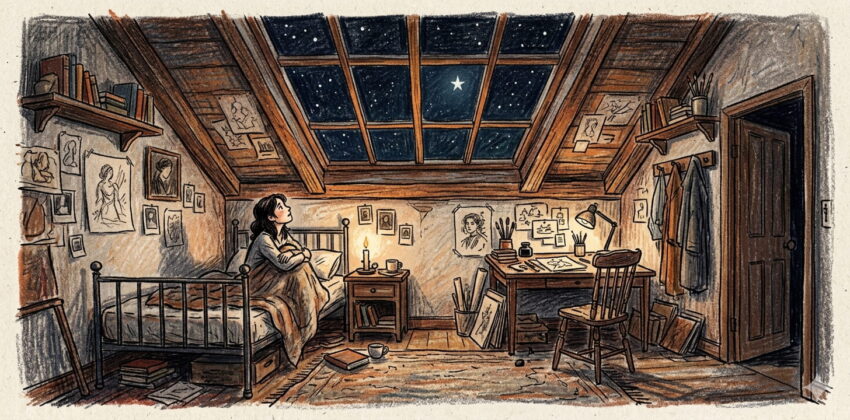
In it was an iron cot, a washstand and a chair. A shelf was the dresser. Its four bare walls seemed to close in upon you like the sides of a coffin. Your hand crept to your throat, you gasped, you looked up as from a well–and breathed once more. Through the glass of the little skylight you saw a square of blue infinity.
“Two dollars, suh,” Clara would say in her half-contemptuous, half- Tuskegeenial tones.
One day Miss Leeson came hunting for a room. She carried a typewriter made to be lugged around by a much larger lady. She was a very little girl, with eyes and hair that had kept on growing after she had stopped and that always looked as if they were saying: “Goodness me ! Why didn’t you keep up with us?”
Mrs. Parker showed her the double parlours. “In this closet,” she said, “one could keep a skeleton or anaesthetic or coal “
“But I am neither a doctor nor a dentist,” said Miss Leeson, with a shiver.
Mrs. Parker gave her the incredulous, pitying, sneering, icy stare that she kept for those who failed to qualify as doctors or dentists, and led the way to the second floor back.
“Eight dollars?” said Miss Leeson. “Dear me! I’m not Hetty if I do look green. I’m just a poor little working girl. Show me something higher and lower.”
Mr. Skidder jumped and strewed the floor with cigarette stubs at the rap on his door.
“Excuse me, Mr. Skidder,” said Mrs. Parker, with her demon’s smile at his pale looks. “I didn’t know you were in. I asked the lady to have a look at your lambrequins.”
“They’re too lovely for anything,” said Miss Leeson, smiling in exactly the way the angels do.
After they had gone Mr. Skidder got very busy erasing the tall, black-haired heroine from his latest (unproduced) play and inserting a small, roguish one with heavy, bright hair and vivacious features.
“Anna Held’ll jump at it,” said Mr. Skidder to himself, putting his feet up against the lambrequins and disappearing in a cloud of smoke like an aerial cuttlefish.
Presently the tocsin call of “Clara!” sounded to the world the state of Miss Leeson’s purse. A dark goblin seized her, mounted a Stygian stairway, thrust her into a vault with a glimmer of light in its top and muttered the menacing and cabalistic words “Two dollars!”
“I’ll take it!” sighed Miss Leeson, sinking down upon the squeaky iron bed.
Every day Miss Leeson went out to work. At night she brought home papers with handwriting on them and made copies with her typewriter. Sometimes she had no work at night, and then she would sit on the steps of the high stoop with the other roomers. Miss Leeson was not intended for a sky-light room when the plans were drawn for her creation. She was gay-hearted and full of tender, whimsical fancies. Once she let Mr. Skidder read to her three acts of his great (unpublished) comedy, “It’s No Kid; or, The Heir of the Subway.”
There was rejoicing among the gentlemen roomers whenever Miss Leeson had time to sit on the steps for an hour or two. But Miss Longnecker, the tall blonde who taught in a public school and said, “Well, really!” to everything you said, sat on the top step and sniffed. And Miss Dorn, who shot at the moving ducks at Coney every Sunday and worked in a department store, sat on the bottom step and sniffed. Miss Leeson sat on the middle step and the men would quickly group around her.
Especially Mr. Skidder, who had cast her in his mind for the star part in a private, romantic (unspoken) drama in real life. And especially Mr. Hoover, who was forty-five, fat, flush and foolish. And especially very young Mr. Evans, who set up a hollow cough to induce her to ask him to leave off cigarettes. The men voted her “the funniest and jolliest ever,” but the sniffs on the top step and the lower step were implacable.
* * * * * *
I pray you let the drama halt while Chorus stalks to the footlights and drops an epicedian tear upon the fatness of Mr. Hoover. Tune the pipes to the tragedy of tallow, the bane of bulk, the calamity of corpulence. Tried out, Falstaff might have rendered more romance to the ton than would have Romeo’s rickety ribs to the ounce. A lover may sigh, but he must not puff. To the train of Momus are the fat men remanded. In vain beats the faithfullest heart above a 52-inch belt. Avaunt, Hoover! Hoover, forty-five, flush and foolish, might carry off Helen herself; Hoover, forty-five, flush, foolish and fat is meat for perdition. There was never a chance for you, Hoover.
As Mrs. Parker’s roomers sat thus one summer’s evening, Miss Leeson looked up into the firmament and cried with her little gay laugh:
“Why, there’s Billy Jackson! I can see him from down here, too.”
All looked up–some at the windows of skyscrapers, some casting about for an airship, Jackson-guided.
“It’s that star,” explained Miss Leeson, pointing with a tiny finger. “Not the big one that twinkles–the steady blue one near it. I can see it every night through my skylight. I named it Billy Jackson.”
“Well, really!” said Miss Longnecker. “I didn’t know you were an astronomer, Miss Leeson.”
“Oh, yes,” said the small star gazer, “I know as much as any of them about the style of sleeves they’re going to wear next fall in Mars.”
“Well, really!” said Miss Longnecker. “The star you refer to is Gamma, of the constellation Cassiopeia. It is nearly of the second magnitude, and its meridian passage is–“
“Oh,” said the very young Mr. Evans, “I think Billy Jackson is a much better name for it.”
“Same here,” said Mr. Hoover, loudly breathing defiance to Miss Longnecker. “I think Miss Leeson has just as much right to name stars as any of those old astrologers had.”
“Well, really!” said Miss Longnecker.
“I wonder whether it’s a shooting star,” remarked Miss Dorn. “I hit nine ducks and a rabbit out of ten in the gallery at Coney Sunday.”
“He doesn’t show up very well from down here,” said Miss Leeson. “You ought to see him from my room. You know you can see stars even in the daytime from the bottom of a well. At night my room is like the shaft of a coal mine, and it makes Billy Jackson look like the big diamond pin that Night fastens her kimono with.”
There came a time after that when Miss Leeson brought no formidable papers home to copy. And when she went out in the morning, instead of working, she went from office to office and let her heart melt away in the drip of cold refusals transmitted through insolent office boys. This went on.
There came an evening when she wearily climbed Mrs. Parker’s stoop at the hour when she always returned from her dinner at the restaurant. But she had had no dinner.
As she stepped into the hall Mr. Hoover met her and seized his chance. He asked her to marry him, and his fatness hovered above her like an avalanche. She dodged, and caught the balustrade. He tried for her hand, and she raised it and smote him weakly in the face. Step by step she went up, dragging herself by the railing. She passed Mr. Skidder’s door as he was red-inking a stage direction for Myrtle Delorme (Miss Leeson) in his (unaccepted) comedy, to “pirouette across stage from L to the side of the Count.” Up the carpeted ladder she crawled at last and opened the door of the skylight room.
She was too weak to light the lamp or to undress. She fell upon the iron cot, her fragile body scarcely hollowing the worn springs. And in that Erebus of the skylight room, she slowly raised her heavy eyelids, and smiled.
For Billy Jackson was shining down on her, calm and bright and constant through the skylight. There was no world about her. She was sunk in a pit of blackness, with but that small square of pallid light framing the star that she had so whimsically and oh, so ineffectually named. Miss Longnecker must be right; it was Gamma, of the constellation Cassiopeia, and not Billy Jackson. And yet she could not let it be Gamma.
As she lay on her back she tried twice to raise her arm. The third time she got two thin fingers to her lips and blew a kiss out of the black pit to Billy Jackson. Her arm fell back limply.
“Good-bye, Billy,” she murmured faintly. “You’re millions of miles away and you won’t even twinkle once. But you kept where I could see you most of the time up there when there wasn’t anything else but darkness to look at, didn’t you? . . . Millions of miles. . . . Good-bye, Billy Jackson.”
Clara, the coloured maid, found the door locked at 10 the next day, and they forced it open. Vinegar, and the slapping of wrists and burnt feathers proving of no avail, some one ran to ‘phone for an ambulance.
In due time it backed up to the door with much gong-clanging, and the capable young medico, in his white linen coat, ready, active, confident, with his smooth face half debonair, half grim, danced up the steps.
“Ambulance call to 49,” he said briefly. “What’s the trouble?”
“Oh, yes, doctor,” sniffed Mrs. Parker, as though her trouble that there should be trouble in the house was the greater. “I can’t think what can be the matter with her. Nothing we could do would bring her to. It’s a young woman, a Miss Elsie–yes, a Miss Elsie Leeson. Never before in my house–“
“What room?” cried the doctor in a terrible voice, to which Mrs. Parker was a stranger.
“The skylight room. It–
Evidently the ambulance doctor was familiar with the location of skylight rooms. He was gone up the stairs, four at a time. Mrs. Parker followed slowly, as her dignity demanded.
On the first landing she met him coming back bearing the astronomer in his arms. He stopped and let loose the practised scalpel of his tongue, not loudly. Gradually Mrs. Parker crumpled as a stiff garment that slips down from a nail. Ever afterward there remained crumples in her mind and body. Sometimes her curious roomers would ask her what the doctor said to her.
“Let that be,” she would answer. “If I can get forgiveness for having heard it I will be satisfied.”
The ambulance physician strode with his burden through the pack of hounds that follow the curiosity chase, and even they fell back along the sidewalk abashed, for his face was that of one who bears his own dead.
They noticed that he did not lay down upon the bed prepared for it in the ambulance the form that he carried, and all that he said was: “Drive like h**l, Wilson,” to the driver.
That is all. Is it a story? In the next morning’s paper I saw a little news item, and the last sentence of it may help you (as it helped me) to weld the incidents together.
It recounted the reception into Bellevue Hospital of a young woman who had been removed from No. 49 East — street, suffering from debility induced by starvation. It concluded with these words:
“Dr. William Jackson, the ambulance physician who attended the case, says the patient will recover.”
Translation
First Mrs. Parker would show you the double parlours. You would not dare to interrupt her description of their advantages and of the merits of the gentleman who had occupied them for eight years. Then you would manage to stammer forth the confession that you were neither a doctor nor a dentist. Mrs. Parker’s manner of receiving the admission was such that you could never afterward entertain the same feeling toward your parents, who had neglected to train you up in one of the professions that fitted Mrs. Parker’s parlours.
Next you ascended one flight of stairs and looked at the second- floor-back at $8. Convinced by her second-floor manner that it was worth the $12 that Mr. Toosenberry always paid for it until he left to take charge of his brother’s orange plantation in Florida near Palm Beach, where Mrs. McIntyre always spent the winters that had the double front room with private bath, you managed to babble that you wanted something still cheaper.
If you survived Mrs. Parker’s scorn, you were taken to look at Mr. Skidder’s large hall room on the third floor. Mr. Skidder’s room was not vacant. He wrote plays and smoked cigarettes in it all day long. But every room-hunter was made to visit his room to admire the lambrequins. After each visit, Mr. Skidder, from the fright caused by possible eviction, would pay something on his rent.
Then–oh, then–if you still stood on one foot, with your hot hand clutching the three moist dollars in your pocket, and hoarsely proclaimed your hideous and culpable poverty, nevermore would Mrs. Parker be cicerone of yours. She would honk loudly the word “Clara” she would show you her back, and march downstairs. Then Clara, the coloured maid, would escort you up the carpeted ladder that served for the fourth flight, and show you the Skylight Room. It occupied 7×8 feet of floor space at the middle of the hall. On each side of it was a dark lumber closet or storeroom.
In it was an iron cot, a washstand and a chair. A shelf was the dresser. Its four bare walls seemed to close in upon you like the sides of a coffin. Your hand crept to your throat, you gasped, you looked up as from a well–and breathed once more. Through the glass of the little skylight you saw a square of blue infinity.
“Two dollars, suh,” Clara would say in her half-contemptuous, half- Tuskegeenial tones.
One day Miss Leeson came hunting for a room. She carried a typewriter made to be lugged around by a much larger lady. She was a very little girl, with eyes and hair that had kept on growing after she had stopped and that always looked as if they were saying: “Goodness me ! Why didn’t you keep up with us?”
Mrs. Parker showed her the double parlours. “In this closet,” she said, “one could keep a skeleton or anaesthetic or coal “
“But I am neither a doctor nor a dentist,” said Miss Leeson, with a shiver.
Mrs. Parker gave her the incredulous, pitying, sneering, icy stare that she kept for those who failed to qualify as doctors or dentists, and led the way to the second floor back.
“Eight dollars?” said Miss Leeson. “Dear me! I’m not Hetty if I do look green. I’m just a poor little working girl. Show me something higher and lower.”
Mr. Skidder jumped and strewed the floor with cigarette stubs at the rap on his door.
“Excuse me, Mr. Skidder,” said Mrs. Parker, with her demon’s smile at his pale looks. “I didn’t know you were in. I asked the lady to have a look at your lambrequins.”
“They’re too lovely for anything,” said Miss Leeson, smiling in exactly the way the angels do.
After they had gone Mr. Skidder got very busy erasing the tall, black-haired heroine from his latest (unproduced) play and inserting a small, roguish one with heavy, bright hair and vivacious features.
“Anna Held’ll jump at it,” said Mr. Skidder to himself, putting his feet up against the lambrequins and disappearing in a cloud of smoke like an aerial cuttlefish.
Presently the tocsin call of “Clara!” sounded to the world the state of Miss Leeson’s purse. A dark goblin seized her, mounted a Stygian stairway, thrust her into a vault with a glimmer of light in its top and muttered the menacing and cabalistic words “Two dollars!”
“I’ll take it!” sighed Miss Leeson, sinking down upon the squeaky iron bed.
Every day Miss Leeson went out to work. At night she brought home papers with handwriting on them and made copies with her typewriter. Sometimes she had no work at night, and then she would sit on the steps of the high stoop with the other roomers. Miss Leeson was not intended for a sky-light room when the plans were drawn for her creation. She was gay-hearted and full of tender, whimsical fancies. Once she let Mr. Skidder read to her three acts of his great (unpublished) comedy, “It’s No Kid; or, The Heir of the Subway.”
There was rejoicing among the gentlemen roomers whenever Miss Leeson had time to sit on the steps for an hour or two. But Miss Longnecker, the tall blonde who taught in a public school and said, “Well, really!” to everything you said, sat on the top step and sniffed. And Miss Dorn, who shot at the moving ducks at Coney every Sunday and worked in a department store, sat on the bottom step and sniffed. Miss Leeson sat on the middle step and the men would quickly group around her.
Especially Mr. Skidder, who had cast her in his mind for the star part in a private, romantic (unspoken) drama in real life. And especially Mr. Hoover, who was forty-five, fat, flush and foolish. And especially very young Mr. Evans, who set up a hollow cough to induce her to ask him to leave off cigarettes. The men voted her “the funniest and jolliest ever,” but the sniffs on the top step and the lower step were implacable.
* * * * * *
I pray you let the drama halt while Chorus stalks to the footlights and drops an epicedian tear upon the fatness of Mr. Hoover. Tune the pipes to the tragedy of tallow, the bane of bulk, the calamity of corpulence. Tried out, Falstaff might have rendered more romance to the ton than would have Romeo’s rickety ribs to the ounce. A lover may sigh, but he must not puff. To the train of Momus are the fat men remanded. In vain beats the faithfullest heart above a 52-inch belt. Avaunt, Hoover! Hoover, forty-five, flush and foolish, might carry off Helen herself; Hoover, forty-five, flush, foolish and fat is meat for perdition. There was never a chance for you, Hoover.
As Mrs. Parker’s roomers sat thus one summer’s evening, Miss Leeson looked up into the firmament and cried with her little gay laugh:
“Why, there’s Billy Jackson! I can see him from down here, too.”
All looked up–some at the windows of skyscrapers, some casting about for an airship, Jackson-guided.
“It’s that star,” explained Miss Leeson, pointing with a tiny finger. “Not the big one that twinkles–the steady blue one near it. I can see it every night through my skylight. I named it Billy Jackson.”
“Well, really!” said Miss Longnecker. “I didn’t know you were an astronomer, Miss Leeson.”
“Oh, yes,” said the small star gazer, “I know as much as any of them about the style of sleeves they’re going to wear next fall in Mars.”
“Well, really!” said Miss Longnecker. “The star you refer to is Gamma, of the constellation Cassiopeia. It is nearly of the second magnitude, and its meridian passage is–“
“Oh,” said the very young Mr. Evans, “I think Billy Jackson is a much better name for it.”
“Same here,” said Mr. Hoover, loudly breathing defiance to Miss Longnecker. “I think Miss Leeson has just as much right to name stars as any of those old astrologers had.”
“Well, really!” said Miss Longnecker.
“I wonder whether it’s a shooting star,” remarked Miss Dorn. “I hit nine ducks and a rabbit out of ten in the gallery at Coney Sunday.”
“He doesn’t show up very well from down here,” said Miss Leeson. “You ought to see him from my room. You know you can see stars even in the daytime from the bottom of a well. At night my room is like the shaft of a coal mine, and it makes Billy Jackson look like the big diamond pin that Night fastens her kimono with.”
There came a time after that when Miss Leeson brought no formidable papers home to copy. And when she went out in the morning, instead of working, she went from office to office and let her heart melt away in the drip of cold refusals transmitted through insolent office boys. This went on.
There came an evening when she wearily climbed Mrs. Parker’s stoop at the hour when she always returned from her dinner at the restaurant. But she had had no dinner.
As she stepped into the hall Mr. Hoover met her and seized his chance. He asked her to marry him, and his fatness hovered above her like an avalanche. She dodged, and caught the balustrade. He tried for her hand, and she raised it and smote him weakly in the face. Step by step she went up, dragging herself by the railing. She passed Mr. Skidder’s door as he was red-inking a stage direction for Myrtle Delorme (Miss Leeson) in his (unaccepted) comedy, to “pirouette across stage from L to the side of the Count.” Up the carpeted ladder she crawled at last and opened the door of the skylight room.
She was too weak to light the lamp or to undress. She fell upon the iron cot, her fragile body scarcely hollowing the worn springs. And in that Erebus of the skylight room, she slowly raised her heavy eyelids, and smiled.
For Billy Jackson was shining down on her, calm and bright and constant through the skylight. There was no world about her. She was sunk in a pit of blackness, with but that small square of pallid light framing the star that she had so whimsically and oh, so ineffectually named. Miss Longnecker must be right; it was Gamma, of the constellation Cassiopeia, and not Billy Jackson. And yet she could not let it be Gamma.
As she lay on her back she tried twice to raise her arm. The third time she got two thin fingers to her lips and blew a kiss out of the black pit to Billy Jackson. Her arm fell back limply.
“Good-bye, Billy,” she murmured faintly. “You’re millions of miles away and you won’t even twinkle once. But you kept where I could see you most of the time up there when there wasn’t anything else but darkness to look at, didn’t you? . . . Millions of miles. . . . Good-bye, Billy Jackson.”
Clara, the coloured maid, found the door locked at 10 the next day, and they forced it open. Vinegar, and the slapping of wrists and burnt feathers proving of no avail, some one ran to ‘phone for an ambulance.
In due time it backed up to the door with much gong-clanging, and the capable young medico, in his white linen coat, ready, active, confident, with his smooth face half debonair, half grim, danced up the steps.
“Ambulance call to 49,” he said briefly. “What’s the trouble?”
“Oh, yes, doctor,” sniffed Mrs. Parker, as though her trouble that there should be trouble in the house was the greater. “I can’t think what can be the matter with her. Nothing we could do would bring her to. It’s a young woman, a Miss Elsie–yes, a Miss Elsie Leeson. Never before in my house–“
“What room?” cried the doctor in a terrible voice, to which Mrs. Parker was a stranger.
“The skylight room. It–
Evidently the ambulance doctor was familiar with the location of skylight rooms. He was gone up the stairs, four at a time. Mrs. Parker followed slowly, as her dignity demanded.
On the first landing she met him coming back bearing the astronomer in his arms. He stopped and let loose the practised scalpel of his tongue, not loudly. Gradually Mrs. Parker crumpled as a stiff garment that slips down from a nail. Ever afterward there remained crumples in her mind and body. Sometimes her curious roomers would ask her what the doctor said to her.
“Let that be,” she would answer. “If I can get forgiveness for having heard it I will be satisfied.”
The ambulance physician strode with his burden through the pack of hounds that follow the curiosity chase, and even they fell back along the sidewalk abashed, for his face was that of one who bears his own dead.
They noticed that he did not lay down upon the bed prepared for it in the ambulance the form that he carried, and all that he said was: “Drive like h**l, Wilson,” to the driver.
That is all. Is it a story? In the next morning’s paper I saw a little news item, and the last sentence of it may help you (as it helped me) to weld the incidents together.
It recounted the reception into Bellevue Hospital of a young woman who had been removed from No. 49 East — street, suffering from debility induced by starvation. It concluded with these words:
“Dr. William Jackson, the ambulance physician who attended the case, says the patient will recover.”
“Tôi không cần một căn phòng; tôi cần một ngôi sao.”
Đầu tiên, bà Parker sẽ dẫn bạn xem hai phòng khách liền nhau. Bạn sẽ không dám ngắt lời bà khi bà đang say sưa mô tả những ưu điểm của chúng và những phẩm chất của vị quý ông đã ở đó suốt tám năm. Rồi bạn sẽ ấp úng thú nhận rằng mình không phải bác sĩ cũng chẳng phải nha sĩ. Cái cách bà Parker tiếp nhận lời thú nhận đó khiến bạn không bao giờ còn có thể nhìn cha mẹ mình bằng con mắt như cũ nữa — những người đã không chịu hướng bạn vào một trong những nghề nghiệp phù hợp với phòng khách của bà Parker.
Tiếp theo, bạn leo lên một tầng cầu thang và xem căn phòng phía sau tầng hai với giá 8 đô la. Bị cái phong thái tầng hai của bà thuyết phục rằng nó đáng giá 12 đô la mà ông Toosenberry vẫn trả cho đến khi ông rời đi để trông coi đồn điền cam của anh trai ở Florida gần Palm Beach, nơi bà McIntyre thường nghỉ đông với căn phòng mặt tiền đôi có phòng tắm riêng, bạn lắp bắp rằng mình cần thứ gì đó rẻ hơn nữa.
Nếu bạn sống sót qua cái nhìn khinh thường của bà Parker, bạn sẽ được dẫn đến xem căn phòng hành lang rộng của ông Skidder ở tầng ba. Phòng của ông Skidder không trống. Ông viết kịch bản và hút thuốc lá trong đó suốt ngày. Nhưng mọi người đi tìm phòng đều bị dẫn đến thăm phòng ông để ngắm những tấm rèm trang trí. Sau mỗi lần có khách thăm, ông Skidder, vì sợ bị đuổi, lại trả thêm một ít tiền thuê phòng.
Rồi thì — ôi, rồi thì — nếu bạn vẫn còn đứng đó với một chân, bàn tay nóng hổi nắm chặt ba tờ đô la ẩm ướt trong túi, và khàn khàn tuyên bố sự nghèo túng đáng xấu hổ và đáng trách của mình, thì bà Parker sẽ không còn là người hướng dẫn của bạn nữa. Bà sẽ gọi to một tiếng “Clara,” quay lưng lại và đi xuống cầu thang. Rồi Clara, cô hầu gái da màu, sẽ dẫn bạn leo lên chiếc thang có trải thảm đóng vai trò là cầu thang tầng bốn, và chỉ cho bạn xem Căn Phòng Có Ô Cửa Trời. Nó chiếm 7×8 feet diện tích sàn ở giữa hành lang. Hai bên nó là những tủ gỗ tối tăm hoặc kho chứa đồ.
Trong phòng có một chiếc giường sắt, một bàn rửa mặt và một chiếc ghế. Một cái kệ đóng vai trò là tủ đầu giường. Bốn bức tường trần trụi dường như khép lại bao quanh bạn như những tấm ván quan tài. Tay bạn run run đưa lên cổ họng, bạn thở hổn hển, bạn ngước nhìn lên như từ dưới đáy giếng — và thở phào một lần nữa. Qua tấm kính của ô cửa trời nhỏ bé, bạn nhìn thấy một ô vuông xanh vô tận.
“Hai đô la thôi, thưa cô,” Clara sẽ nói bằng giọng nửa khinh thường, nửa thân thiện.
Một ngày nọ, cô Leeson đến tìm phòng. Cô mang theo một chiếc máy đánh chữ vốn được thiết kế để một người phụ nữ to lớn hơn nhiều mới xách nổi. Cô là một cô gái rất nhỏ nhắn, với đôi mắt và mái tóc dường như vẫn tiếp tục lớn sau khi cô đã ngừng lớn, và chúng luôn trông như thể đang nói: “Trời ơi! Sao cô không chịu lớn theo chúng tôi vậy?”
Bà Parker dẫn cô xem hai phòng khách liền nhau. “Trong cái tủ này,” bà nói, “người ta có thể cất một bộ xương hoặc thuốc gây mê hoặc than củi.”
“Nhưng tôi không phải bác sĩ cũng không phải nha sĩ,” cô Leeson nói, rùng mình.
Bà Parker nhìn cô bằng cái nhìn không tin tưởng, thương hại, chế giễu và lạnh lùng mà bà dành cho những ai không đủ tiêu chuẩn là bác sĩ hay nha sĩ, rồi dẫn đường lên tầng hai phía sau.
“Tám đô la?” cô Leeson nói. “Trời ơi! Tôi không phải Hetty dù tôi có trông ngây thơ đến vậy. Tôi chỉ là một cô gái lao động nghèo. Cho tôi xem thứ gì cao hơn mà thấp hơn đi.”
Ông Skidder giật mình và vung vãi đầu mẩu thuốc lá khắp sàn khi có tiếng gõ cửa phòng ông.
“Xin lỗi ông Skidder,” bà Parker nói với nụ cười ma quỷ trước vẻ mặt tái nhợt của ông. “Tôi không biết ông đang ở trong. Tôi mời cô này vào xem những tấm rèm của ông.”
“Chúng đẹp tuyệt vời,” cô Leeson nói, mỉm cười đúng theo cái cách mà các thiên thần vẫn làm.
Sau khi họ đi rồi, ông Skidder bận rộn xóa đi nhân vật nữ chính cao ráo, tóc đen trong vở kịch mới nhất (chưa được dàn dựng) của mình và thay vào đó một nhân vật nhỏ nhắn, tinh nghịch với mái tóc dày, sáng và vẻ mặt sống động.
“Anna Held sẽ nhảy vào vai ngay thôi,” ông Skidder tự nhủ, gác chân lên những tấm rèm và biến mất trong đám khói như một con mực bay trên không.
Chẳng mấy chốc tiếng gọi như hồi kèn “Clara!” vang lên báo hiệu cho cả thế giới biết tình trạng ví tiền của cô Leeson. Một bóng ma tối tăm nắm lấy cô, leo lên một cầu thang âm u, đẩy cô vào một căn hầm với một tia sáng le lói trên đỉnh và lầm bầm những lời đe dọa và bí ẩn “Hai đô la!”
“Tôi lấy nó!” cô Leeson thở dài, ngồi phịch xuống chiếc giường sắt kêu cọt kẹt.
Mỗi ngày cô Leeson đi làm. Buổi tối cô mang về những tờ giấy có chữ viết tay và đánh máy lại. Đôi khi buổi tối cô không có việc làm, và khi đó cô sẽ ngồi trên bậc thềm cao cùng những người thuê phòng khác. Cô Leeson vốn không được sinh ra để ở trong một căn phòng có ô cửa trời. Cô vui vẻ và đầy những tưởng tượng dịu dàng, kỳ thú. Một lần cô để ông Skidder đọc cho cô nghe ba màn của vở hài kịch vĩ đại (chưa được xuất bản) của ông, “Không Phải Trò Đùa; hay, Người Thừa Kế Của Tàu Điện Ngầm.”
Những người thuê phòng nam giới đều vui mừng mỗi khi cô Leeson có thời gian ngồi trên bậc thềm một hai tiếng đồng hồ. Nhưng cô Longnecker, người phụ nữ tóc vàng cao ráo dạy ở trường công và nói “Ồ, thật sao!” với mọi thứ bạn nói, ngồi trên bậc thềm cao nhất và hếch mũi. Và cô Dorn, người bắn vịt chuyển động ở Coney mỗi Chủ nhật và làm việc ở một cửa hàng bách hóa, ngồi trên bậc thềm thấp nhất và hếch mũi. Cô Leeson ngồi ở bậc thềm giữa và những người đàn ông nhanh chóng tụ tập quanh cô.
Đặc biệt là ông Skidder, người đã trong tâm trí mình chọn cô cho vai chính trong một vở kịch lãng mạn riêng tư (chưa được nói ra) trong cuộc sống thực. Và đặc biệt là ông Hoover, bốn mươi lăm tuổi, béo, giàu có và ngốc nghếch. Và đặc biệt là chàng Evans rất trẻ, người giả vờ ho khan để khiến cô hỏi thăm và bảo anh bỏ thuốc lá. Những người đàn ông bầu cô là “người vui nhộn và dễ thương nhất từ trước đến nay,” nhưng những cái hếch mũi trên bậc thềm cao và bậc thềm thấp thì không thể lay chuyển.
Tôi xin bạn hãy để câu chuyện dừng lại một chút trong khi Người Dẫn Chuyện bước ra sân khấu và nhỏ một giọt nước mắt thương tiếc lên cái béo phì của ông Hoover. Hãy gảy đàn cho bi kịch của mỡ thừa, tai họa của sự cồng kềnh, thảm kịch của béo phì. Nếu được vắt ra, Falstaff có thể mang lại nhiều lãng mạn hơn trên mỗi tấn so với những xương sườn gầy guộc của Romeo trên mỗi ounce. Một người yêu có thể thở dài, nhưng không được thở phì phò. Những người đàn ông béo bị đày vào đoàn tùy tùng của Momus. Vô ích thay trái tim trung thành nhất đập trên một chiếc thắt lưng 52 inch. Cút đi, Hoover! Hoover bốn mươi lăm tuổi, giàu có và ngốc nghếch, có thể chinh phục cả nàng Helen; Hoover bốn mươi lăm tuổi, giàu có, ngốc nghếch và béo phì thì chỉ là mồi cho sự diệt vong. Chưa bao giờ có cơ hội nào cho anh, Hoover.
Khi những người thuê phòng của bà Parker ngồi như vậy vào một buổi tối mùa hè, cô Leeson ngước nhìn lên bầu trời và kêu lên với tiếng cười nhỏ vui vẻ của cô:
“Ồ, kìa Billy Jackson! Tôi có thể nhìn thấy anh ấy từ dưới đây nữa kìa.”
Tất cả đều ngước nhìn lên — một số nhìn vào những cửa sổ của các tòa nhà chọc trời, một số nhìn quanh tìm kiếm một chiếc tàu bay do Jackson điều khiển.
“Đó là ngôi sao kia,” cô Leeson giải thích, chỉ bằng ngón tay nhỏ xíu. “Không phải ngôi sao lớn đang nhấp nháy — mà là ngôi sao xanh ổn định gần đó. Tôi có thể nhìn thấy nó mỗi đêm qua ô cửa trời của mình. Tôi đặt tên nó là Billy Jackson.”
“Ồ, thật sao!” cô Longnecker nói. “Tôi không biết cô là nhà thiên văn học, cô Leeson.”
“Ồ, đúng vậy,” cô gái ngắm sao nhỏ bé nói, “tôi biết nhiều như bất kỳ ai trong số họ về kiểu tay áo mà người ta sẽ mặc vào mùa thu tới trên sao Hỏa.”
“Ồ, thật sao!” cô Longnecker nói. “Ngôi sao mà cô đề cập đến là Gamma, thuộc chòm sao Cassiopeia. Nó gần như thuộc cấp độ hai, và đường kinh tuyến của nó là —”
“Ồ,” chàng Evans rất trẻ nói, “tôi nghĩ Billy Jackson là cái tên hay hơn nhiều.”
“Tôi cũng vậy,” ông Hoover nói to, thở phì phò thách thức cô Longnecker. “Tôi nghĩ cô Leeson có quyền đặt tên cho các ngôi sao không kém gì những nhà chiêm tinh học cổ đại đó.”
“Ồ, thật sao!” cô Longnecker nói.
“Tôi tự hỏi liệu đó có phải là sao băng không,” cô Dorn nhận xét. “Tôi bắn trúng chín con vịt và một con thỏ trong mười lần ở phòng bắn Coney hôm Chủ nhật.”
“Anh ấy không hiện ra rõ lắm từ dưới đây,” cô Leeson nói. “Cô nên nhìn anh ấy từ phòng của tôi mới được. Cô biết đấy, người ta có thể nhìn thấy sao ngay cả ban ngày từ dưới đáy giếng. Ban đêm phòng tôi như giếng mỏ than, và nó làm cho Billy Jackson trông như viên kim cương lớn mà Đêm Tối dùng để cài áo kimono của mình.”
Rồi đến một lúc cô Leeson không còn mang về những tờ giấy dày cộp để đánh máy nữa. Và khi cô ra ngoài vào buổi sáng, thay vì đi làm, cô đi từ văn phòng này sang văn phòng khác và để trái tim mình tan chảy dần trong những lời từ chối lạnh lùng được truyền đạt qua những cậu bé văn phòng hỗn láo. Cứ thế tiếp diễn.
Rồi đến một buổi tối cô mệt mỏi leo lên bậc thềm của bà Parker vào giờ cô thường trở về sau bữa tối ở nhà hàng. Nhưng hôm nay cô chưa ăn tối.
Khi cô bước vào hành lang, ông Hoover gặp cô và nắm lấy cơ hội. Ông cầu hôn cô, và cái béo phì của ông lơ lửng trên đầu cô như một trận tuyết lở. Cô né tránh và bám vào tay vịn cầu thang. Ông cố nắm lấy tay cô, và cô giơ tay lên đánh yếu ớt vào mặt ông. Từng bước một cô leo lên, kéo mình theo tay vịn. Cô đi qua cửa phòng ông Skidder khi ông đang dùng mực đỏ ghi chú một chỉ đạo sân khấu cho Myrtle Delorme (cô Leeson) trong vở hài kịch (chưa được chấp nhận) của ông, để “xoay pirouette qua sân khấu từ trái sang bên cạnh Bá tước.” Cuối cùng cô bò lên chiếc thang có trải thảm và mở cửa căn phòng có ô cửa trời.
Cô quá yếu để thắp đèn hay thay quần áo. Cô ngã xuống chiếc giường sắt, thân hình mỏng manh của cô hầu như không tạo ra vết lõm nào trên những lò xo đã mòn. Và trong bóng tối âm u của căn phòng có ô cửa trời đó, cô từ từ mở đôi mắt nặng nề, và mỉm cười.
Vì Billy Jackson đang chiếu sáng xuống cô, bình thản và sáng ngời và kiên định qua ô cửa trời. Không có thế giới nào xung quanh cô. Cô chìm trong một hố tối tăm, chỉ có ô vuông ánh sáng nhợt nhạt nhỏ bé đó bao quanh ngôi sao mà cô đã đặt tên một cách kỳ thú và ôi, thật vô hiệu. Cô Longnecker chắc hẳn đúng; đó là Gamma, thuộc chòm sao Cassiopeia, chứ không phải Billy Jackson. Nhưng cô không thể để nó là Gamma được.
Khi nằm ngửa, cô cố giơ tay lên hai lần. Đến lần thứ ba cô đưa được hai ngón tay gầy guộc lên môi và thổi một nụ hôn từ hố tối tăm lên Billy Jackson. Cánh tay cô rơi xuống bất lực.
“Tạm biệt, Billy,” cô thì thầm yếu ớt. “Anh ở cách xa hàng triệu dặm và anh thậm chí không chịu nhấp nháy một lần. Nhưng anh đã ở đó để em có thể nhìn thấy anh hầu hết thời gian ở trên đó khi không có gì khác ngoài bóng tối để nhìn vào, phải không? . . . Hàng triệu dặm. . . . Tạm biệt, Billy Jackson.”
Clara, cô hầu gái da màu, thấy cửa bị khóa vào lúc 10 giờ sáng hôm sau, và họ phá cửa ra. Giấm, vỗ cổ tay và lông vũ đốt cháy đều không có tác dụng, ai đó chạy đi gọi điện thoại cho xe cấp cứu.
Đúng lúc, xe cấp cứu lùi vào trước cửa với tiếng chuông inh ỏi, và vị bác sĩ trẻ tài năng, trong chiếc áo khoác vải lanh trắng, sẵn sàng, nhanh nhẹn, tự tin, với khuôn mặt nhẵn nhụi nửa vui vẻ nửa nghiêm nghị, bước nhanh lên bậc thềm.
“Xe cấp cứu đến số 49,” ông nói ngắn gọn. “Có chuyện gì vậy?”
“Ồ, vâng, bác sĩ,” bà Parker hếch mũi, như thể nỗi phiền muộn của bà vì có chuyện rắc rối trong nhà mới là điều quan trọng hơn. “Tôi không hiểu chuyện gì đã xảy ra với cô ấy. Không có gì chúng tôi làm có thể đánh thức cô ấy dậy. Đó là một cô gái trẻ, một cô Elsie — vâng, một cô Elsie Leeson. Chưa bao giờ có chuyện như thế này trong nhà tôi —”
“Phòng nào?” vị bác sĩ hét lên bằng giọng khủng khiếp mà bà Parker chưa từng nghe bao giờ.
“Căn phòng có ô cửa trời. Nó —”
Rõ ràng vị bác sĩ xe cấp cứu đã quen thuộc với vị trí của những căn phòng có ô cửa trời. Ông đã biến lên cầu thang, bốn bậc một lần. Bà Parker theo sau chậm rãi, như phẩm giá của bà đòi hỏi.
Ở chiếu nghỉ đầu tiên, bà gặp ông đang đi xuống, bế trên tay nhà thiên văn học nhỏ bé. Ông dừng lại và thả ra lưỡi dao mổ đã được luyện tập của mình, không to tiếng. Dần dần bà Parker co rúm lại như một chiếc áo cứng tuột khỏi đinh treo. Mãi về sau vẫn còn những nếp nhăn trong tâm trí và thân xác bà. Đôi khi những người thuê phòng tò mò của bà sẽ hỏi bà vị bác sĩ đã nói gì với bà.
“Thôi bỏ qua đi,” bà sẽ trả lời. “Nếu tôi có thể được tha thứ vì đã nghe những lời đó, tôi sẽ mãn nguyện.”
Vị bác sĩ xe cấp cứu bước nhanh với người trên tay qua đám đông hiếu kỳ đang bu lại, và ngay cả họ cũng dạt ra hai bên vỉa hè ngượng ngùng, vì khuôn mặt ông là khuôn mặt của người đang bế chính người thân đã mất của mình.
Người ta nhận thấy rằng ông không đặt xuống chiếc cáng đã được chuẩn bị sẵn trong xe cấp cứu cái hình hài mà ông đang bế, và tất cả những gì ông nói là: “Lái nhanh lên, Wilson,” với người lái xe.
Chỉ vậy thôi. Đây có phải là một câu chuyện không? Trên tờ báo sáng hôm sau tôi thấy một mẩu tin nhỏ, và câu cuối cùng của nó có thể giúp bạn (như nó đã giúp tôi) kết nối tất cả các sự kiện lại với nhau.
Mẩu tin kể về việc tiếp nhận vào Bệnh viện Bellevue một cô gái trẻ đã được đưa đến từ số 49 phố East, đang bị suy nhược do đói ăn. Nó kết thúc bằng những lời này:
“Bác sĩ William Jackson, bác sĩ xe cấp cứu đã xử lý ca này, cho biết bệnh nhân sẽ hồi phục.”
— HẾT —