Reading Passage: The Biological Cost of Vertical Living
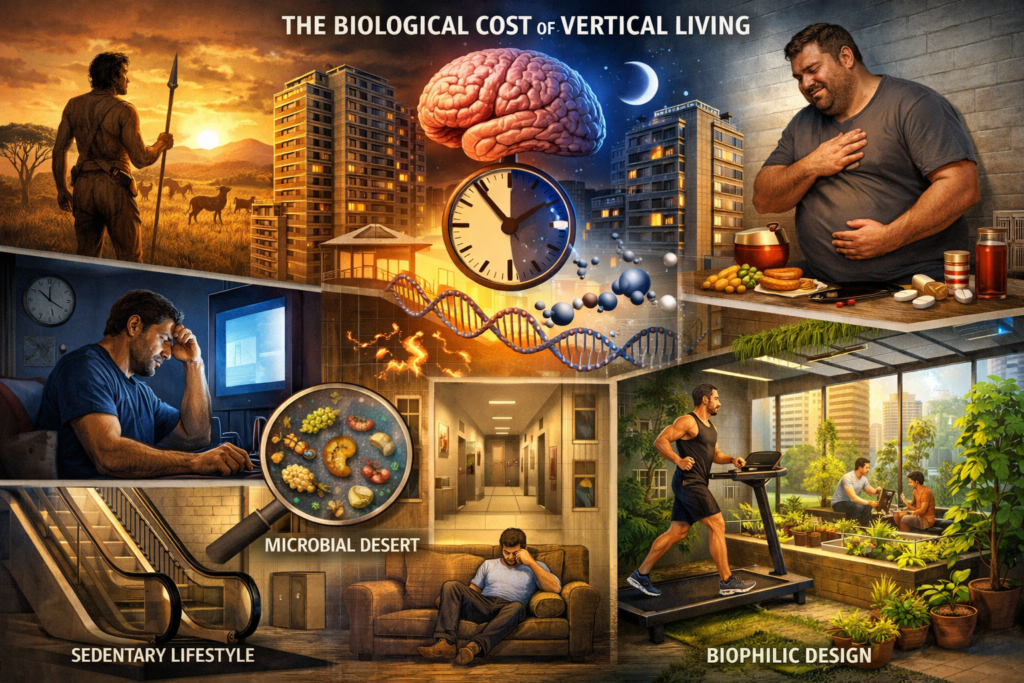
A. In the evolutionary blink of an eye, the human species has migrated from the sprawling savannas to the confined, multi-storeyed structures of modern metropolises. While these architectural marvels address the logistical nightmare of overpopulation, a growing body of research suggests a profound evolutionary mismatch between high-rise living and human physiology. Our biological systems, honed over millions of years to interact with the natural world, are now being forced to adapt to a “concrete-and-glass” vacuum that many scientists label as inherently “anti-nature.”
B. The most immediate physiological casualty of apartment living is the disruption of the circadian rhythm. Human biology is fundamentally governed by the 24-hour light-dark cycle, managed by the suprachiasmatic nucleus in the brain. In many modern apartments, however, residents are subjected to “light poverty”—a lack of sufficient morning sunlight—and “light pollution”—an overabundance of artificial blue light at night. This dysregulation inhibits the production of melatonin, the hormone responsible for sleep and cellular repair. Over time, this chronic imbalance can lead to metabolic disorders, weakened immune responses, and a persistent state of physiological stress.
C. Furthermore, the “sanitized” environment of a high-rise building often results in what microbiologists call a “microbial desert.” Traditional human dwellings were porous, allowing for a healthy exchange of diverse bacteria from the soil and vegetation. In contrast, modern apartments are designed for hermetic efficiency. By stripping away our contact with “old friends”—the commensal bacteria that train our immune systems—vertical living may be contributing to the skyrocketing rates of autoimmune diseases and allergies. We are, in essence, becoming too clean for our own biological good.
D. Beyond the invisible, there is the tangible issue of sedentary architecture. The very design of an apartment complex is predicated on “frictionless” living: elevators replace stairs, and compact floor plans minimize the need for functional movement. This convenience leads to a decline in Non-Exercise Activity Thermogenesis (NEAT), which is crucial for maintaining cardiovascular health and bone density. Our ancestors’ physiology thrived on the varied mechanical stresses of uneven terrain; the flat, predictable surfaces of a 20th-floor flat lead to muscle atrophy and a sluggish metabolism.
E. However, the tide may be turning with the advent of biophilic urbanism. Architects are increasingly incorporating “living walls,” natural ventilation corridors, and communal gardens into high-rise designs. These interventions aim to bridge the gap between our ancient DNA and our modern requirements. The question remains: can we truly re-engineer these vertical boxes to satisfy the primal needs of the human animal, or is the high-rise fundamentally at odds with our species’ survival?
Audio
Volcabularies Recap
Click to expand …
| Term | Pronunciation | Root (Etymology) | Definition | Usage Example |
| The sprawling savannas | /ðə ˈsprɔː.lɪŋ səˈvæn.əz/ | Old Eng. spreawlian (to move limbs) + Span. sabana (treeless plain) | Vast, open grasslands with scattered trees that spread out over a large area. | “Early humans hunted across the sprawling savannas of Africa.” |
| Modern metropolises | /ˈmɒd.ən məˈtrɒp.əl.ɪ.siz/ | Gk. mētēr (mother) + polis (city) | Large, densely populated, and sophisticated contemporary cities. | “Tokyo and New York are prime examples of modern metropolises.” |
| Architectural marvels | /ˌɑːr.kɪˈtek.tʃər.əl ˈmɑːr.vəlz/ | Gk. arkhitektōn (master builder) + Lat. mirari (to wonder at) | Buildings or structures that are impressively beautiful or technically advanced. | “The Burj Khalifa is considered one of the world’s greatest architectural marvels.” |
| Honed | /hoʊnd/ | Old Eng. han (stone) | Sharpened or perfected over a long period of time. | “His survival skills were honed by years of living in the wilderness.” |
| The suprachiasmatic nucleus | /ðə ˌsuː.prə.kaɪ.æzˈmæt.ɪk ˈnuː.kli.əs/ | Lat. supra (above) + chiasma (crossing) + nucleus (kernel) | A tiny region of the brain in the hypothalamus that controls circadian rhythms. | “The suprachiasmatic nucleus acts as the body’s master internal clock.” |
| Dysregulation | /ˌdɪs.reɡ.juˈleɪ.ʃən/ | Gk. dys- (bad) + Lat. regulatus (directed) | An impairment of a physiological or psychological regulatory mechanism. | “Sleep dysregulation can lead to irritability and poor focus.” |
| Microbial desert | /maɪˈkroʊ.bi.əl ˈdez.ərt/ | Gk. mikros (small) + bios (life) | An environment (like a sanitized room) that lacks a healthy diversity of bacteria. | “Living in a high-rise can turn an apartment into a microbial desert.” |
| Dwellings | /ˈdwel.ɪŋz/ | Old Eng. dwellan (to lead astray/stay) | Places where people live; residences. | “Ancient cave dwellings provided shelter from extreme weather.” |
| Porous | /ˈpɔː.rəs/ | Gk. poros (passage) | Having minute spaces or holes through which liquid or air may pass. | “Traditional brick walls are more porous than modern glass panels.” |
| Hermetic efficiency | /hɜːrˈmet.ɪk ɪˈfɪʃ.ən.si/ | Gk. Hermēs (Messenger god/secret arts) + Lat. efficere (work out) | A state of being perfectly airtight and energy-efficient, often excluding external air. | “While saving energy, hermetic efficiency can lower indoor air quality.” |
| Commensal bacteria | /kəˈmen.səl bækˈtɪə.ri.ə/ | Lat. com- (together) + mensa (table) | Microorganisms that live on or in a host without causing harm, often providing benefits. | “Our gut is home to trillions of commensal bacteria that aid digestion.” |
| Autoimmune diseases | /ˌɔː.toʊ.ɪˈmjuːn dɪˈziː.zɪz/ | Gk. autos (self) + Lat. immunis (exempt) | Conditions where the immune system mistakenly attacks the body’s own cells. | “Lupus and rheumatoid arthritis are common autoimmune diseases.” |
| NEAT | /niːt/ | Non-Exercise Activity Thermogenesis | The energy expended for everything we do that is not sleeping, eating, or sports-like exercise. | “Taking the stairs instead of the elevator is a great way to increase NEAT.” |
| Thrived on | /θraɪvd ɒn/ | Old Norse thrifask (to grasp for oneself) | To grow or develop successfully because of a specific environment or factor. | “Our ancestors thrived on a diet of wild plants and lean proteins.” |
| Atrophy | /ˈæt.rə.fi/ | Gk. atrophos (ill-fed/wasting) | To waste away, typically due to the degeneration of cells or disuse. | “The astronaut’s muscles began to atrophy after months in zero gravity.” |
| Sluggish metabolism | /ˈslʌɡ.ɪʃ məˈtæb.əl.ɪ.zəm/ | Mid. Eng. slugge (lazy person) + Gk. metabolē (change) | A slow rate at which the body converts food and drink into energy. | “A sedentary lifestyle often results in a sluggish metabolism.” |
| The advent of biophilic urbanism | /ðə ˈæd.vent əv ˌbaɪ.oʊˈfɪl.ɪk ˈɜːr.bə.nɪ.zəm/ | Lat. adventus (arrival) + Gk. bios (life) + philos (loving) | The arrival of a design trend that incorporates nature into city living. | “With the advent of biophilic urbanism, we see more trees on balconies.” |
| Natural ventilation corridors | /ˈnætʃ.ər.əl ˌven.tɪˈleɪ.ʃən ˈkɒr.ɪ.dɔːrz/ | Lat. ventila (fanned by wind) + currere (to run) | Pathways in buildings designed to allow fresh air to flow through naturally. | “Natural ventilation corridors reduce the need for air conditioning.” |
| Communal gardens | /kəˈmjuː.nəl ˈɡɑːr.dənz/ | Lat. communis (shared) | Shared outdoor spaces where a community can grow plants or relax. | “Communal gardens on rooftops help residents connect with nature.” |
| Interventions | /ˌɪn.təˈven.ʃənz/ | Lat. intervenire (to come between) | Actions taken to improve a situation or modify an outcome. | “Architectural interventions can make high-rises more livable.” |
| At odds | /æt ɒdz/ | Old Norse odd (point/triangle) | In disagreement or conflict with something else. | “His modern lifestyle is at odds with his desire for a simple life.” |
English Vietnamese Translation
Click to expand …
Reading Passage: The Biological Cost of Vertical Living
A. In the evolutionary blink of an eye, the human species has migrated from the sprawling savannas to the confined, multi-storeyed structures of modern metropolises. While these architectural marvels address the logistical nightmare of overpopulation, a growing body of research suggests a profound evolutionary mismatch between high-rise living and human physiology. Our biological systems, honed over millions of years to interact with the natural world, are now being forced to adapt to a “concrete-and-glass” vacuum that many scientists label as inherently “anti-nature.”
B. The most immediate physiological casualty of apartment living is the disruption of the circadian rhythm. Human biology is fundamentally governed by the 24-hour light-dark cycle, managed by the suprachiasmatic nucleus in the brain. In many modern apartments, however, residents are subjected to “light poverty”—a lack of sufficient morning sunlight—and “light pollution”—an overabundance of artificial blue light at night. This dysregulation inhibits the production of melatonin, the hormone responsible for sleep and cellular repair. Over time, this chronic imbalance can lead to metabolic disorders, weakened immune responses, and a persistent state of physiological stress.
C. Furthermore, the “sanitized” environment of a high-rise building often results in what microbiologists call a “microbial desert.” Traditional human dwellings were porous, allowing for a healthy exchange of diverse bacteria from the soil and vegetation. In contrast, modern apartments are designed for hermetic efficiency. By stripping away our contact with “old friends”—the commensal bacteria that train our immune systems—vertical living may be contributing to the skyrocketing rates of autoimmune diseases and allergies. We are, in essence, becoming too clean for our own biological good.
D. Beyond the invisible, there is the tangible issue of sedentary architecture. The very design of an apartment complex is predicated on “frictionless” living: elevators replace stairs, and compact floor plans minimize the need for functional movement. This convenience leads to a decline in Non-Exercise Activity Thermogenesis (NEAT), which is crucial for maintaining cardiovascular health and bone density. Our ancestors’ physiology thrived on the varied mechanical stresses of uneven terrain; the flat, predictable surfaces of a 20th-floor flat lead to muscle atrophy and a sluggish metabolism.
E. However, the tide may be turning with the advent of biophilic urbanism. Architects are increasingly incorporating “living walls,” natural ventilation corridors, and communal gardens into high-rise designs. These interventions aim to bridge the gap between our ancient DNA and our modern requirements. The question remains: can we truly re-engineer these vertical boxes to satisfy the primal needs of the human animal, or is the high-rise fundamentally at odds with our species’ survival?
Cái Giá Sinh Học Của Lối Sống Trên Cao
A. Chỉ trong một “cái chớp mắt” của quá trình tiến hóa, loài người đã di cư từ những vùng thảo nguyên bao la sang những cấu trúc cao tầng, chật hẹp của các đô thị hiện đại. Trong khi những kỳ quan kiến trúc này giải quyết được cơn ác mộng hậu cần về bùng nổ dân số, một nhóm nghiên cứu ngày càng lớn mạnh cho thấy có một sự lệch pha tiến hóa sâu sắc giữa việc sống trong nhà cao tầng và sinh lý học con người. Hệ thống sinh học của chúng ta, vốn được tôi luyện qua hàng triệu năm để tương tác với thế giới tự nhiên, hiện đang bị buộc phải thích nghi với một môi trường chân không “bê tông và kính” mà nhiều nhà khoa học dán nhãn là bản chất “chống lại tự nhiên”.
B. Thương tổn sinh lý tức thời nhất của việc sống trong căn hộ là sự xáo trộn nhịp sinh học. Sinh học con người về cơ bản được điều khiển bởi chu kỳ sáng – tối 24 giờ, do nhân trên chéo (SCN) trong não quản lý. Tuy nhiên, trong nhiều căn hộ hiện đại, cư dân phải chịu đựng tình trạng “nghèo ánh sáng” — thiếu ánh sáng mặt trời buổi sáng — và “ô nhiễm ánh sáng” — sự dư thừa ánh sáng xanh nhân tạo vào ban đêm. Sự rối loạn điều tiết này ức chế quá trình sản xuất melatonin, hormone chịu trách nhiệm cho giấc ngủ và sửa chữa tế bào. Theo thời gian, sự mất cân bằng mãn tính này có thể dẫn đến rối loạn chuyển hóa, suy giảm phản ứng miễn dịch và trạng thái căng thẳng sinh lý dai dẳng.
C. Hơn nữa, môi trường “được khử trùng” của một tòa nhà cao tầng thường dẫn đến cái mà các nhà vi sinh học gọi là “sa mạc vi sinh“. Những nơi cư trú truyền thống của con người thường có độ xốp, cho phép sự trao đổi lành mạnh các loại vi khuẩn đa dạng từ đất và thực vật. Ngược lại, các căn hộ hiện đại được thiết kế với hiệu suất kín khít tuyệt đối. Bằng cách tước bỏ sự tiếp xúc của chúng ta với những “người bạn cũ” — các loại vi khuẩn cộng sinh giúp huấn luyện hệ thống miễn dịch — việc sống theo chiều dọc có thể đang góp phần vào tỷ lệ tăng vọt của các bệnh tự miễn và dị ứng. Về bản chất, chúng ta đang trở nên quá sạch sẽ so với lợi ích sinh học của chính mình.
D. Bên cạnh những yếu tố vô hình, còn có vấn đề hữu hình về kiến trúc thụ động. Chính thiết kế của một khu chung cư được dựa trên lối sống “không ma sát”: thang máy thay thế cầu thang bộ, và sơ đồ mặt bằng nhỏ gọn làm giảm thiểu nhu cầu vận động chức năng. Sự tiện lợi này dẫn đến sự sụt giảm trong Quá trình tạo nhiệt do các hoạt động không phải tập thể dục (NEAT), vốn rất quan trọng để duy trì sức khỏe tim mạch và mật độ xương. Sinh lý tổ tiên chúng ta phát triển mạnh mẽ dựa trên các áp lực cơ học đa dạng của địa hình mấp mô; còn những bề mặt phẳng, dễ đoán của một căn hộ tầng 20 dẫn đến teo cơ và trao đổi chất trì trệ.
E. Tuy nhiên, cục diện có thể đang thay đổi với sự ra đời của chủ nghĩa đô thị ưa sinh học (biophilic urbanism). Các kiến trúc sư đang ngày càng kết hợp “tường cây xanh”, các hành lang thông gió tự nhiên và vườn cộng đồng vào các thiết kế cao tầng. Những sự can thiệp này nhằm mục đích thu hẹp khoảng cách giữa DNA cổ xưa và các yêu cầu hiện đại của chúng ta. Câu hỏi vẫn còn đó: liệu chúng ta có thực sự có thể tái cấu trúc những chiếc hộp thẳng đứng này để thỏa mãn các nhu cầu nguyên thủy của “con thú người”, hay nhà cao tầng về cơ bản là mâu thuẫn với sự sinh tồn của loài chúng ta?