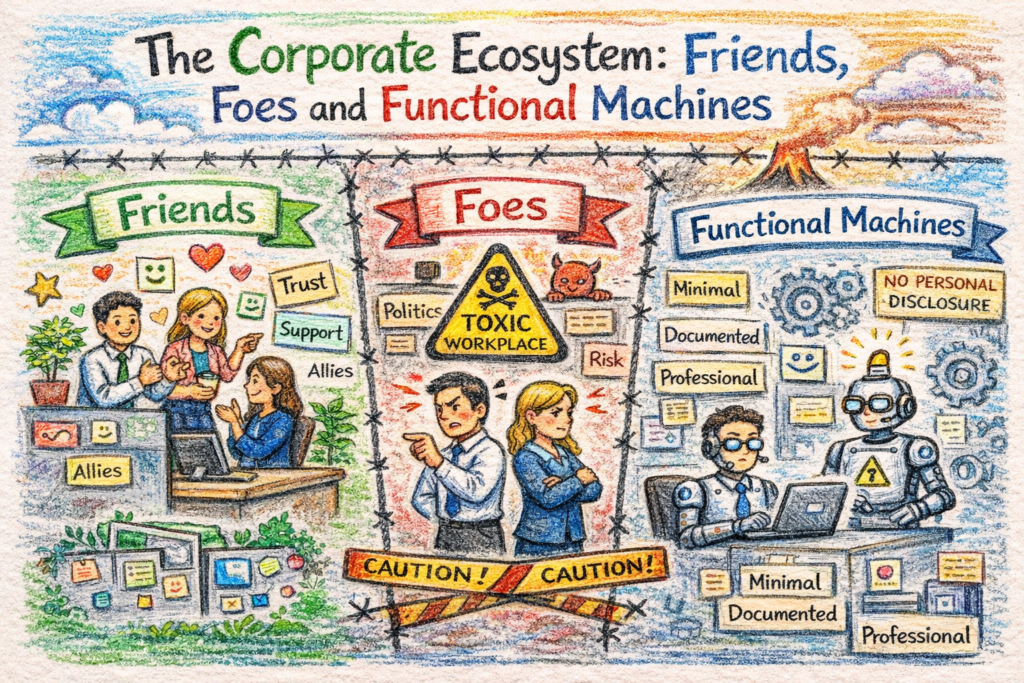
The modern workplace is often portrayed as a collaborative sanctuary, but for many, it is a “toxic” landscape fraught with political landmines and interpersonal friction. In such environments, the traditional advice of “bringing your whole self to work” can be a recipe for emotional burnout. To survive, organizational psychologists are increasingly advocating for a form of cognitive reappraisal: a strategy where employees categorize their colleagues not by personality, but by their functional utility and emotional risk. This involves a clear distinction between genuine allies and those who should be viewed merely as “functional machines.”
Genuine friendships at work act as a crucial buffer against the deleterious effects of a high-pressure environment. These “allies” provide psychological safety, allowing for the exchange of honest feedback and emotional support. However, the danger arises when an individual attempts to apply this same level of vulnerability to every member of the hierarchy. In a toxic culture, some individuals operate on a purely transactional or even predatory basis. For these “toxic actors,” empathy is a weakness to be exploited. Therefore, viewing them through a lens of human friendship is not only futile but professionally hazardous.
The concept of viewing a coworker as a “machine” is a form of psychological compartmentalization. By stripping away the expectation of human warmth or moral reciprocity from a toxic colleague, an employee can adopt a stance of rational detachment. When a “machine” colleague exhibits erratic behavior or delivers unfair criticism, it is processed not as a personal slight, but as a “system error” or an expected output of a faulty algorithm. This shift from emotional reaction to logical observation allows the observer to bypass the amygdala’s “fight or flight” response, maintaining a state of corporate stoicism.
Using logic as a shield involves strict boundary-setting. When interacting with “mechanical” coworkers, communication should be minimalist, documented, and devoid of personal disclosure. By treating these interactions as data exchanges rather than social engagements, one minimizes the “surface area” available for emotional harm. This does not imply being robotic or rude; rather, it is about maintaining a professional veneer that protects the underlying personal core. In this strategic framework, rationality becomes the ultimate insulation against the volatility of workplace toxicity.
Ultimately, the mastery of workplace survival lies in the ability to pivot between these two modes of interaction. While the “friends” provide the nutrients for career longevity and mental well-being, the “machines” define the boundaries of one’s resilience. Recognizing that not every human being in an office deserves a “human” response is not an act of coldness; it is a necessary evolution of professional self-preservation in the 21st century.
Volcabularies Recap
Click to Expand
| Term | Pronunciation | Root (Etymology) | Definition | Usage Context |
| A collaborative sanctuary | /kəˈlæb.ə.rə.tɪv ˈsæŋk.tʃu.er.i/ | Lat. collaborare (work together) + sanctuarium (sacred place) | A safe, supportive space where people work together without fear of judgment. | Team building, psychological safety in the workplace. |
| Advocating | /ˈæd.və.keɪ.tɪŋ/ | Lat. advocare (to call to one’s aid) | Publicly recommending or supporting a particular cause or policy. | Legal settings, social justice, or supporting a colleague’s idea. |
| Cognitive reappraisal | /ˈkɒɡ.nɪ.tɪv ˌriː.əˈpreɪ.zəl/ | Lat. cognoscere (get to know) + appretiare (to value) | An emotional regulation strategy that involves changing the way one thinks about a situation to alter its emotional impact. | Therapy (CBT), stress management, emotional intelligence. |
| The deleterious effects | /ˌdel.ɪˈtɪə.ri.əs ɪˈfekts/ | Gk. dēlētērios (harmful) | The damaging or harmful consequences of something. | Medical reports, discussing the impact of stress or pollution. |
| Futile | /ˈfjuː.taɪl/ | Lat. futilis (leaky, easily poured) | Incapable of producing any useful result; pointless. | Describing a failed project or an argument that cannot be won. |
| Professionally hazardous | /prəˈfeʃ.ən.əl.i ˈhæz.ər.dəs/ | Lat. professio (public declaration) + Old Fr. hasard (game of chance) | Likely to cause harm to one’s career, reputation, or standing in a job. | HR warnings, whistleblowing, or office politics. |
| Psychological compartmentalization | /ˌsaɪ.kəˈlɒdʒ.ɪ.kəl kəmˌpɑːrtˌmen.təl.əˈzeɪ.ʃən/ | Gk. psukhē (soul) + Lat. compartiri (to divide) | A defense mechanism where a person isolates conflicting thoughts or feelings to avoid mental discomfort. | Trauma recovery, work-life balance, or high-stress jobs. |
| Reciprocity | /ˌres.ɪˈprɒs.ə.ti/ | Lat. reciprocus (moving backward and forward) | The practice of exchanging things with others for mutual benefit. | Networking, social psychology, international trade. |
| A stance of rational detachment | /ə stæns əv ˈræʃ.ən.əl dɪˈtætʃ.mənt/ | Lat. ratio (reason) + Old Fr. destacher (unfasten) | An objective position where one remains calm and logical without being influenced by emotions. | Crisis management, negotiations, or medical practice. |
| Erratic behavior | /ɪˈræt.ɪk bɪˈheɪ.vjər/ | Lat. erraticus (wandering, straying) | Unpredictable, inconsistent, or irregular actions. | Mental health assessments, describing a malfunctioning machine or person. |
| Amygdala | /əˈmɪɡ.də.lə/ | Gk. amugdalē (almond) | An almond-shaped part of the brain involved with experiencing emotions, especially fear. | Neuroscience, discussing “fight or flight” responses. |
| Corporate stoicism | /ˈkɔːr.pər.ət ˈstoʊ.ɪ.sɪ.zəm/ | Lat. corporatus (formed into a body) + Gk. stoikos (philosophy of the porch) | A professional culture of remaining indifferent to pain or emotion; maintaining a “poker face” at work. | High-pressure environments like finance or law. |
| Devoid | /dɪˈvɔɪd/ | Old Fr. desvuidier (to empty) | Entirely lacking or free from (usually something desirable). | “The room was devoid of personality” or “devoid of logic.” |
| Veneer | /vəˈnɪər/ | Ger. furnieren (to provide) | A thin decorative covering or a deceptive outward appearance. | “A veneer of professionalism” (masking true anger or chaos). |
| Insulation | /ˌɪn.sjəˈleɪ.ʃən/ | Lat. insula (island) | Material used to stop the passage of heat/sound, or a barrier that protects someone from unpleasant influences. | Construction or protecting oneself from office gossip/stress. |
| Resilience | /rɪˈzɪl.jəns/ | Lat. resilire (to recoil or leap back) | The capacity to recover quickly from difficulties; toughness. | Personal growth, mental health, engineering. |
English Vietnamese Translation
The Corporate Ecosystem: Friends, Foes, and Functional Machines
A. The modern workplace is often portrayed as a collaborative sanctuary, but for many, it is a “toxic” landscape fraught with political landmines and interpersonal friction. In such environments, the traditional advice of “bringing your whole self to work” can be a recipe for emotional burnout. To survive, organizational psychologists are increasingly advocating for a form of cognitive reappraisal: a strategy where employees categorize their colleagues not by personality, but by their functional utility and emotional risk. This involves a clear distinction between genuine allies and those who should be viewed merely as “functional machines.”
B. Genuine friendships at work act as a crucial buffer against the deleterious effects of a high-pressure environment. These “allies” provide psychological safety, allowing for the exchange of honest feedback and emotional support. However, the danger arises when an individual attempts to apply this same level of vulnerability to every member of the hierarchy. In a toxic culture, some individuals operate on a purely transactional or even predatory basis. For these “toxic actors,” empathy is a weakness to be exploited. Therefore, viewing them through a lens of human friendship is not only futile but professionally hazardous.
C. The concept of viewing a coworker as a “machine” is a form of psychological compartmentalization. By stripping away the expectation of human warmth or moral reciprocity from a toxic colleague, an employee can adopt a stance of rational detachment. When a “machine” colleague exhibits erratic behavior or delivers unfair criticism, it is processed not as a personal slight, but as a “system error” or an expected output of a faulty algorithm. This shift from emotional reaction to logical observation allows the observer to bypass the amygdala’s “fight or flight” response, maintaining a state of corporate stoicism.
D. Using logic as a shield involves strict boundary-setting. When interacting with “mechanical” coworkers, communication should be minimalist, documented, and devoid of personal disclosure. By treating these interactions as data exchanges rather than social engagements, one minimizes the “surface area” available for emotional harm. This does not imply being robotic or rude; rather, it is about maintaining a professional veneer that protects the underlying personal core. In this strategic framework, rationality becomes the ultimate insulation against the volatility of workplace toxicity.
E. Ultimately, the mastery of workplace survival lies in the ability to pivot between these two modes of interaction. While the “friends” provide the nutrients for career longevity and mental well-being, the “machines” define the boundaries of one’s resilience. Recognizing that not every human being in an office deserves a “human” response is not an act of coldness; it is a necessary evolution of professional self-preservation in the 21st century.
Hệ sinh thái công sở: Bạn bè, Kẻ thù và Những “Cỗ máy chức năng”
A. Nơi làm việc hiện đại thường được khắc họa như một thánh đường cộng tác (collaborative sanctuary), nhưng với nhiều người, đó lại là một cảnh quan “độc hại” đầy rẫy những quả mìn chính trị và ma sát giữa cá nhân. Trong những môi trường như vậy, lời khuyên truyền thống về việc “mang toàn bộ con người thật đến công sở” có thể là công thức dẫn đến sự kiệt sức về cảm xúc. Để tồn tại, các nhà tâm lý học tổ chức đang ngày càng ủng hộ (advocating) một hình thức tái đánh giá nhận thức (cognitive reappraisal): một chiến lược mà nhân viên phân loại đồng nghiệp không phải theo tính cách, mà theo tiện ích chức năng và rủi ro cảm xúc của họ. Điều này bao gồm một sự phân biệt rõ ràng giữa những đồng minh thực sự và những người chỉ nên được xem đơn thuần là những “cỗ máy chức năng”.
B. Những tình bạn chân chính tại nơi làm việc đóng vai trò như một vùng đệm quan trọng chống lại những tác động có hại (the deleterious effects) của môi trường áp lực cao. Những “đồng minh” này cung cấp sự an toàn về tâm lý, cho phép trao đổi phản hồi trung thực và hỗ trợ cảm xúc. Tuy nhiên, nguy hiểm phát sinh khi một cá nhân cố gắng áp dụng mức độ bộc lộ bản thân tương tự với mọi thành viên trong hệ thống phân cấp. Trong một văn hóa độc hại, một số cá nhân hoạt động trên cơ sở thuần túy là giao dịch hoặc thậm chí là trục lợi. Đối với những “diễn viên độc hại” này, sự thấu cảm là một điểm yếu để khai thác. Do đó, việc nhìn nhận họ qua lăng kính tình bạn là không chỉ vô ích (futile) mà còn nguy hiểm về mặt nghề nghiệp (professionally hazardous).
C. Khái niệm xem đồng nghiệp như một “cỗ máy” là một hình thức ngăn cách tâm lý (psychological compartmentalization). Bằng cách tước bỏ kỳ vọng về sự ấm áp của con người hoặc sự có đi có lại về đạo đức (moral reciprocity) từ một đồng nghiệp độc hại, nhân viên có thể áp dụng một thái độ tách rời lý tính (a stance of rational detachment). Khi một đồng nghiệp “cỗ máy” bộc lộ hành vi thất thường (erratic behavior) hoặc đưa ra những lời chỉ trích bất công, nó được xử lý không phải như một sự xúc phạm cá nhân, mà là một “lỗi hệ thống” hoặc một đầu ra dự kiến của một thuật toán bị lỗi. Sự chuyển đổi từ phản ứng cảm xúc sang quan sát logic này cho phép người quan sát bỏ qua phản ứng “chiến hay chạy” của hạch hạnh nhân (amygdala), duy trì trạng thái khắc kỷ công sở (corporate stoicism).
D. Sử dụng logic như một lá chắn bao gồm việc thiết lập ranh giới nghiêm ngặt. Khi tương tác với các đồng nghiệp “máy móc”, việc giao tiếp nên ở mức tối giản, có văn bản chứng minh và thiếu vắng (devoid) sự tiết lộ cá nhân. Bằng cách coi những tương tác này là trao đổi dữ liệu thay vì cam kết xã hội, người ta giảm thiểu “diện tích bề mặt” có thể bị tổn thương về cảm xúc. Điều này không ngụ ý việc trở nên robot hay thô lỗ; thay vào đó, đó là việc duy trì một lớp vỏ (veneer) chuyên nghiệp bảo vệ cốt lõi cá nhân bên dưới. Trong khung chiến lược này, tính hợp lý trở thành lớp cách nhiệt (insulation) tối thượng chống lại sự biến động của độc tính nơi làm việc.
E. Cuối cùng, sự làm chủ việc tồn tại nơi công sở nằm ở khả năng xoay trục giữa hai chế độ tương tác này. Trong khi “những người bạn” cung cấp dưỡng chất cho sự bền bỉ trong sự nghiệp và sức khỏe tinh thần, thì “những cỗ máy” xác định ranh giới cho sự kiên cường (resilience) của mỗi người. Nhận ra rằng không phải mọi con người trong văn phòng đều xứng đáng nhận được một phản hồi “đậm chất người” không phải là một hành động lạnh lùng; đó là một sự tiến hóa cần thiết của việc tự bảo vệ bản thân chuyên nghiệp trong thế kỷ 21.