The Quiet Disillusionment of Fulfillment
There exists a widely held assumption that happiness is the natural consequence of achievement. From an early age, individuals are encouraged to define their aspirations in concrete terms: a stable and well-compensated career, a comfortable home, financial security, and a family life that reflects social ideals. These goals, once internalized, become the framework through which success is measured. Yet for many, the attainment of these very milestones in middle age gives rise not to contentment, but to a more ambiguous emotional state — one that is often difficult to articulate, yet persistently felt.
At first glance, this dissonance appears paradoxical. The conditions that were once imagined as the foundation of a fulfilling life have been realized. Material insecurity has been reduced, social expectations have been met, and the uncertainties of youth have largely been replaced by stability. However, it is precisely this transition — from striving to having — that reveals a subtle flaw in the original premise.
Desire, by its nature, is forward-oriented. It derives its intensity not from possession, but from anticipation. During youth, goals function as organizing principles, providing direction and meaning to daily effort. The future is imbued with promise, and the present is interpreted as a necessary step toward its realization. In this context, motivation and hope are closely intertwined.
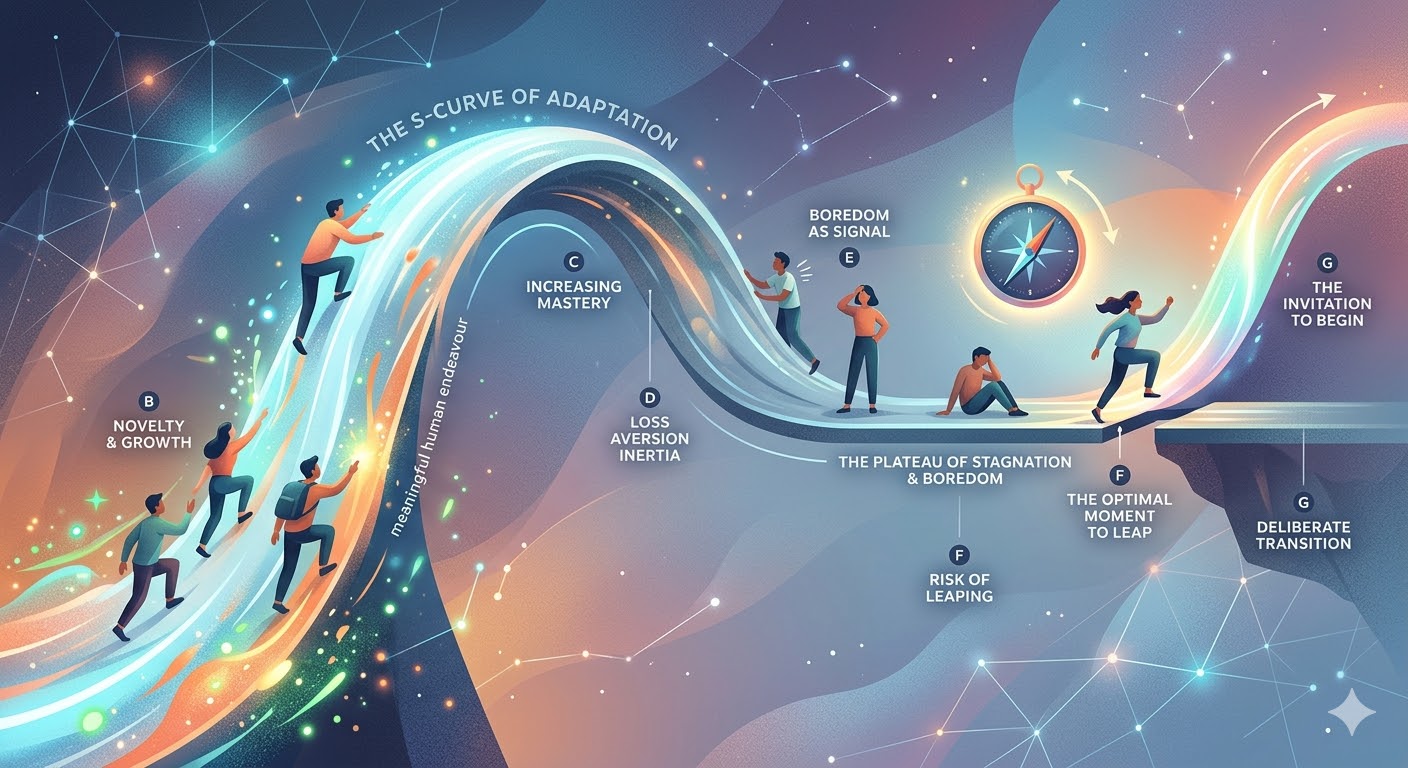
When these goals are eventually achieved, the psychological structure that sustained them begins to dissolve. The future, once a source of projection and possibility, becomes less defined. The individual is no longer moving toward something clearly articulated, but is instead situated within a condition that was previously imagined as an endpoint. What emerges is not failure, but a kind of existential plateau — a state in which the absence of striving creates an unexpected vacuum.
Compounding this effect is the phenomenon of adaptation. Human beings possess a remarkable capacity to normalize their circumstances, regardless of how desirable those circumstances may once have appeared. The house that once symbolized success becomes simply the place one lives. The income that once represented security becomes the baseline against which new concerns are measured. Over time, what was once extraordinary becomes ordinary, and the emotional intensity associated with its attainment gradually diminishes.
There is also a deeper question concerning the origin of these goals. Many of the aspirations pursued in youth are not entirely self-generated but are shaped by cultural narratives and social expectations. The ideal of a “successful life” is often inherited rather than critically examined. As individuals reach middle age, they may begin to recognize that the life they have constructed, while objectively successful, does not fully align with their internal values or evolving sense of meaning.
This realization does not necessarily manifest as dramatic dissatisfaction. More often, it takes the form of a quiet unease — a sense that something is missing, despite the apparent completeness of one’s circumstances. The absence is not material but existential. It reflects a gap between external achievement and internal fulfillment, between what has been attained and what genuinely matters.
Moreover, the constraints of middle age further complicate this dynamic. Responsibilities — professional, familial, and financial — limit the flexibility to radically redefine one’s path. The possibility of starting anew, which seemed readily available in youth, now appears constrained by accumulated commitments. As a result, individuals may find themselves inhabiting lives that are both secure and subtly confining.
Yet this condition need not be interpreted solely in negative terms. It can also represent a critical point of reflection — an opportunity to reassess the assumptions that have guided one’s life thus far. The recognition that achievement alone does not guarantee fulfillment may prompt a shift in perspective, from external validation to internal coherence. Rather than pursuing additional goals of the same kind, individuals may begin to seek experiences that emphasize meaning, connection, and presence.
Ultimately, the dissatisfaction of middle age reveals a fundamental truth about human well-being: that happiness is not a fixed destination reached through accumulation, but a dynamic process shaped by alignment between one’s values, actions, and experiences. The goals of youth may provide direction, but they cannot, on their own, sustain a sense of purpose indefinitely. To live well, it may be necessary not only to achieve, but to continually redefine what achievement itself means.