Human existence is not sustained by material conditions alone. While food, shelter, and security form the biological foundation of life, they do not fully account for the persistence of human striving. Across cultures and historical periods, individuals have demonstrated a remarkable capacity to endure hardship, uncertainty, and even suffering — not merely because survival demands it, but because they are oriented toward something beyond their present condition. This orientation often takes the form of an imagined future: a vision of a life that is more coherent, more fulfilling, or simply more bearable than the one currently lived.
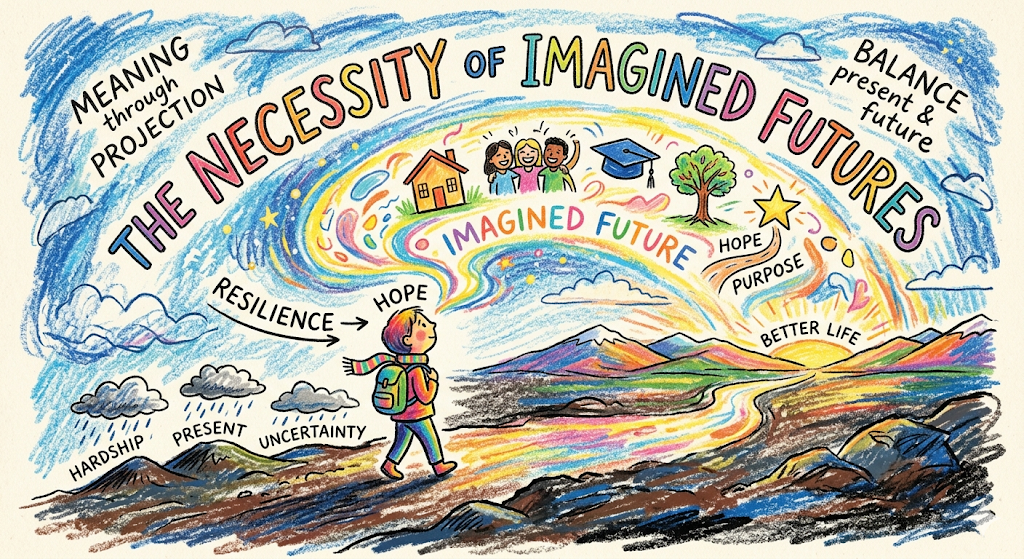
Such visions are not always grand or utopian. They may be modest and deeply personal — the hope of stability, the anticipation of meaningful relationships, or the belief that one’s efforts will eventually yield a sense of purpose. Yet regardless of their scale, these imagined futures exert a powerful psychological force. They organize perception, guide decision-making, and, perhaps most importantly, render present difficulties intelligible. Hardship, when framed as a step toward a desired future, becomes more than mere suffering; it acquires narrative significance.
This phenomenon suggests that meaning is not located exclusively in present experience but is, in part, constructed through temporal projection. To live is not simply to respond to immediate stimuli, but to situate oneself within a trajectory — a movement from what is toward what might be. In this sense, the future functions not only as a destination but as a structuring principle for the present.
However, the reliance on imagined futures introduces a subtle tension. If the value of the present is derived primarily from its relationship to a better future, then the present risks becoming instrumentalized. Life is experienced less as something to be lived in its own right and more as a preparatory phase for something else. The danger here is not merely postponement, but a form of existential deferral in which fulfillment is perpetually relocated to a horizon that is never fully reached.
Yet to reject future-oriented thinking altogether would be equally problematic. Without some projection beyond the present, motivation itself begins to erode. The absence of a meaningful future can give rise to stagnation, apathy, or even despair. In such conditions, the present loses its structure, becoming a series of disconnected moments lacking coherence or direction.
The challenge, therefore, lies in negotiating the relationship between present experience and future aspiration. A vision of a better life can function as a source of resilience, enabling individuals to persist through difficulty and uncertainty. At the same time, it must not become so dominant that it eclipses the intrinsic value of the present moment. The imagined future should illuminate the present, not overshadow it.
This balance is neither simple nor stable. It requires a continuous recalibration of expectations, desires, and priorities. As circumstances change, so too must the visions that guide them. What once served as a motivating ideal may, over time, become a constraint if it no longer aligns with one’s evolving understanding of a meaningful life.
Ultimately, the role of imagined futures reveals something fundamental about human nature. To exist is not merely to occupy the present, but to extend oneself beyond it — to inhabit possibilities that have not yet materialized. Whether these possibilities are ever fully realized may be less important than the fact that they are envisioned at all. For in the act of imagining a better life, individuals do not simply anticipate the future; they create the very conditions that make endurance, effort, and meaning possible in the present.