The Seduction of Street Food
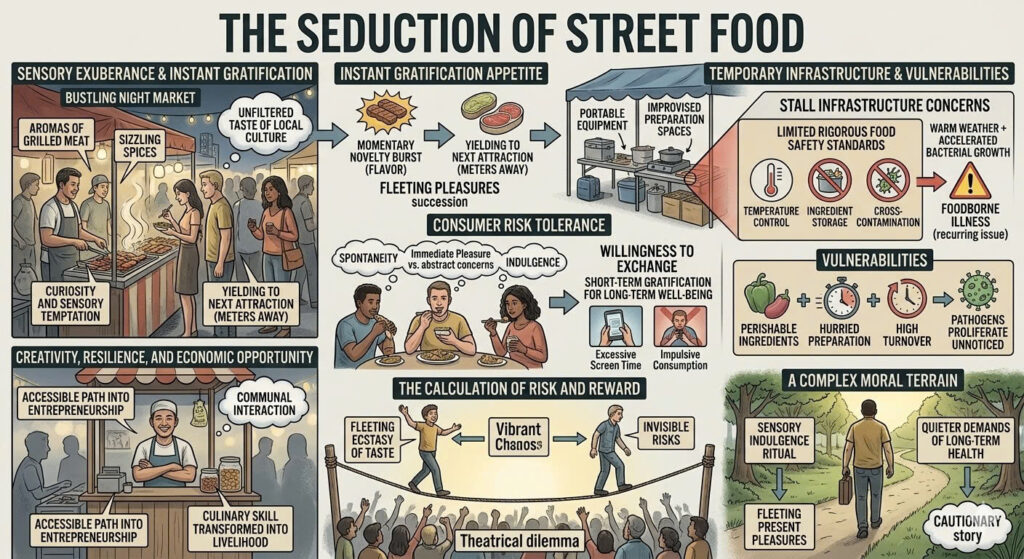
Few experiences capture the sensory exuberance of urban life quite like a bustling street food market. Aromas of grilled meat, sizzling spices, and caramelizing sugar drift through narrow alleyways, drawing crowds toward stalls where cooks work with rapid, almost theatrical precision. For many city dwellers and travelers alike, street food represents authenticity — an unfiltered taste of local culture that seems far removed from the sterile uniformity of chain restaurants.
Yet this celebration of immediacy conceals a subtle paradox. Street food markets thrive precisely because they appeal to the human appetite for instant gratification. Unlike formal dining, which unfolds slowly within controlled environments, street food invites impulsive consumption. One wanders through the crowd, sampling dish after dish, guided less by hunger than by curiosity and sensory temptation. The experience is less a meal than a succession of fleeting pleasures.
This pattern reflects a broader feature of contemporary consumer culture: the prioritization of immediacy over deliberation. In the same way that social media rewards rapid attention shifts, food festivals encourage rapid indulgence. The psychological mechanism is straightforward. Each dish offers a momentary burst of novelty — a spike of flavor that briefly captures the senses before yielding to the next attraction a few meters away.
However, the very conditions that make street food appealing can also create vulnerabilities. Temporary stalls often operate with limited infrastructure, relying on portable equipment and improvised preparation spaces. Under such circumstances, maintaining rigorous food safety standards becomes considerably more challenging than in conventional kitchens. Temperature control, ingredient storage, and cross-contamination are constant concerns, particularly when large crowds and warm weather combine to accelerate bacterial growth.
None of this implies that street food is inherently unsafe. In many parts of the world, vendors possess generations of culinary knowledge and take considerable pride in their craft. Nevertheless, foodborne illness remains a recurring issue at crowded festivals and night markets. The combination of perishable ingredients, hurried preparation, and high turnover can produce conditions in which pathogens proliferate unnoticed.
What makes this risk especially intriguing is the way in which consumers appear to accept it — often implicitly — as part of the experience. The same spontaneity that defines street food culture also encourages a degree of risk tolerance. When confronted with the choice between caution and indulgence, many diners choose the latter. The promise of immediate pleasure outweighs abstract concerns about possible consequences hours later.
This willingness to exchange long-term well-being for short-term gratification is hardly unique to food culture. It mirrors patterns visible across modern life, from excessive screen time to impulsive consumption. Yet street food markets make this trade-off unusually visible. In the vibrant chaos of a food fair — where laughter, music, and fragrant smoke mingle in the air — the calculus of risk and reward becomes almost theatrical.
Still, the story is not purely cautionary. Street food also embodies creativity, resilience, and economic opportunity. For many vendors, a small stall represents an accessible path into entrepreneurship, enabling individuals to transform culinary skill into livelihood. Moreover, the social atmosphere of street markets fosters communal interaction in ways that formal dining often cannot replicate.
Thus, the street food phenomenon occupies a complex moral terrain. It is at once a celebration of culinary diversity and a reminder of the compromises embedded within modern pleasure-seeking. To wander through a night market is to participate, however briefly, in a ritual of sensory indulgence — one that invites the individual to weigh the delights of the present moment against the quieter demands of long-term health.
In the end, the allure of street food may lie precisely in this tension. Amid the laughter of crowds and the glow of neon lights, diners confront a familiar human dilemma: whether the fleeting ecstasy of taste is worth the invisible risks that sometimes accompany it.
Audio
Volcabulary Recap
Click to expand …
| Term | Pronunciation | Root | Definition | Vietnamese Translation | Usage Example |
| Sensory exuberance | /ˈsen.sər.i ɪɡˈzjuː.bər.əns/ | Latin sensus (feel) + exuberare (be fruitful) | A high degree of energy or excitement related to the five senses. | Sự bùng nổ của các giác quan | The night market offered a sensory exuberance of bright lights and loud music. |
| Bustling | /ˈbʌs.lɪŋ/ | Middle English bustelen (to move noisily) | Full of energetic and noisy activity. | Nhộn nhịp / Hối hả | The bustling streets of the city never seem to sleep. |
| Dazzling spices | /ˈdæz.lɪŋ spaɪ.sɪz/ | Old Norse dasask (to tire) + Latin species | Spices that are impressively bright in color or strikingly intense in flavor. | Những loại gia vị rực rỡ/ấn tượng | The curry was seasoned with dazzling spices that colored the rice vibrant yellow. |
| Subtle paradox | /ˈsʌt.əl ˈpær.ə.dɒks/ | Latin subtilis (fine) + Greek paradoxon | A situation that seems contradictory but is true in a delicate, not obvious way. | Nghịch lý tinh tế | It is a subtle paradox that the more choices we have, the harder it is to decide. |
| Impulsive consumption | /ɪmˈpʌl.sɪv kənˈsʌmp.ʃən/ | Latin impulsus (pushed) + consumere | The act of buying or eating things quickly without prior planning. | Sự tiêu dùng nhất thời/bốc đồng | The low prices at the stall encouraged impulsive consumption. |
| Sensory temptation | /ˈsen.sər.i tempˈteɪ.ʃən/ | Latin temptare (to handle/test) | Something that attracts the senses and makes one want to have it. | Sự cám dỗ của các giác quan | The smell of fresh bread is a powerful sensory temptation. |
| Immediacy | /ɪˈmiː.di.ə.si/ | Latin immediatus (without anything between) | The quality of happening right now; directness. | Sự tức thì / Tính trực tiếp | Live theater has an immediacy that recorded movies lack. |
| Deliberation | /dɪˌlɪb.əˈreɪ.ʃən/ | Latin deliberare (to weigh well) | Long and careful consideration or discussion. | Sự cân nhắc kỹ lưỡng | After much deliberation, they decided to move to a new country. |
| Indulgence | /ɪnˈdʌl.dʒəns/ | Latin indulgere (be kind to/yield to) | Allowing oneself to enjoy something special or unhealthy. | Sự nuông chiều bản thân | Buying the expensive watch was a rare indulgence for him. |
| Improvised preparation | /ˈɪm.prə.vaɪzd/ | Latin im-providus (not foreseen) | The act of making or doing something without preparation, using whatever is available. | Sự chuẩn bị ngẫu hứng | Cooking over a campfire requires a bit of improvised preparation. |
| Rigorous | /ˈrɪɡ.ər.əs/ | Latin rigere (be stiff) | Extremely thorough, exhaustive, or accurate. | Nghiêm ngặt / Khắt khe | The pilots underwent rigorous training before their first flight. |
| Conventional kitchen | /kənˈven.ʃən.əl/ | Latin convenire (come together) | A standard, traditional indoor kitchen with fixed appliances. | Nhà bếp truyền thống | He found it hard to cook street food in a conventional kitchen. |
| Perishable ingredient | /ˈper.ɪ.ʃə.bəl/ | Latin perire (pass away/die) | Food items that are likely to decay or go bad quickly (e.g., meat, milk). | Nguyên liệu dễ hỏng | Seafood is a highly perishable ingredient that must be kept on ice. |
| Pathogens | /ˈpæθ.ə.dʒənz/ | Greek pathos (suffering) + genes (born) | Bacterias, viruses, or other microorganisms that can cause disease. | Các tác nhân gây bệnh | Proper handwashing is essential to eliminate pathogens in the kitchen. |
| Vibrant chaos | /ˈvaɪ.brənt ˈkeɪ.ɒs/ | Latin vibrare + Greek khaos | A state of complete confusion or disorder that is full of life and energy. | Sự hỗn loạn đầy sức sống | The festival was a scene of vibrant chaos, with dancing and music everywhere. |
| Theatrical | /θiˈæt.rɪ.kəl/ | Greek theatron (theater) | Exaggerated or dramatic, often as if performing for an audience. | Có tính sân khấu / Kịch tính | The chef’s theatrical style of flipping noodles attracted a large crowd. |
| Resilience | /rɪˈzɪl.i.əns/ | Latin resilire (to recoil/jump back) | The capacity to recover quickly from difficulties; toughness. | Sự kiên cường / Khả năng phục hồi | The small business showed great resilience during the economic crisis. |
| Moral terrain | /ˈmɒr.əl təˈreɪn/ | Latin mos (custom) + terra (earth) | The complex landscape of ethical decisions and values. | Bình diện đạo đức | The debate over AI ethics enters difficult moral terrain. |
| Allure of street food | /əˈljʊər/ | Old French alurer (to bait) | The quality of being powerfully and mysteriously attractive or fascinating. | Sự lôi cuốn của thức ăn đường phố | The allure of street food lies in its speed, taste, and social atmosphere. |
| Human dilemma | /hjuː.mən dɪˈlem.ə/ | Greek di- (twice) + lemma (premise) | A difficult situation in which a choice has to be made between two undesirable options. | Tình thế tiến thoái lưỡng nan của con người | Choosing between job security and following one’s passion is a classic human dilemma. |
English Vietnamese Translation
Click to expand …
The Seduction of Street Food
Few experiences capture the sensory exuberance of urban life quite like a bustling street food market. Aromas of grilled meat, sizzling spices, and caramelizing sugar drift through narrow alleyways, drawing crowds toward stalls where cooks work with rapid, almost theatrical precision. For many city dwellers and travelers alike, street food represents authenticity — an unfiltered taste of local culture that seems far removed from the sterile uniformity of chain restaurants.
Yet this celebration of immediacy conceals a subtle paradox. Street food markets thrive precisely because they appeal to the human appetite for instant gratification. Unlike formal dining, which unfolds slowly within controlled environments, street food invites impulsive consumption. One wanders through the crowd, sampling dish after dish, guided less by hunger than by curiosity and sensory temptation. The experience is less a meal than a succession of fleeting pleasures.
This pattern reflects a broader feature of contemporary consumer culture: the prioritization of immediacy over deliberation. In the same way that social media rewards rapid attention shifts, food festivals encourage rapid indulgence. The psychological mechanism is straightforward. Each dish offers a momentary burst of novelty — a spike of flavor that briefly captures the senses before yielding to the next attraction a few meters away.
However, the very conditions that make street food appealing can also create vulnerabilities. Temporary stalls often operate with limited infrastructure, relying on portable equipment and improvised preparation spaces. Under such circumstances, maintaining rigorous food safety standards becomes considerably more challenging than in conventional kitchens. Temperature control, ingredient storage, and cross-contamination are constant concerns, particularly when large crowds and warm weather combine to accelerate bacterial growth.
None of this implies that street food is inherently unsafe. In many parts of the world, vendors possess generations of culinary knowledge and take considerable pride in their craft. Nevertheless, foodborne illness remains a recurring issue at crowded festivals and night markets. The combination of perishable ingredients, hurried preparation, and high turnover can produce conditions in which pathogens proliferate unnoticed.
What makes this risk especially intriguing is the way in which consumers appear to accept it — often implicitly — as part of the experience. The same spontaneity that defines street food culture also encourages a degree of risk tolerance. When confronted with the choice between caution and indulgence, many diners choose the latter. The promise of immediate pleasure outweighs abstract concerns about possible consequences hours later.
This willingness to exchange long-term well-being for short-term gratification is hardly unique to food culture. It mirrors patterns visible across modern life, from excessive screen time to impulsive consumption. Yet street food markets make this trade-off unusually visible. In the vibrant chaos of a food fair — where laughter, music, and fragrant smoke mingle in the air — the calculus of risk and reward becomes almost theatrical.
Still, the story is not purely cautionary. Street food also embodies creativity, resilience, and economic opportunity. For many vendors, a small stall represents an accessible path into entrepreneurship, enabling individuals to transform culinary skill into livelihood. Moreover, the social atmosphere of street markets fosters communal interaction in ways that formal dining often cannot replicate.
Thus, the street food phenomenon occupies a complex moral terrain. It is at once a celebration of culinary diversity and a reminder of the compromises embedded within modern pleasure-seeking. To wander through a night market is to participate, however briefly, in a ritual of sensory indulgence — one that invites the individual to weigh the delights of the present moment against the quieter demands of long-term health.
In the end, the allure of street food may lie precisely in this tension. Amid the laughter of crowds and the glow of neon lights, diners confront a familiar human dilemma: whether the fleeting ecstasy of taste is worth the invisible risks that sometimes accompany it.
Sự Quyến Rũ của Ẩm Thực Đường Phố
Hiếm có trải nghiệm nào lột tả được sự phong phú về cảm giác của đời sống đô thị rõ nét như một khu chợ ẩm thực đường phố sầm uất. Hương thơm của thịt nướng, gia vị xèo xèo trên chảo và đường caramen lan tỏa qua những con ngõ hẹp, thu hút đám đông về phía những quầy hàng nơi người nấu làm việc với sự chính xác nhanh nhẹn, gần như mang tính trình diễn. Đối với nhiều cư dân thành thị cũng như khách du lịch, ẩm thực đường phố đại diện cho tính nguyên bản — một hương vị không lọc qua màng ngăn của văn hóa địa phương, dường như khác xa với sự đồng nhất vô trùng của các chuỗi nhà hàng.
Tuy nhiên, sự tôn vinh tính tức thời này lại che giấu một nghịch lý tinh vi. Các khu chợ ẩm thực đường phố phát triển mạnh mẽ chính vì chúng đánh vào khao khát của con người đối với sự thỏa mãn tức thì (instant gratification). Không giống như việc dùng bữa chính quy vốn diễn ra chậm rãi trong môi trường được kiểm soát, ẩm thực đường phố mời gọi sự tiêu thụ bốc đồng. Người ta lang thang trong đám đông, nếm thử hết món này đến món khác, được dẫn dắt không phải bởi cơn đói mà bởi sự tò mò và sự cám dỗ của giác quan. Trải nghiệm này ít giống một bữa ăn mà giống một chuỗi những khoái lạc thoáng qua hơn.
Mô hình này phản ánh một đặc điểm rộng lớn hơn của văn hóa tiêu dùng đương đại: ưu tiên tính tức thời hơn sự cân nhắc. Giống như cách mà mạng xã hội thưởng cho việc thay đổi sự chú ý nhanh chóng, các lễ hội ẩm thực khuyến khích sự nuông chiều bản thân chớp nhoáng. Cơ chế tâm lý rất đơn giản: mỗi món ăn mang lại một luồng hưng phấn mới lạ nhất thời — một đỉnh cao hương vị chiếm lĩnh các giác quan trong chốc lát trước khi nhường chỗ cho sự thu hút tiếp theo chỉ cách đó vài mét.
Tuy nhiên, chính những điều kiện làm cho ẩm thực đường phố trở nên hấp dẫn cũng có thể tạo ra những lỗ hổng. Các quầy hàng tạm thời thường vận hành với cơ sở hạ tầng hạn chế, dựa vào thiết bị di động và không gian chế biến ứng biến. Trong những hoàn cảnh đó, việc duy trì các tiêu chuẩn an toàn thực phẩm nghiêm ngặt trở nên thách thức hơn đáng kể so với trong các nhà bếp truyền thống. Kiểm soát nhiệt độ, bảo quản nguyên liệu và nhiễm chéo là những mối lo ngại thường trực, đặc biệt khi đám đông lớn và thời tiết ấm áp kết hợp lại làm tăng tốc độ phát triển của vi khuẩn.
Điều này không có nghĩa là ẩm thực đường phố vốn dĩ không an toàn. Ở nhiều nơi trên thế giới, những người bán hàng sở hữu kiến thức ẩm thực qua nhiều thế hệ và vô cùng tự hào về tay nghề của mình. Tuy nhiên, ngộ độc thực phẩm vẫn là một vấn đề tái diễn tại các lễ hội đông đúc và chợ đêm. Sự kết hợp giữa nguyên liệu dễ hỏng, việc chuẩn bị vội vàng và tốc độ luân chuyển khách cao có thể tạo ra các điều kiện cho mầm bệnh phát triển mà không bị phát hiện.
Điều khiến rủi ro này trở nên đặc biệt thú vị là cách người tiêu dùng dường như chấp nhận nó — thường là ngầm định — như một phần của trải nghiệm. Chính sự ngẫu hứng định nghĩa nên văn hóa ẩm thực đường phố cũng khuyến khích một mức độ chấp nhận rủi ro nhất định. Khi đối mặt với sự lựa chọn giữa thận trọng và nuông chiều, nhiều thực khách chọn vế sau. Lời hứa về sự thỏa mãn tức thì lấn át những lo ngại mơ hồ về những hậu quả có thể xảy ra vài giờ sau đó.
Sự sẵn lòng trao đổi phúc lợi dài hạn lấy khoái lạc ngắn hạn này không chỉ tồn tại duy nhất trong văn hóa thực phẩm. Nó phản chiếu các mô hình hiển hiện trong khắp đời sống hiện đại, từ việc sử dụng màn hình quá mức đến tiêu dùng bốc đồng. Tuy nhiên, các khu chợ ẩm thực đường phố làm cho sự đánh đổi này trở nên rõ rệt một cách bất thường. Trong sự hỗn loạn sôi động của một hội chợ thực phẩm — nơi tiếng cười, âm nhạc và khói thơm hòa quyện trong không trung — phép tính rủi ro và phần thưởng trở nên gần như mang tính kịch nghệ.
Tuy vậy, câu chuyện không hoàn toàn chỉ mang tính cảnh báo. Ẩm thực đường phố cũng hiện thực hóa sự sáng tạo, khả năng phục hồi và cơ hội kinh tế. Đối với nhiều người bán hàng, một quầy hàng nhỏ đại diện cho một con đường dễ tiếp cận vào tinh thần khởi nghiệp, cho phép các cá nhân biến kỹ năng nấu nướng thành sinh kế. Hơn nữa, bầu không khí xã hội của các khu chợ đường phố thúc đẩy tương tác cộng đồng theo những cách mà việc dùng bữa chính quy thường không thể sao chép được.
Vì vậy, hiện tượng ẩm thực đường phố chiếm giữ một vùng địa hình đạo đức phức tạp. Nó vừa là sự tôn vinh đa dạng ẩm thực, vừa là lời nhắc nhở về những sự thỏa hiệp nằm sâu trong việc tìm kiếm khoái lạc hiện đại. Lang thang qua một khu chợ đêm là tham gia, dù chỉ ngắn ngủi, vào một nghi lễ nuông chiều giác quan — một nghi lễ mời gọi cá nhân cân nhắc giữa những lạc thú của khoảnh khắc hiện tại với những đòi hỏi lặng lẽ của sức khỏe dài hạn.
Cuối cùng, sức quyến rũ của ẩm thực đường phố có thể nằm chính ở sự căng thẳng này. Giữa tiếng cười của đám đông và ánh đèn neon rực rỡ, thực khách đối mặt với một tình thế tiến thoái lưỡng nan quen thuộc của con người: liệu sự ngây ngất thoáng qua của vị giác có đáng giá với những rủi ro vô hình đôi khi đi kèm với nó hay không.