The Limits of Minimalism
In recent years, minimalism has emerged as a cultural movement promising liberation from the excesses of modern consumer society. Its advocates argue that by reducing possessions, commitments, and distractions, individuals can reclaim a more meaningful existence. The philosophy appears deceptively simple: own less, desire less, and life will become clearer, calmer, and more fulfilling. Yet beneath this appealing clarity lies a deeper philosophical question — whether a deliberately simplified life is genuinely capable of delivering what philosophers once described as the good whole life.
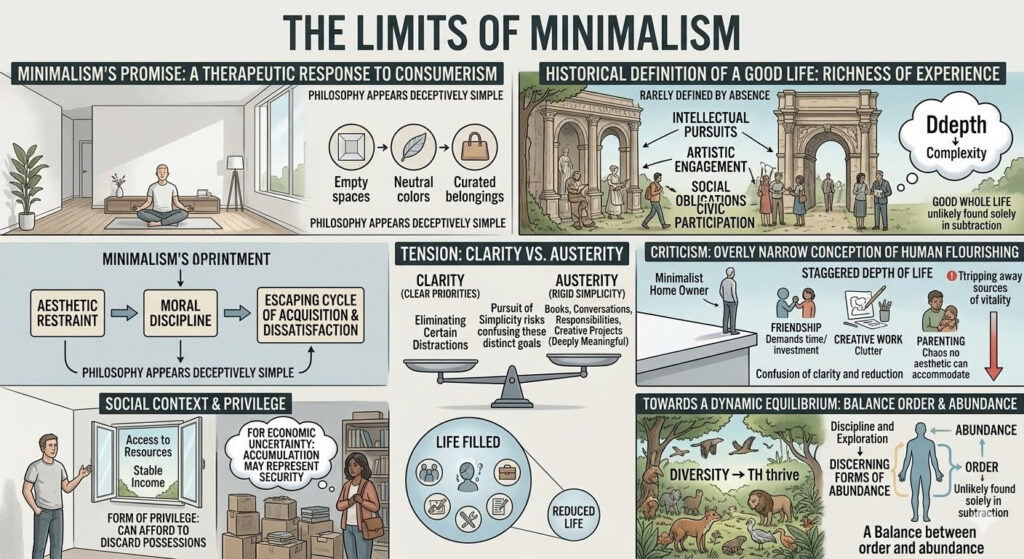
Minimalism, in its contemporary form, often presents itself as a corrective to consumerism. Modern economies encourage constant acquisition, framing identity through material accumulation. Against this backdrop, the minimalist response feels almost therapeutic. Empty spaces, neutral colors, and carefully curated belongings symbolize not merely aesthetic restraint but moral discipline. The minimalist home becomes a visible declaration that the owner has escaped the endless cycle of acquisition and dissatisfaction.
However, critics argue that this narrative rests on an overly narrow conception of human flourishing. Historically, the idea of a good life has rarely been defined by absence. Classical philosophical traditions — from ancient Greek ethics to later humanistic thought — emphasized richness of experience rather than its reduction. A fulfilling life was expected to include intellectual pursuits, artistic engagement, social obligations, and civic participation. Such forms of activity inevitably generate complexity rather than simplicity.
This observation raises an important tension. The minimalist pursuit of simplicity often involves eliminating what are perceived as unnecessary burdens: possessions, social commitments, even ambitions. Yet many of the elements that complicate life are precisely those that give it depth. Friendship demands time and emotional investment. Creative work generates clutter — both literal and mental. Parenthood introduces chaos that no minimalist aesthetic can fully accommodate.
In this sense, minimalism risks confusing two distinct goals: clarity and reduction. A life organized around clear priorities may indeed require eliminating certain distractions. But clarity does not necessarily entail austerity. One might lead a life filled with books, conversations, responsibilities, and creative projects — a life that appears crowded yet remains deeply meaningful. The pursuit of simplicity, if interpreted too rigidly, may inadvertently strip away precisely those sources of vitality.
Another criticism concerns the social context in which minimalism flourishes. The ability to embrace simplicity is often itself a form of privilege. Those with stable incomes, secure housing, and access to resources can afford to discard possessions because they retain the capacity to replace them when necessary. For individuals living with economic uncertainty, accumulation may represent security rather than excess.
This does not mean that minimalism lacks value. The movement has illuminated genuine problems within contemporary consumer culture: environmental waste, psychological stress, and the illusion that happiness can be purchased indefinitely. Its emphasis on intentional living encourages individuals to examine their habits rather than passively adopting societal norms.
Yet the deeper philosophical challenge remains unresolved. A good life may not be best understood as a minimalist composition but as a dynamic equilibrium — a balance between order and abundance, discipline and exploration. Just as ecosystems thrive through diversity rather than uniform simplicity, human lives may flourish through a similar richness of experiences.
Thus, while minimalism offers a compelling critique of excess, it may be less convincing as a universal prescription. The good whole life is unlikely to be found solely in subtraction. Instead, it may emerge from a more complex process: discerning which forms of abundance enrich our existence and which merely distract from it.
Audio
Special Talk
Volcabulary Recap
Click to expand …
English Vietnamese Translation
Click to expand …
The Limits of Minimalism
In recent years, minimalism has emerged as a cultural movement promising liberation from the excesses of modern consumer society. Its advocates argue that by reducing possessions, commitments, and distractions, individuals can reclaim a more meaningful existence. The philosophy appears deceptively simple: own less, desire less, and life will become clearer, calmer, and more fulfilling. Yet beneath this appealing clarity lies a deeper philosophical question — whether a deliberately simplified life is genuinely capable of delivering what philosophers once described as the good whole life.
Minimalism, in its contemporary form, often presents itself as a corrective to consumerism. Modern economies encourage constant acquisition, framing identity through material accumulation. Against this backdrop, the minimalist response feels almost therapeutic. Empty spaces, neutral colors, and carefully curated belongings symbolize not merely aesthetic restraint but moral discipline. The minimalist home becomes a visible declaration that the owner has escaped the endless cycle of acquisition and dissatisfaction.
However, critics argue that this narrative rests on an overly narrow conception of human flourishing. Historically, the idea of a good life has rarely been defined by absence. Classical philosophical traditions — from ancient Greek ethics to later humanistic thought — emphasized richness of experience rather than its reduction. A fulfilling life was expected to include intellectual pursuits, artistic engagement, social obligations, and civic participation. Such forms of activity inevitably generate complexity rather than simplicity.
This observation raises an important tension. The minimalist pursuit of simplicity often involves eliminating what are perceived as unnecessary burdens: possessions, social commitments, even ambitions. Yet many of the elements that complicate life are precisely those that give it depth. Friendship demands time and emotional investment. Creative work generates clutter — both literal and mental. Parenthood introduces chaos that no minimalist aesthetic can fully accommodate.
In this sense, minimalism risks confusing two distinct goals: clarity and reduction. A life organized around clear priorities may indeed require eliminating certain distractions. But clarity does not necessarily entail austerity. One might lead a life filled with books, conversations, responsibilities, and creative projects — a life that appears crowded yet remains deeply meaningful. The pursuit of simplicity, if interpreted too rigidly, may inadvertently strip away precisely those sources of vitality.
Another criticism concerns the social context in which minimalism flourishes. The ability to embrace simplicity is often itself a form of privilege. Those with stable incomes, secure housing, and access to resources can afford to discard possessions because they retain the capacity to replace them when necessary. For individuals living with economic uncertainty, accumulation may represent security rather than excess.
This does not mean that minimalism lacks value. The movement has illuminated genuine problems within contemporary consumer culture: environmental waste, psychological stress, and the illusion that happiness can be purchased indefinitely. Its emphasis on intentional living encourages individuals to examine their habits rather than passively adopting societal norms.
Yet the deeper philosophical challenge remains unresolved. A good life may not be best understood as a minimalist composition but as a dynamic equilibrium — a balance between order and abundance, discipline and exploration. Just as ecosystems thrive through diversity rather than uniform simplicity, human lives may flourish through a similar richness of experiences.
Thus, while minimalism offers a compelling critique of excess, it may be less convincing as a universal prescription. The good whole life is unlikely to be found solely in subtraction. Instead, it may emerge from a more complex process: discerning which forms of abundance enrich our existence and which merely distract from it.
Những Giới Hạn của Chủ Nghĩa Tối Giản
Trong những năm gần đây, chủ nghĩa tối giản đã trỗi dậy như một phong trào văn hóa hứa hẹn sự giải phóng khỏi những thái quá của xã hội tiêu dùng hiện đại. Những người ủng hộ lập luận rằng bằng cách cắt giảm tài sản, các cam kết và sự xao nhãng, cá nhân có thể đòi lại một sự tồn tại ý nghĩa hơn. Triết lý này có vẻ đơn giản một cách đánh lừa: sở hữu ít đi, ham muốn ít lại, và cuộc sống sẽ trở nên rõ ràng hơn, bình lặng hơn và trọn vẹn hơn. Tuy nhiên, đằng sau sự rõ ràng đầy hấp dẫn đó ẩn chứa một câu hỏi triết học sâu sắc hơn — liệu một cuộc sống được đơn giản hóa có chủ đích có thực sự đủ khả năng mang lại điều mà các triết gia từng mô tả là “một cuộc đời tốt đẹp toàn diện”?
Chủ nghĩa tối giản, trong hình thái đương đại của nó, thường tự trình diện như một phương thuốc điều chỉnh cho chủ nghĩa tiêu dùng. Các nền kinh tế hiện đại khuyến khích sự chiếm hữu liên tục, định hình bản sắc thông qua việc tích lũy vật chất. Trong bối cảnh đó, phản ứng tối giản tạo cảm giác gần như là một liệu pháp chữa lành. Những không gian trống trải, màu sắc trung tính và những đồ đạc được chọn lọc kỹ lưỡng không chỉ tượng trưng cho sự tiết chế về thẩm mỹ mà còn là kỷ luật đạo đức. Ngôi nhà tối giản trở thành một tuyên ngôn hữu hình rằng chủ nhân của nó đã thoát khỏi vòng lặp vô tận của sự chiếm hữu và bất mãn.
Shutterstock
Tuy nhiên, các nhà phê bình lập luận rằng câu chuyện này dựa trên một quan niệm quá hẹp về sự thăng hoa của con người. Về mặt lịch sử, ý tưởng về một cuộc sống tốt đẹp hiếm khi được định nghĩa bằng sự vắng bóng. Các truyền thống triết học cổ điển — từ đạo đức học Hy Lạp cổ đại đến tư tưởng nhân văn sau này — đều nhấn mạnh vào sự phong phú của trải nghiệm hơn là sự cắt giảm chúng. Một cuộc sống trọn vẹn được kỳ vọng sẽ bao gồm các theo đuổi trí tuệ, sự dấn thân vào nghệ thuật, nghĩa vụ xã hội và sự tham gia vào đời sống dân sự. Những hình thái hoạt động như vậy chắc chắn sẽ tạo ra sự phức tạp thay vì sự đơn giản.
Quan sát này làm nảy sinh một sự căng thẳng quan trọng. Sự theo đuổi sự đơn giản của chủ nghĩa tối giản thường bao gồm việc loại bỏ những gì được coi là gánh nặng không cần thiết: tài sản, các cam kết xã hội, thậm chí cả những tham vọng. Thế nhưng, nhiều yếu tố làm phức tạp hóa cuộc sống lại chính là những thứ tạo nên chiều sâu cho nó. Tình bạn đòi hỏi thời gian và sự đầu tư cảm xúc. Công việc sáng tạo tạo ra sự bừa bộn — cả về vật chất lẫn tinh thần. Thiên chức làm cha mẹ mang đến sự hỗn loạn mà không một thẩm mỹ tối giản nào có thể dung chứa trọn vẹn.
Theo nghĩa này, chủ nghĩa tối giản có nguy cơ nhầm lẫn giữa hai mục tiêu khác biệt: sự rõ ràng và sự cắt giảm. Một cuộc sống được tổ chức xoay quanh các ưu tiên rõ ràng thực sự có thể đòi hỏi việc loại bỏ một số yếu tố gây xao nhãng. Nhưng sự rõ ràng không nhất thiết kéo theo sự khắc khổ. Một người có thể dẫn dắt một cuộc đời chứa đầy sách vở, những cuộc trò chuyện, các trách nhiệm và những dự án sáng tạo — một cuộc đời trông có vẻ đông đúc nhưng vẫn giữ được ý nghĩa sâu sắc. Sự theo đuổi sự đơn giản, nếu được diễn giải quá cứng nhắc, có thể vô tình tước đi chính những nguồn lực của sức sống.
Một lời chỉ trích khác liên quan đến bối cảnh xã hội nơi chủ nghĩa tối giản nảy nở. Khả năng đón nhận sự đơn giản thường chính là một dạng đặc quyền. Những người có thu nhập ổn định, nhà ở an toàn và khả năng tiếp cận các nguồn lực có thể đủ khả năng vứt bỏ tài sản vì họ vẫn giữ được năng lực thay thế chúng khi cần thiết. Đối với những cá nhân đang sống trong sự bất ổn kinh tế, việc tích lũy có thể đại diện cho sự an toàn thay vì sự dư thừa.
Điều này không có nghĩa là chủ nghĩa tối giản thiếu đi giá trị. Phong trào này đã soi sáng những vấn đề thực sự bên trong văn hóa tiêu dùng đương đại: rác thải môi trường, căng thẳng tâm lý và ảo tưởng rằng hạnh phúc có thể được mua sắm vô tận. Sự nhấn mạnh vào lối sống có chủ đích khuyến khích các cá nhân xem xét thói quen của họ thay vì thụ động chấp nhận các chuẩn mực xã hội.
Tuy nhiên, thách thức triết học sâu xa hơn vẫn chưa được giải quyết. Một cuộc đời tốt đẹp có lẽ không nên được hiểu như một bản nhạc tối giản, mà là một sự cân bằng động — sự thăng bằng giữa trật tự và sự phong phú, kỷ luật và sự khám phá. Giống như các hệ sinh thái phát triển mạnh mẽ nhờ sự đa dạng thay vì sự đơn giản đồng nhất, cuộc sống con người có thể thăng hoa thông qua một sự phong phú tương tự về các trải nghiệm.
Vì vậy, trong khi chủ nghĩa tối giản đưa ra một lời phê bình đầy thuyết phục về sự thái quá, nó có thể kém thuyết phục hơn khi được coi là một công thức vạn năng. Một cuộc đời tốt đẹp toàn diện khó có thể được tìm thấy chỉ bằng phép trừ. Thay vào đó, nó có thể nảy sinh từ một quá trình phức tạp hơn: phân biệt rõ hình thái phong phú nào làm giàu cho sự tồn tại của chúng ta và hình thái nào chỉ đơn thuần làm ta xao nhãng khỏi nó.