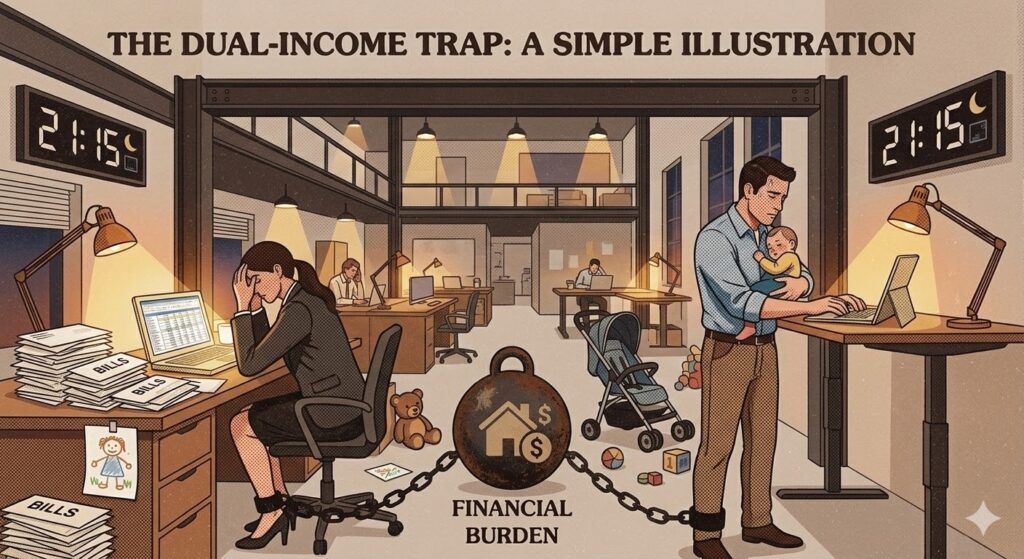
The Dual-Income Trap: Is the 9-5 Paradigm Obsolete?
A. For much of the 20th century, the “breadwinner-homemaker” model was the bedrock of the middle-class family. However, the dawn of the 21st century has witnessed a seismic shift toward the dual-income household, where both partners are tethered to the 9-5 corporate grind. While this evolution is often celebrated as a triumph of gender equality and economic empowerment, a growing cohort of sociologists argues that this “double-career” mandate has inadvertently created a temporal deficit that threatens the very fabric of modern society.
B. The primary driver of this shift was economic necessity. As the cost of living—particularly housing and education—skyrocketed, a single salary became insufficient to maintain a decent standard of living. Yet, this transition has not been without a “hidden tax.” When both parents are absent from the home during peak hours, the domestic sphere suffers from a lack of emotional labor. The traditional tasks of child-rearing, elder care, and community building are increasingly being “outsourced” to third-party institutions, leading to what experts call the “institutionalization of childhood.”
C. Moreover, the 9-5 structure itself is a relic of an era when it was assumed that a worker had a “support system” (a stay-at-home spouse) to manage life’s logistical demands. In a dual-income setup, this support system vanishes, leaving couples to navigate a “second shift”—a term coined by Arlie Hochschild to describe the unpaid domestic work that must be squeezed into the exhausted hours after 5 PM. This structural obsolescence of the 8-hour workday leads to chronic stress, as the friction between professional rigidity and domestic fluidity becomes unbearable.
D. Beyond the psychological strain, there is the issue of “The Two-Income Trap,” as highlighted by Elizabeth Warren. Paradoxically, dual-earner families are often more financially vulnerable than their single-income predecessors. With two incomes, families bid up the price of housing in “good” school districts, locking themselves into massive mortgages. If either partner loses their job or falls ill, the entire financial tower collapses. The “safety net” that a non-working spouse once provided—as a backup earner or a domestic stabilizer—is no longer available, leaving the modern family in a state of precarious equilibrium.
E. To address this, some progressive corporations are experimenting with “Results-Only Work Environments” (ROWE) or four-day workweeks. The goal is to move away from presenteeism—the outdated notion that productivity is measured by hours spent at a desk—and toward a model that respects human biological and social needs. Whether society can successfully decouple professional worth from the 9-5 clock remains the defining challenge of the modern labor market.
Volcabulary Learning
| Word | Phonetic (IPA) | Etymology (Root) | Definition | Usage Example |
| Paradigm | /ˈpærədaɪm/ | Greek paradeigma (pattern, model) | A typical example or pattern of something; a dominant school of thought. | “The shift toward remote work has created a new paradigm in corporate culture.” |
| Obsolete | /ˌɒbsəˈliːt/ | Latin obsoletus (worn out, gone out of use) | No longer produced or used; out of date. | “With the rise of smartphones, traditional pagers quickly became obsolete.” |
| Seismic shift | /ˈsaɪzmɪk ʃɪft/ | Greek seismos (earthquake) | A major, sudden, and highly significant change in a situation. | “The invention of the internet caused a seismic shift in how we consume media.” |
| Tethered | /ˈteðərd/ | Old Norse tjōthr (a rope for tying animals) | Tied or restricted to a particular person, place, or thing. | “Many employees feel tethered to their laptops even after office hours.” |
| Grind | /ɡraɪnd/ | Old English grindan (to crush into powder) | Hard, monotonous, or routine work; a laborious task. | “The daily grind of commuting two hours each way can lead to burnout.” |
| Cohort | /ˈkoʊhɔːrt/ | Latin cohors (an enclosure, a company of soldiers) | A group of people with a shared characteristic or experience. | “This cohort of graduates is entering the toughest job market in decades.” |
| Mandate | /ˈmændeɪt/ | Latin mandatum (commission, command) | An official order or commission to do something; a requirement. | “The government issued a mandate requiring all citizens to wear masks.” |
| Inadvertently | /ˌɪnədˈvɜːrtəntli/ | Latin in- (not) + advertere (pay attention) | Without intention; accidentally or by mistake. | “The technician inadvertently deleted the entire database during the update.” |
| Temporal deficit | /ˈtempərəl ˈdefɪsɪt/ | Latin tempus (time) + deficere (to fail or lack) | A situation where there is a significant shortage of time for necessary activities. | “Working two jobs results in a temporal deficit that affects family bonding.” |
| Phrase | Phonetic (IPA) | Etymology (Root) | Definition | Professional Context |
| Decent | /ˈdiːsnt/ | Latin decentem (becoming, proper, fitting) | Conforming with generally accepted standards of respectable or moral behavior. | Refers to a “living wage” or a standard that allows for dignity without luxury. |
| The domestic sphere | /dəˈmestɪk sfɪr/ | Latin domus (house) + Greek sphaira (globe/ball) | The area of life relating to the home, household affairs, and family. | Used in sociology to distinguish home life from the “public/professional sphere.” |
| Emotional labor | /ɪˈmoʊʃənl ˈleɪbər/ | Latin emovere (stir up) + labor (toil/exertion) | The effort of managing feelings and relationships to keep a family or team functioning. | Often refers to the “invisible work” of caring, listening, and maintaining harmony. |
| A relic of an era | /ə ˈrelɪk əv ən ˈɪərə/ | Latin reliquiae (remains/survivor) + aera (counters/time) | Something that has survived from the past, though it may no longer be relevant. | Describes systems (like the 8-hour day) that were built for a world that no longer exists. |
| Logistical demands | /ləˈdʒɪstɪkl dɪˈmændz/ | Greek logistikos (skilled in calculating) | The practical, day-to-day requirements of managing a household (e.g., bills, chores). | In a dual-income home, these “operations” often lack a dedicated manager. |
| Structural obsolescence | /ˈstrʌktʃərəl ˌɒbsəˈliːtns/ | Latin structura (fitting together) + obsoletus (worn out) | A state where the basic setup of a system is no longer functional for modern needs. | The “9-5” is structurally obsolete because it assumes someone is always home to handle life. |
| Professional rigidity | /prəˈfeʃənl rɪˈdʒɪdəti/ | Latin professio (public declaration) + rigidus (stiff/hard) | The strict, inflexible nature of corporate schedules and rules. | Contrast this with “Domestic fluidity,” where family needs are unpredictable and changing. |
| Phrase | Phonetic (IPA) | Etymology (Root) | Definition | Usage in Context |
| Predecessors | /ˈpredəsesərz/ | Pre- (before) + decedere (to depart/withdraw). | Those who held a position or lived in a system before the current ones. | Refers to the single-income families of the 20th century who lived before the “dual-income” shift. |
| Precarious equilibrium | /prɪˈkeriəs ˌekwɪˈlɪbriəm/ | Precarius (obtained by prayer/favor –> dependent on another’s will –> risky) + aequilibrium (even balance). | A state of balance that is dangerously unstable and likely to collapse. | Describes a family that looks stable with two incomes but is one job-loss away from financial ruin. |
| Outdated notion | /ˌaʊtˈdeɪtɪd ˈnoʊʃn/ | Out (beyond) + date + notionem (knowledge/idea). | An idea, belief, or concept that is no longer valid, relevant, or effective. | Used to criticize “presenteeism”—the old belief that hours spent at a desk equal high productivity. |