The Collapse of Moral Vocation
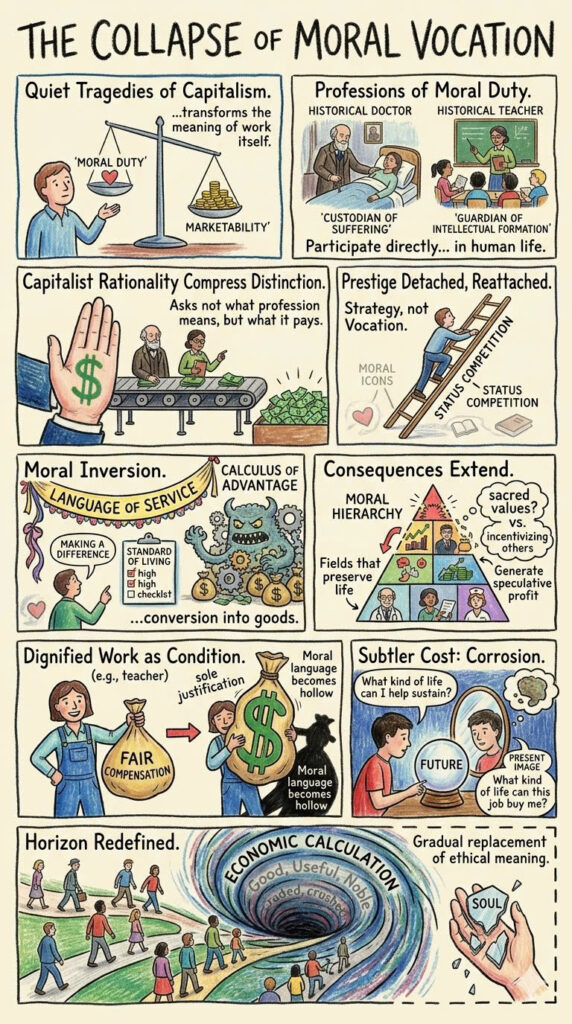
One of the quiet tragedies of modern capitalism is not merely that it distributes wealth unevenly, but that it transforms the meaning of work itself. Professions once regarded as expressions of moral duty — above all medicine and education — increasingly risk being interpreted through the language of marketability, income, and social advancement. In such a climate, the question is no longer what a profession contributes to society, but what it can return to the individual in material terms.
Historically, the doctor was imagined as a custodian of human suffering, and the teacher as a guardian of intellectual and moral formation. These roles were never purely altruistic, of course, nor were they free from hierarchy or prestige. Yet they were anchored in a normative idea: that certain forms of labor are noble because they participate directly in the maintenance and elevation of human life. Their value was not reducible to price. A physician healed, a teacher instructed, and both were understood to stand in relation to the common good.
Capitalist rationality, however, tends to compress such distinctions. It asks not what a profession means, but what it pays. The prestige of a vocation becomes detached from its ethical substance and reattached to salary, lifestyle, and upward mobility. Under this logic, a career in medicine may be admired less for its responsibility than for its security; teaching may be tolerated less as a calling than as a respectable fallback. What was once vocation risks becoming strategy.
This shift reveals a deeper moral inversion. In a society governed by exchange value, even ideals are often absorbed into the calculus of advantage. The language of service remains, but it is increasingly decorative. People may still speak of “making a difference,” yet the decisive factor in choosing a profession is frequently its ability to sustain a desirable standard of living. The profession is then no longer pursued because it is good, but because it can be converted into goods.
Such a transformation has consequences that extend beyond individual ambition. When doctors, teachers, nurses, and other socially essential workers are evaluated primarily through compensation rather than civic importance, the moral hierarchy of society begins to erode. Fields that preserve life, cultivate minds, and maintain social continuity may be less rewarded than those that generate speculative profit or status competition. The result is not only economic distortion, but ethical confusion: society declares certain values sacred while incentivizing others entirely.
To say this is not to romanticize self-sacrifice or deny the necessity of material security. People must live, and professions that demand years of training deserve fair compensation. The problem arises when remuneration ceases to be a practical condition of dignified work and becomes its sole justification. At that point, the moral language surrounding professions becomes hollow, and the ideal of service is subordinated to the logic of accumulation.
There is also a subtler cost. When young people are taught to evaluate careers mainly by income potential, they may internalize the belief that one’s worth is measured by one’s earning power. This can corrode not only social ethics but personal identity. A person who might once have asked, “What kind of life can I help sustain?” now asks, “What kind of life can this job buy me?” The shift seems small, yet it marks a profound change in the moral imagination.
In this sense, the crisis is not simply that capitalism pays some professions more than others, but that it redefines the horizon within which professions are judged. The good is translated into the profitable; the useful into the monetizable; the noble into the prestigious. Once this translation becomes habitual, the distinction between work as contribution and work as extraction grows increasingly difficult to preserve.
Ultimately, the collapse of moral vocation reflects a broader condition of modern life: the gradual replacement of ethical meaning by economic calculation. A society that cannot distinguish between what is valuable and what is merely valuable in the market has not abolished morality, but hollowed it out. And when even the most noble professions are pursued primarily for what they can exchange for, then the crisis is not only in the labor market, but in the soul of the culture itself.