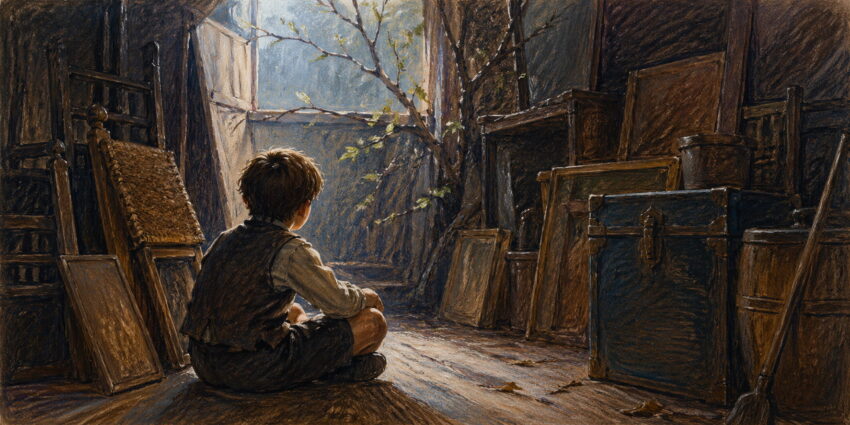
Một con ếch trong bát sữa có thể lật đổ quyền lực của người lớn? Nicholas đã biến hình phạt thành một cuộc viễn chinh vào “thiên đường bị cấm”. Khám phá cú lật kèo trí tuệ đỉnh cao và đầy châm biếm của bậc thầy Saki tại đây!
The Lumber Room / Căn Phòng Kho by H.H. Munro (Saki)
Part 1: The Frog in the Bread-and-Milk
Phần 1: Con Ếch Trong Bát Bánh Mì và Sữa
The children were to be driven, as a special treat, to the sands at Jagborough.
Những đứa trẻ sẽ được đưa đi, như một phần thưởng đặc biệt, đến bãi cát ở Jagborough.
Nicholas was not to be of the party; he was in disgrace.
Nicholas sẽ không được đi cùng; cậu đang bị phạt.
Only that morning he had refused to eat his wholesome bread-and-milk on the seemingly frivolous ground that there was a frog in it.
Chính sáng hôm đó cậu đã từ chối ăn bát bánh mì và sữa bổ dưỡng với lý do có vẻ vớ vẩn là có con ếch trong đó.
Older and wiser and better people had told him that there could not possibly be a frog in his bread-and-milk and that he was not to talk nonsense; he continued, nevertheless, to talk what seemed the veriest nonsense, and described with much detail the colouration and markings of the alleged frog.
Những người lớn tuổi hơn, khôn ngoan hơn và tốt hơn đã nói với cậu rằng không thể có con ếch nào trong bát bánh mì và sữa của cậu và cậu không được nói bậy; tuy nhiên cậu vẫn tiếp tục nói những gì có vẻ là chuyện vô nghĩa nhất, và mô tả tỉ mỉ màu sắc và những đốm của con ếch bị cáo buộc đó.
The dramatic part of the incident was that there really was a frog in Nicholas’ basin of bread-and-milk; he had put it there himself, so he felt entitled to know something about it.
Phần kịch tính của sự việc là thực sự có một con ếch trong bát bánh mì và sữa của Nicholas; chính cậu đã đặt nó vào đó, vì vậy cậu cảm thấy có quyền biết điều gì đó về nó.
The sin of taking a frog from the garden and putting it into a bowl of wholesome bread-and-milk was enlarged on at great length, but the fact that stood out clearest in the whole affair, as it presented itself to the mind of Nicholas, was that the older, wiser, and better people had been proved to be profoundly in error in matters about which they had expressed the utmost assurance.
Tội lỗi của việc bắt con ếch từ vườn bỏ vào bát bánh mì và sữa bổ dưỡng được kể lể dài dòng, nhưng sự thật nổi bật nhất trong toàn bộ sự việc, như nó hiện ra trong tâm trí Nicholas, là những người lớn tuổi hơn, khôn ngoan hơn và tốt hơn đó đã bị chứng minh là sai lầm sâu sắc về những vấn đề mà họ đã bày tỏ sự chắc chắn tuyệt đối.
“You said there couldn’t possibly be a frog in my bread-and-milk; there was a frog in my bread-and-milk,” he repeated, with the insistence of a skilled tactician who does not intend to shift from favourable ground.
“Cô nói không thể có con ếch trong bát bánh mì và sữa của cháu; nhưng có con ếch trong bát bánh mì và sữa của cháu,” cậu nhắc đi nhắc lại, với sự kiên quyết của một nhà chiến thuật lành nghề không có ý định rời khỏi địa thế có lợi.
So his boy-cousin and girl-cousin and his quite uninteresting younger brother were to be taken to Jagborough sands that afternoon and he was to stay at home.
Vì vậy anh họ, chị họ và đứa em trai khá nhàm chán của cậu sẽ được đưa đến bãi cát Jagborough chiều hôm đó còn cậu phải ở nhà.
His cousins’ aunt, who insisted, by an unwarranted stretch of imagination, in styling herself his aunt also, had hastily invented the Jagborough expedition in order to impress on Nicholas the delights that he had justly forfeited by his disgraceful conduct at the breakfast-table.
Dì của những đứa em họ, người khăng khăng, bằng một trí tưởng tượng thái quá vô căn cứ, tự gọi mình là dì của cậu, đã vội vã bịa ra chuyến đi Jagborough để cho Nicholas thấy những thú vui mà cậu đã đáng bị tước đoạt vì hành động đáng xấu hổ ở bàn ăn sáng.
It was her habit, whenever one of the children fell from grace, to improvise something of a festival nature from which the offender would be rigorously debarred; if all the children sinned collectively they were suddenly informed of a circus in a neighbouring town, a circus of unrivalled merit and uncounted elephants, to which, but for their depravity, they would have been taken that very day.
Thói quen của bà là, bất cứ khi nào một trong những đứa trẻ sa ngã, bà sẽ ngẫu hứng bày ra thứ gì đó mang tính lễ hội mà kẻ vi phạm sẽ bị nghiêm khắc cấm tham dự; nếu tất cả trẻ cùng phạm tội thì chúng đột nhiên được thông báo về một rạp xiếc ở thị trấn lân cận, một rạp xiếc xuất sắc vô song với vô số con voi, mà nếu không vì sự đồi bại của chúng thì chúng đã được đưa đến đó ngay hôm đó.
A few decent tears were looked for on the part of Nicholas when the moment for the departure of the expedition arrived.
Người ta trông đợi vài giọt nước mắt xứng đáng từ phía Nicholas khi khoảnh khắc đoàn người lên đường đến.
As a matter of fact, however, all the crying was done by his girl-cousin, who scraped her knee rather painfully against the step of the carriage as she was scrambling in.
Thực ra thì tất cả tiếng khóc lại đến từ cô chị họ, người đã cọ đầu gối đau khá đau vào bậc xe ngựa khi đang trèo lên.
“How she did howl,” said Nicholas cheerfully, as the party drove off without any of the elation of high spirits that should have characterised it.
“Cô ấy khóc to thật,” Nicholas nói vui vẻ khi đoàn người lên đường mà không có chút vui vẻ phấn khích nào đáng ra phải có.
“She’ll soon get over that,” said the soi-disant aunt; “it will be a glorious afternoon for racing about over those beautiful sands. How they will enjoy themselves!”
“Cô bé sẽ sớm quên thôi,” người tự xưng là dì nói; “chiều nay sẽ là buổi chiều tuyệt vời để chạy nhảy trên bãi cát đẹp đó. Chúng sẽ vui biết bao!”
“Bobby won’t enjoy himself much, and he won’t race much either,” said Nicholas with a grim chuckle; “his boots are hurting him. They’re too tight.”
“Bobby sẽ không vui lắm đâu, cậu ấy cũng sẽ không chạy nhiều,” Nicholas nói với tiếng cười khẩy u ám; “giày của cậu ấy đang làm cậu đau. Chật quá.”
“Why didn’t he tell me they were hurting?” asked the aunt with some asperity.
“Tại sao cậu ấy không nói với tôi là giày đau?” bà dì hỏi với giọng hơi gay gắt.
“He told you twice, but you weren’t listening. You often don’t listen when we tell you important things.”
“Cậu ấy đã nói với cô hai lần rồi, nhưng cô không nghe. Cô thường không nghe khi chúng cháu nói những điều quan trọng.”
End of Episode 1 — Stay tuned for the next episode! / Kết thúc Episode 1 — Hãy đón đọc episode tiếp theo!
Part 2: The Decoy and the Key
Phần 2: Mồi Nhử và Chiếc Chìa Khóa
“You are not to go into the gooseberry garden,” said the aunt, changing the subject.
“Cháu không được vào vườn lý gai,” bà dì nói, chuyển chủ đề.
“Why not?” demanded Nicholas.
“Tại sao không?” Nicholas đòi biết.
“Because you are in disgrace,” said the aunt loftily.
“Vì cháu đang bị phạt,” bà dì nói kiêu ngạo.
Nicholas did not admit the flawlessness of the reasoning; he felt perfectly capable of being in disgrace and in a gooseberry garden at the same moment.
Nicholas không thừa nhận sự hoàn hảo của lập luận đó; cậu cảm thấy hoàn toàn có khả năng vừa đang bị phạt vừa ở trong vườn lý gai cùng một lúc.
His face took on an expression of considerable obstinacy. It was clear to his aunt that he was determined to get into the gooseberry garden, “only,” as she remarked to herself, “because I have told him he is not to.”
Mặt cậu mang vẻ bướng bỉnh đáng kể. Bà dì thấy rõ rằng cậu quyết tâm vào vườn lý gai, “chỉ vì,” bà tự nhủ, “tôi đã nói với cậu bé là không được vào.”
Now the gooseberry garden had two doors by which it might be entered, and once a small person like Nicholas could slip in there he could effectually disappear from view amid the masking growth of artichokes, raspberry canes, and fruit bushes.
Vườn lý gai có hai cánh cửa để vào, và một khi một người nhỏ bé như Nicholas trượt vào được thì cậu có thể biến mất hoàn toàn khỏi tầm nhìn trong đám cây atisô, cây mâm xôi và bụi cây ăn quả um tùm che khuất.
The aunt had many other things to do that afternoon, but she spent an hour or two in trivial gardening operations among flower beds and shrubberies, whence she could keep a watchful eye on the two doors that led to the forbidden paradise.
Bà dì có nhiều việc khác phải làm buổi chiều hôm đó, nhưng bà dành một hai tiếng đồng hồ làm những việc làm vườn vụn vặt trong các luống hoa và bụi cây, từ đó bà có thể giữ mắt canh chừng hai cánh cửa dẫn vào thiên đường bị cấm.
She was a woman of few ideas, with immense powers of concentration.
Bà là người ít ý tưởng nhưng có sức tập trung phi thường.
Nicholas made one or two sorties into the front garden, wriggling his way with obvious stealth of purpose towards one or other of the doors, but never able for a moment to evade the aunt’s watchful eye.
Nicholas thực hiện một hai lần đột kích ra vườn trước, len lỏi với vẻ bí mật có chủ đích rõ ràng về phía một trong hai cánh cửa, nhưng không bao giờ thoát được dù chỉ một khoảnh khắc khỏi ánh mắt cảnh giác của bà dì.
As a matter of fact, he had no intention of trying to get into the gooseberry garden, but it was extremely convenient for him that his aunt should believe that he had; it was a belief that would keep her on self-imposed sentry-duty for the greater part of the afternoon.
Thực ra cậu không hề có ý định cố vào vườn lý gai, nhưng việc bà dì tin như vậy lại rất thuận lợi cho cậu; đó là niềm tin sẽ giữ bà tự nguyện làm nhiệm vụ canh gác phần lớn buổi chiều.
Having thoroughly confirmed and fortified her suspicions Nicholas slipped back into the house and rapidly put into execution a plan of action that had long germinated in his brain.
Sau khi đã xác nhận và củng cố triệt để nghi ngờ của bà, Nicholas trượt trở vào nhà và nhanh chóng thực hiện kế hoạch hành động đã nung nấu lâu ngày trong đầu cậu.
By standing on a chair in the library one could reach a shelf on which reposed a fat, important-looking key.
Bằng cách đứng lên ghế trong phòng đọc sách người ta có thể với tới một cái giá có một chiếc chìa khóa to, trông quan trọng nằm trên đó.
The key was as important as it looked; it was the instrument which kept the mysteries of the lumber-room secure from unauthorised intrusion, which opened a way only for aunts and such-like privileged persons.
Chiếc chìa khóa quan trọng đúng như vẻ ngoài của nó; đó là công cụ giữ những bí ẩn của căn phòng kho an toàn khỏi sự xâm nhập trái phép, chỉ mở đường cho những bà dì và những người có đặc quyền tương tự.
Nicholas had not had much experience of the art of fitting keys into keyholes and turning locks, but for some days past he had practised with the key of the schoolroom door; he did not believe in trusting too much to luck and accident.
Nicholas không có nhiều kinh nghiệm trong nghệ thuật tra chìa khóa vào ổ khóa và xoay khóa, nhưng trong vài ngày qua cậu đã luyện tập với chìa khóa cửa phòng học; cậu không tin vào việc trông chờ quá nhiều vào may mắn và ngẫu nhiên.
The key turned stiffly in the lock, but it turned. The door opened, and Nicholas was in an unknown land, compared with which the gooseberry garden was a stale delight, a mere material pleasure.
Chiếc chìa khóa xoay cứng trong ổ khóa, nhưng nó xoay được. Cánh cửa mở ra, và Nicholas đang ở trong một vùng đất chưa biết, so với đó thì vườn lý gai chỉ là thú vui nhàm chán, một niềm vui vật chất tầm thường.
End of Episode 2 — Stay tuned for the next episode! / Kết thúc Episode 2 — Hãy đón đọc episode tiếp theo!
Part 3: The Wonders of the Lumber Room
Phần 3: Những Kỳ Diệu Trong Căn Phòng Kho
Often and often Nicholas had pictured to himself what the lumber-room might be like, that region that was so carefully sealed from youthful eyes and concerning which no questions were ever answered.
Nhiều lần nhiều lần Nicholas đã hình dung cho mình xem căn phòng kho có thể trông như thế nào, vùng đất được giữ kín cẩn thận khỏi đôi mắt trẻ thơ và không bao giờ có câu hỏi nào về nó được trả lời.
It came up to his expectations. In the first place it was large and dimly lit, one high window opening on to the forbidden garden being its only source of illumination.
Nó đáp ứng được kỳ vọng của cậu. Thứ nhất nó rộng lớn và ánh sáng mờ nhạt, một cửa sổ cao mở ra khu vườn bị cấm là nguồn ánh sáng duy nhất.
In the second place it was a storehouse of unimagined treasures.
Thứ hai nó là kho chứa những kho báu chưa từng được tưởng tượng.
The aunt-by-assertion was one of those people who think that things spoil by use and consign them to dust and damp by way of preserving them.
Bà dì tự phong là một trong những người nghĩ rằng đồ vật hỏng vì sử dụng nên đưa chúng vào bụi bặm và ẩm ướt như cách bảo quản.
Such parts of the house as Nicholas knew best were rather bare and cheerless, but here there were wonderful things for the eye to feast on.
Những phần của ngôi nhà mà Nicholas biết rõ nhất khá trống trải và 殺u ám, nhưng ở đây có những thứ tuyệt vời cho mắt chiêm ngưỡng.
First and foremost there was a piece of framed tapestry that was evidently meant to be a fire-screen. To Nicholas it was a living, breathing story; he sat down on a roll of Indian hangings, glowing in wonderful colours beneath a layer of dust, and took in all the details of the tapestry picture.
Trước tiên và trên hết là một tấm thảm thêu có khung rõ ràng được dùng làm màn chắn lửa. Đối với Nicholas đó là một câu chuyện sống động, thở hít; cậu ngồi xuống trên cuộn vải treo Ấn Độ đang tỏa sáng với những màu sắc tuyệt vời dưới lớp bụi và ngắm nhìn tất cả chi tiết của bức tranh thêu.
A man, dressed in the hunting costume of some remote period, had just transfixed a stag with an arrow; it could not have been a difficult shot because the stag was only one or two paces away from him; in the thickly-growing vegetation that the picture suggested it would not have been difficult to creep up to a feeding stag, and the two spotted dogs that were springing forward to join in the chase had evidently been trained to keep to heel till the arrow was discharged.
Một người đàn ông mặc trang phục săn bắn từ thời xa xưa nào đó vừa ghim một con hươu đực bằng mũi tên; đó hẳn không phải phát bắn khó vì con hươu chỉ cách người đó một hai bước; trong lớp thực vật rậm rạp mà bức tranh gợi lên, việc bò đến gần một con hươu đang ăn cỏ sẽ không khó, và hai con chó đốm đang lao về phía trước để tham gia truy đuổi rõ ràng đã được huấn luyện bám sát gót cho đến khi mũi tên được bắn ra.
That part of the picture was simple, if interesting, but did the huntsman see, what Nicholas saw, that four galloping wolves were coming in his direction through the wood?
Phần đó của bức tranh đơn giản dù thú vị, nhưng liệu người thợ săn có thấy, như Nicholas thấy, rằng bốn con sói đang phi nước đại đang đến hướng anh ta qua khu rừng không?
There might be more than four of them hidden behind the trees, and in any case would the man and his dogs be able to cope with the four wolves if they made an attack?
Có thể có nhiều hơn bốn con đang ẩn náu sau những cây cối, và trong mọi trường hợp liệu người đàn ông và những con chó của anh ta có thể đối phó với bốn con sói nếu chúng tấn công không?
The man had only two arrows left in his quiver, and he might miss with one or both of them; all one knew about his skill in shooting was that he could hit a large stag at a ridiculously short range.
Người đàn ông chỉ còn hai mũi tên trong ống đựng tên, và anh ta có thể bắn trượt một hoặc cả hai; tất cả những gì biết về kỹ năng bắn của anh ta là anh có thể bắn trúng một con hươu lớn ở khoảng cách buồn cười ngắn ngủi.
Nicholas sat for many golden minutes revolving the possibilities of the scene; he was inclined to think that there were more than four wolves and that the man and his dogs were in a tight corner.
Nicholas ngồi trong nhiều phút vàng ngọc suy nghĩ về các khả năng của cảnh tượng đó; cậu có xu hướng nghĩ rằng có nhiều hơn bốn con sói và người đàn ông cùng những con chó đang trong tình thế bí.
But there were other objects of delight and interest claiming his instant attention: there were quaint twisted candlesticks in the shape of snakes, and a teapot fashioned like a china duck, out of whose open beak the tea was supposed to come.
Nhưng còn có những vật khác thú vị và hấp dẫn đòi hỏi sự chú ý ngay lập tức của cậu: có những chiếc chân nến vặn vẹo kỳ lạ hình con rắn, và một ấm trà làm theo hình con vịt sứ mà trà được rót ra từ mỏ vịt há miệng.
And there was a carved sandal-wood box packed tight with aromatic cottonwool, and between the layers of cottonwool were little brass figures, hump-necked bulls, and peacocks and goblins, delightful to see and to handle.
Và có một hộp gỗ đàn hương chạm khắc nhồi chặt bông thơm, và giữa các lớp bông là những hình đồng nhỏ, những con bò u vai, công và tiểu quỷ, thật thích khi nhìn và cầm trên tay.
Less promising in appearance was a large square book with plain black covers; Nicholas peeped into it, and, behold, it was full of coloured pictures of birds. And such birds!
Trông kém hứa hẹn hơn là một cuốn sách vuông lớn bìa đen trơn; Nicholas liếc vào đó và kìa, nó đầy những bức tranh màu về các loài chim. Và những loài chim thế nào!
In the garden, and in the lanes when he went for a walk, Nicholas came across a few birds, of which the largest were an occasional magpie or wood-pigeon; here were herons and bustards, kites, toucans, tiger-bitterns, brush turkeys, ibises, golden pheasants, a whole portrait gallery of undreamed-of creatures.
Trong vườn và trên những con đường làng khi cậu đi dạo, Nicholas bắt gặp một vài loài chim mà lớn nhất chỉ là chim khách hoặc bồ câu rừng thỉnh thoảng xuất hiện; ở đây là những con diệc và chim quần cư, diều hâu, toucan, chim vạc hổ, gà tây bụi, cò quắm, trĩ vàng, cả một phòng tranh chân dung của những sinh vật chưa từng mơ tới.
And as he was admiring the colouring of the mandarin duck and assigning a life-history to it, the voice of his aunt in shrill vociferation of his name came from the gooseberry garden without.
Và khi cậu đang ngắm màu sắc của con vịt quan thoại và tưởng tượng tiểu sử của nó, giọng bà dì đang la hét the thé tên cậu vang ra từ vườn lý gai bên ngoài.
She had grown suspicious at his long disappearance, and had leapt to the conclusion that he had climbed over the wall behind the sheltering screen of the lilac bushes; she was now engaged in energetic and rather hopeless search for him among the artichokes and raspberry canes.
Bà đã trở nên nghi ngờ trước sự vắng mặt lâu của cậu, và kết luận vội vã rằng cậu đã trèo qua tường sau tấm màn che của bụi hoa tử đinh hương; bà đang hăng hái và khá vô vọng tìm kiếm cậu trong đám cây atisô và cây mâm xôi.
“Nicholas, Nicholas!” she screamed, “you are to come out of this at once. It’s no use trying to hide there; I can see you all the time.”
“Nicholas, Nicholas!” bà thét, “cháu phải ra khỏi đó ngay. Vô ích khi cố trốn ở đó; tôi thấy cháu suốt.”
It was probably the first time for twenty years that anyone had smiled in that lumber-room.
Đây có lẽ là lần đầu tiên trong hai mươi năm có ai đó mỉm cười trong căn phòng kho đó.
End of Episode 3 — Stay tuned for the next episode! / Kết thúc Episode 3 — Hãy đón đọc episode tiếp theo!
Final Part: The Trap Reversed
Part Cuối: Cái Bẫy Bị Lật Ngược
Presently the angry repetitions of Nicholas’ name gave way to a shriek, and a cry for somebody to come quickly.
Chẳng mấy chốc những lần lặp đi lặp lại tức giận tên Nicholas nhường chỗ cho tiếng thét và tiếng kêu cứu ai đó đến nhanh.
Nicholas shut the book, restored it carefully to its place in a corner, and shook some dust from a neighbouring pile of newspapers over it.
Nicholas đóng cuốn sách lại, cẩn thận đặt nó trở lại chỗ cũ ở góc phòng, và phủ một ít bụi từ đống báo gần đó lên trên.
Then he crept from the room, locked the door, and replaced the key exactly where he had found it.
Rồi cậu lén rời khỏi phòng, khóa cửa lại và đặt chìa khóa đúng chỗ cũ nơi cậu đã tìm thấy nó.
His aunt was still calling his name when he sauntered into the front garden.
Bà dì vẫn đang gọi tên cậu khi cậu thong thả bước ra vườn trước.
“Who’s calling?” he asked.
“Ai đang gọi vậy?” cậu hỏi.
“Me,” came the answer from the other side of the wall; “didn’t you hear me? I’ve been looking for you in the gooseberry garden, and I’ve slipped into the rain-water tank. Luckily there’s no water in it, but the sides are slippery and I can’t get out. Fetch the little ladder from under the cherry tree — “
“Tôi,” câu trả lời vang từ phía bên kia bức tường; “cháu không nghe tôi gọi sao? Tôi đang tìm cháu trong vườn lý gai và tôi đã trượt xuống bể chứa nước mưa. May mắn là không có nước trong đó, nhưng các thành bên trơn và tôi không ra được. Hãy lấy cái thang nhỏ từ dưới cây anh đào — “
“I was told I wasn’t to go into the gooseberry garden,” said Nicholas promptly.
“Cháu được nói là không được vào vườn lý gai,” Nicholas nói ngay lập tức.
“I told you not to, and now I tell you that you may,” came the voice from the rain-water tank, rather impatiently.
“Tôi đã bảo cháu không được vào, và bây giờ tôi bảo cháu có thể vào,” giọng từ bể chứa nước mưa vang lên, khá thiếu kiên nhẫn.
“Your voice doesn’t sound like aunt’s,” objected Nicholas; “you may be the Evil One tempting me to be disobedient. Aunt often tells me that the Evil One tempts me and that I always yield. This time I’m not going to yield.”
“Giọng của cô không giống giọng dì,” Nicholas phản đối; “cô có thể là Kẻ Ác đang cám dỗ cháu bất tuân. Dì thường nói với cháu rằng Kẻ Ác cám dỗ cháu và cháu luôn luôn nhượng bộ. Lần này cháu sẽ không nhượng bộ.”
“Don’t talk nonsense,” said the prisoner in the tank; “go and fetch the ladder.”
“Đừng nói bậy,” người tù nhân trong bể nói; “đi lấy cái thang đi.”
“Will there be strawberry jam for tea?” asked Nicholas innocently.
“Chiều nay có mứt dâu không?” Nicholas hỏi vô tội.
“Certainly there will be,” said the aunt, privately resolving that Nicholas should have none of it.
“Chắc chắn có,” bà dì nói, thầm quyết tâm rằng Nicholas sẽ không được ăn tí nào.
“Now I know that you are the Evil One and not aunt,” shouted Nicholas gleefully; “when we asked aunt for strawberry jam yesterday she said there wasn’t any. I know there are four jars of it in the store cupboard, because I looked, and of course you know it’s there, but she doesn’t, because she said there wasn’t any. Oh, Devil, you have sold yourself!”
“Bây giờ cháu biết cô là Kẻ Ác chứ không phải dì,” Nicholas reo lên vui mừng; “khi chúng cháu xin dì mứt dâu hôm qua dì nói không có. Cháu biết có bốn lọ trong tủ đồ, vì cháu đã nhìn, và tất nhiên cô biết nó ở đó, nhưng dì không biết vì dì nói không có. Ôi, Quỷ dữ ơi, cô đã lộ tẩy rồi!”
There was an unusual sense of luxury in being able to talk to an aunt as though one was talking to the Evil One, but Nicholas knew, with childish discernment, that such luxuries were not to be over-indulged in.
Có một cảm giác xa hoa bất thường khi có thể nói chuyện với bà dì như thể đang nói chuyện với Kẻ Ác, nhưng Nicholas biết, với sự tinh tế trẻ thơ, rằng những xa hoa như vậy không nên được hưởng quá mức.
He walked noisily away, and it was a kitchenmaid, in search of parsley, who eventually rescued the aunt from the rain-water tank.
Cậu bước đi ồn ào, và chính cô hầu bếp đang đi tìm mùi tây là người cuối cùng cứu bà dì ra khỏi bể chứa nước mưa.
Tea that evening was partaken of in a fearsome silence. The tide had been at its highest when the children had arrived at Jagborough Cove, so there had been no sands to play on — a circumstance that the aunt had overlooked in the haste of organising her punitive expedition.
Bữa trà tối hôm đó được uống trong im lặng đáng sợ. Thủy triều đang ở mức cao nhất khi những đứa trẻ đến Jagborough Cove, vì vậy không có bãi cát để chơi — hoàn cảnh mà bà dì đã bỏ qua trong lúc vội vã tổ chức chuyến đi trừng phạt.
The tightness of Bobby’s boots had had disastrous effect on his temper the whole of the afternoon, and altogether the children could not have been said to have enjoyed themselves.
Sự chật của giày Bobby đã có tác động thảm khốc đến tính khí của cậu suốt cả buổi chiều, và nhìn chung không thể nói là những đứa trẻ đã vui chơi thoải mái.
The aunt maintained the frozen muteness of one who has suffered undignified and unmerited detention in a rain-water tank for thirty-five minutes.
Bà dì giữ vẻ câm lặng đông cứng của người đã phải chịu đựng sự giam giữ mất phẩm giá và không xứng đáng trong bể chứa nước mưa suốt ba mươi lăm phút.
As for Nicholas, he, too, was silent, in the absorption of one who has much to think about; it was just possible, he considered, that the huntsman would escape with his hounds while the wolves feasted on the stricken stag.
Còn về phía Nicholas, cậu cũng im lặng, chìm đắm trong suy nghĩ của người có nhiều điều để suy ngẫm; cậu cho rằng hoàn toàn có thể người thợ săn sẽ thoát được cùng những con chó trong khi lũ sói đang thịnh soạn với con hươu bị thương.
The End / Kết Thúc
Special Topic: Saki’s Triumph of the Child’s Mind
Bình Luận: Chiến Thắng của Tâm Trí Trẻ Thơ trong Saki
“The Lumber Room” (1914) is one of the finest short stories by H.H. Munro, who wrote under the pen name Saki — a master of the comic-macabre and one of English literature’s most elegant satirists.
“Căn Phòng Kho” (1914) là một trong những truyện ngắn xuất sắc nhất của H.H. Munro, người viết dưới bút danh Saki — bậc thầy của thể loại hài-ma quái và một trong những nhà châm biếm thanh lịch nhất của văn học Anh.
At its core, the story is a battle of wits between a child of genuine intelligence and imagination, and an adult whose authority rests entirely on the assumption that she is wiser, more perceptive, and more truthful than the child she governs.
Về cốt lõi, câu chuyện là một cuộc chiến trí tuệ giữa một đứa trẻ có trí thông minh và trí tưởng tượng thực sự, và một người lớn mà quyền uy của bà hoàn toàn dựa trên giả định rằng bà khôn ngoan hơn, nhạy bén hơn và trung thực hơn đứa trẻ mà bà cai quản.
The story’s opening gambit — the frog in the bread-and-milk — establishes the central irony with perfect economy: the adults declare with absolute certainty that something is impossible; Nicholas knows it is true because he made it happen.
Nước cờ mở đầu của câu chuyện — con ếch trong bánh mì và sữa — thiết lập sự mỉa mai trung tâm với sự súc tích hoàn hảo: người lớn tuyên bố với sự chắc chắn tuyệt đối rằng điều gì đó là không thể; Nicholas biết nó là thật vì chính cậu đã làm cho nó xảy ra.
This is the story’s philosophical foundation: authority without knowledge is not authority at all — it is only the performance of authority, and Nicholas sees through the performance with the clarity of a child who has not yet learned to pretend otherwise.
Đây là nền tảng triết học của câu chuyện: quyền uy không có kiến thức không phải là quyền uy — đó chỉ là màn trình diễn quyền uy, và Nicholas nhìn thấu màn trình diễn đó với sự rõ ràng của đứa trẻ chưa học cách giả vờ khác.
Saki’s genius lies in the way he frames this conflict without sentimentality. Nicholas is not an innocent victim — he is a strategist, a tactician, a player who uses the adults’ assumptions against them with cold precision.
Thiên tài của Saki nằm ở cách ông đóng khung cuộc xung đột này mà không có sự ủy mị. Nicholas không phải là nạn nhân vô tội — cậu là một nhà chiến lược, một chiến thuật gia, một người chơi sử dụng những giả định của người lớn chống lại họ với sự chính xác lạnh lùng.
The aunt’s punishment — the Jagborough expedition — backfires on every level: the tide is in, Bobby’s boots hurt, the girl cries, and the aunt herself ends up trapped in the rain-water tank while Nicholas spends the afternoon in paradise.
Hình phạt của bà dì — chuyến đi Jagborough — phản tác dụng ở mọi cấp độ: thủy triều đang lên, giày Bobby chật, cô bé khóc, và chính bà dì bị mắc kẹt trong bể chứa nước mưa trong khi Nicholas dành cả buổi chiều trong thiên đường.
The lumber room itself is the story’s most beautiful invention. It is not merely a physical space — it is a symbol of the life of the imagination that authority seeks to suppress.
Bản thân căn phòng kho là phát minh đẹp nhất của câu chuyện. Nó không chỉ đơn thuần là một không gian vật lý — nó là biểu tượng của cuộc sống của trí tưởng tượng mà quyền uy tìm cách đàn áp.
The aunt preserves things by locking them away from use — a perfect metaphor for her entire approach to childhood: she administers punishments and rewards, but she does not nurture wonder, curiosity, or genuine thought.
Bà dì bảo quản đồ vật bằng cách khóa chúng đi khỏi tầm sử dụng — một ẩn dụ hoàn hảo cho toàn bộ cách tiếp cận của bà với tuổi thơ: bà thực hiện hình phạt và phần thưởng, nhưng bà không nuôi dưỡng sự kỳ diệu, tò mò hay suy nghĩ thực sự.
The tapestry scene — in which Nicholas loses himself in the story of the hunter, the stag, and the approaching wolves — is one of the most quietly luminous passages in Saki’s work.
Cảnh tấm thảm thêu — trong đó Nicholas đắm chìm vào câu chuyện của người thợ săn, con hươu và lũ sói đang đến gần — là một trong những đoạn văn sáng nhẹ nhàng nhất trong tác phẩm của Saki.
It shows us the quality of Nicholas’s inner life: he does not merely look at the picture, he inhabits it, asks questions of it, and carries its unresolved tension with him to the last line of the story.
Nó cho chúng ta thấy chất lượng của cuộc sống nội tâm của Nicholas: cậu không chỉ đơn giản là nhìn vào bức tranh, cậu sống trong đó, đặt câu hỏi cho nó, và mang theo sức căng chưa được giải quyết của nó đến dòng cuối cùng của câu chuyện.
The story’s final image — Nicholas sitting in silence at tea, considering that the huntsman might escape while the wolves feast on the stag — is a masterpiece of tonal compression: it is simultaneously funny, melancholy, and philosophically rich.
Hình ảnh cuối cùng của câu chuyện — Nicholas ngồi im lặng trong bữa trà, suy nghĩ rằng người thợ săn có thể thoát được trong khi lũ sói thịnh soạn với con hươu — là một kiệt tác của sự nén tông điệu: nó vừa hài hước, vừa u sầu, vừa giàu triết học.
Saki himself had a childhood marked by harsh, joyless authority — he was raised by two strict aunts after his mother’s death — and “The Lumber Room” is widely understood as autobiographical in spirit, a revenge fantasy and a love letter to the imagination at the same time.
Chính Saki có tuổi thơ bị đánh dấu bởi quyền uy khắc nghiệt, không niềm vui — ông được nuôi dưỡng bởi hai bà dì nghiêm khắc sau khi mẹ mất — và “Căn Phòng Kho” được hiểu rộng rãi là có tính chất tự truyện về tinh thần, vừa là giấc mơ trả thù vừa là bức thư tình dành cho trí tưởng tượng.
For Vietnamese readers, the story speaks to a universally recognizable dynamic: the child who sees more clearly than the adult in charge, who navigates a world of arbitrary rules with intelligence and inner freedom, and who finds in the life of the mind a space that no punishment can reach.
Đối với độc giả Việt Nam, câu chuyện nói đến một động lực được nhận ra rộng rãi: đứa trẻ nhìn thấy rõ ràng hơn người lớn đang phụ trách, người điều hướng thế giới của những quy tắc tùy tiện bằng trí thông minh và tự do nội tâm, và người tìm thấy trong cuộc sống của tâm trí một không gian mà không có hình phạt nào có thể chạm tới.
The End / Kết Thúc
The children were to be driven, as a special treat, to the sands at Jagborough. Nicholas was not to be of the party; he was in disgrace. Only that morning he had refused to eat his wholesome bread-and-milk on the seemingly frivolous ground that there was a frog in it. Older and wiser and better people had told him that there could not possibly be a frog in his bread-and-milk and that he was not to talk nonsense; he continued, nevertheless, to talk what seemed the veriest nonsense, and described with much detail the colouration and markings of the alleged frog. The dramatic part of the incident was that there really was a frog in Nicholas’ basin of bread-and-milk; he had put it there himself, so he felt entitled to know something about it. The sin of taking a frog from the garden and putting it into a bowl of wholesome bread-and-milk was enlarged on at great length, but the fact that stood out clearest in the whole affair, as it presented itself to the mind of Nicholas, was that the older, wiser, and better people had been proved to be profoundly in error in matters about which they had expressed the utmost assurance.
“You said there couldn’t possibly be a frog in my bread-and-milk; there was a frog in my bread-and-milk,” he repeated, with the insistence of a skilled tactician who does not intend to shift from favourable ground.
So his boy-cousin and girl-cousin and his quite uninteresting younger brother were to be taken to Jagborough sands that afternoon and he was to stay at home. His cousins’ aunt, who insisted, by an unwarranted stretch of imagination, in styling herself his aunt also, had hastily invented the Jagborough expedition in order to impress on Nicholas the delights that he had justly forfeited by his disgraceful conduct at the breakfast-table. It was her habit, whenever one of the children fell from grace, to improvise something of a festival nature from which the offender would be rigorously debarred; if all the children sinned collectively they were suddenly informed of a circus in a neighbouring town, a circus of unrivalled merit and uncounted elephants, to which, but for their depravity, they would have been taken that very day.
A few decent tears were looked for on the part of Nicholas when the moment for the departure of the expedition arrived. As a matter of fact, however, all the crying was done by his girl-cousin, who scraped her knee rather painfully against the step of the carriage as she was scrambling in.
“How she did howl,” said Nicholas cheerfully, as the party drove off without any of the elation of high spirits that should have characterised it.
“She’ll soon get over that,” said the soi-disant aunt; “it will be a glorious afternoon for racing about over those beautiful sands. How they will enjoy themselves!”
“Bobby won’t enjoy himself much, and he won’t race much either,” said Nicholas with a grim chuckle; “his boots are hurting him. They’re too tight.”
“Why didn’t he tell me they were hurting?” asked the aunt with some asperity.
“He told you twice, but you weren’t listening. You often don’t listen when we tell you important things.”
“You are not to go into the gooseberry garden,” said the aunt, changing the subject.
“Why not?” demanded Nicholas.
“Because you are in disgrace,” said the aunt loftily.
Nicholas did not admit the flawlessness of the reasoning; he felt perfectly capable of being in disgrace and in a gooseberry garden at the same moment. His face took on an expression of considerable obstinacy. It was clear to his aunt that he was determined to get into the gooseberry garden, “only,” as she remarked to herself, “because I have told him he is not to.”
Now the gooseberry garden had two doors by which it might be entered, and once a small person like Nicholas could slip in there he could effectually disappear from view amid the masking growth of artichokes, raspberry canes, and fruit bushes. The aunt had many other things to do that afternoon, but she spent an hour or two in trivial gardening operations among flower beds and shrubberies, whence she could keep a watchful eye on the two doors that led to the forbidden paradise. She was a woman of few ideas, with immense powers of concentration.
Nicholas made one or two sorties into the front garden, wriggling his way with obvious stealth of purpose towards one or other of the doors, but never able for a moment to evade the aunt’s watchful eye. As a matter of fact, he had no intention of trying to get into the gooseberry garden, but it was extremely convenient for him that his aunt should believe that he had; it was a belief that would keep her on self-imposed sentry-duty for the greater part of the afternoon. Having thoroughly confirmed and fortified her suspicions Nicholas slipped back into the house and rapidly put into execution a plan of action that had long germinated in his brain. By standing on a chair in the library one could reach a shelf on which reposed a fat, important-looking key. The key was as important as it looked; it was the instrument which kept the mysteries of the lumber-room secure from unauthorised intrusion, which opened a way only for aunts and such-like privileged persons. Nicholas had not had much experience of the art of fitting keys into keyholes and turning locks, but for some days past he had practised with the key of the schoolroom door; he did not believe in trusting too much to luck and accident. The key turned stiffly in the lock, but it turned. The door opened, and Nicholas was in an unknown land, compared with which the gooseberry garden was a stale delight, a mere material pleasure.
Often and often Nicholas had pictured to himself what the lumber-room might be like, that region that was so carefully sealed from youthful eyes and concerning which no questions were ever answered. It came up to his expectations. In the first place it was large and dimly lit, one high window opening on to the forbidden garden being its only source of illumination. In the second place it was a storehouse of unimagined treasures. The aunt-by-assertion was one of those people who think that things spoil by use and consign them to dust and damp by way of preserving them. Such parts of the house as Nicholas knew best were rather bare and cheerless, but here there were wonderful things for the eye to feast on. First and foremost there was a piece of framed tapestry that was evidently meant to be a fire-screen. To Nicholas it was a living, breathing story; he sat down on a roll of Indian hangings, glowing in wonderful colours beneath a layer of dust, and took in all the details of the tapestry picture. A man, dressed in the hunting costume of some remote period, had just transfixed a stag with an arrow; it could not have been a difficult shot because the stag was only one or two paces away from him; in the thickly-growing vegetation that the picture suggested it would not have been difficult to creep up to a feeding stag, and the two spotted dogs that were springing forward to join in the chase had evidently been trained to keep to heel till the arrow was discharged. That part of the picture was simple, if interesting, but did the huntsman see, what Nicholas saw, that four galloping wolves were coming in his direction through the wood? There might be more than four of them hidden behind the trees, and in any case would the man and his dogs be able to cope with the four wolves if they made an attack? The man had only two arrows left in his quiver, and he might miss with one or both of them; all one knew about his skill in shooting was that he could hit a large stag at a ridiculously short range. Nicholas sat for many golden minutes revolving the possibilities of the scene; he was inclined to think that there were more than four wolves and that the man and his dogs were in a tight corner.
But there were other objects of delight and interest claiming his instant attention: there were quaint twisted candlesticks in the shape of snakes, and a teapot fashioned like a china duck, out of whose open beak the tea was supposed to come. How dull and shapeless the nursery teapot seemed in comparison! And there was a carved sandal-wood box packed tight with aromatic cottonwool, and between the layers of cottonwool were little brass figures, hump-necked bulls, and peacocks and goblins, delightful to see and to handle. Less promising in appearance was a large square book with plain black covers; Nicholas peeped into it, and, behold, it was full of coloured pictures of birds. And such birds! In the garden, and in the lanes when he went for a walk, Nicholas came across a few birds, of which the largest were an occasional magpie or wood-pigeon; here were herons and bustards, kites, toucans, tiger-bitterns, brush turkeys, ibises, golden pheasants, a whole portrait gallery of undreamed-of creatures. And as he was admiring the colouring of the mandarin duck and assigning a life-history to it, the voice of his aunt in shrill vociferation of his name came from the gooseberry garden without. She had grown suspicious at his long disappearance, and had leapt to the conclusion that he had climbed over the wall behind the sheltering screen of the lilac bushes; she was now engaged in energetic and rather hopeless search for him among the artichokes and raspberry canes.
“Nicholas, Nicholas!” she screamed, “you are to come out of this at once. It’s no use trying to hide there; I can see you all the time.”
It was probably the first time for twenty years that anyone had smiled in that lumber-room.
Presently the angry repetitions of Nicholas’ name gave way to a shriek, and a cry for somebody to come quickly. Nicholas shut the book, restored it carefully to its place in a corner, and shook some dust from a neighbouring pile of newspapers over it. Then he crept from the room, locked the door, and replaced the key exactly where he had found it. His aunt was still calling his name when he sauntered into the front garden.
“Who’s calling?” he asked.
“Me,” came the answer from the other side of the wall; “didn’t you hear me? I’ve been looking for you in the gooseberry garden, and I’ve slipped into the rain-water tank. Luckily there’s no water in it, but the sides are slippery and I can’t get out. Fetch the little ladder from under the cherry tree — “
“I was told I wasn’t to go into the gooseberry garden,” said Nicholas promptly.
“I told you not to, and now I tell you that you may,” came the voice from the rain-water tank, rather impatiently.
“Your voice doesn’t sound like aunt’s,” objected Nicholas; “you may be the Evil One tempting me to be disobedient. Aunt often tells me that the Evil One tempts me and that I always yield. This time I’m not going to yield.”
“Don’t talk nonsense,” said the prisoner in the tank; “go and fetch the ladder.”
“Will there be strawberry jam for tea?” asked Nicholas innocently.
“Certainly there will be,” said the aunt, privately resolving that Nicholas should have none of it.
“Now I know that you are the Evil One and not aunt,” shouted Nicholas gleefully; “when we asked aunt for strawberry jam yesterday she said there wasn’t any. I know there are four jars of it in the store cupboard, because I looked, and of course you know it’s there, but she doesn’t, because she said there wasn’t any. Oh, Devil, you have sold yourself!”
There was an unusual sense of luxury in being able to talk to an aunt as though one was talking to the Evil One, but Nicholas knew, with childish discernment, that such luxuries were not to be over-indulged in. He walked noisily away, and it was a kitchenmaid, in search of parsley, who eventually rescued the aunt from the rain-water tank.
Tea that evening was partaken of in a fearsome silence. The tide had been at its highest when the children had arrived at Jagborough Cove, so there had been no sands to play on — a circumstance that the aunt had overlooked in the haste of organising her punitive expedition. The tightness of Bobby’s boots had had disastrous effect on his temper the whole of the afternoon, and altogether the children could not have been said to have enjoyed themselves. The aunt maintained the frozen muteness of one who has suffered undignified and unmerited detention in a rain-water tank for thirty-five minutes. As for Nicholas, he, too, was silent, in the absorption of one who has much to think about; it was just possible, he considered, that the huntsman would escape with his hounds while the wolves feasted on the stricken stag.