Tình yêu là gì nếu không phải một bài ca được nhuộm bằng máu của trái tim? Khi chàng sinh viên chỉ biết đến sách vở và sự thực dụng, chim Họa mi đã đánh đổi cả mạng sống cho một đóa hồng đỏ thắm. Một bi kịch xé lòng về sự hy sinh vô nghĩa trong thế giới vật chất của Oscar Wilde.
The Nightingale and the Rose / Chim Họa Mi và Bông Hồng by Oscar Wilde
Part 1: No Red Rose in All My Garden
Phần 1: Không Có Hoa Hồng Đỏ Trong Vườn Ta
“She said that she would dance with me if I brought her red roses,” cried the young Student; “but in all my garden there is no red rose.”
“Cô ấy nói rằng cô sẽ khiêu vũ với tôi nếu tôi mang đến hoa hồng đỏ,” chàng sinh viên trẻ kêu lên; “nhưng trong tất cả khu vườn của tôi không có bông hồng đỏ nào.”
From her nest in the holm-oak tree the Nightingale heard him, and she looked out through the leaves, and wondered.
Từ tổ của mình trên cây sồi thường xanh, chim Họa Mi nghe thấy anh, và cô nhìn ra qua những chiếc lá, và thắc mắc.
“No red rose in all my garden!” he cried, and his beautiful eyes filled with tears. “Ah, on what little things does happiness depend! I have read all that the wise men have written, and all the secrets of philosophy are mine, yet for want of a red rose is my life made wretched.”
“Không có bông hồng đỏ nào trong toàn bộ khu vườn của tôi!” anh kêu lên, và đôi mắt đẹp của anh tràn đầy nước mắt. “Ôi, hạnh phúc phụ thuộc vào những điều nhỏ nhặt biết bao! Tôi đã đọc tất cả những gì các nhà hiền triết đã viết, và tất cả bí mật của triết học đều thuộc về tôi, vậy mà chỉ vì thiếu một bông hồng đỏ mà cuộc đời tôi trở nên khốn khổ.”
“Here at last is a true lover,” said the Nightingale. “Night after night have I sung of him, though I knew him not: night after night have I told his story to the stars, and now I see him. His hair is dark as the hyacinth-blossom, and his lips are red as the rose of his desire; but passion has made his face like pale ivory, and sorrow has set her seal upon his brow.”
“Đây rồi, cuối cùng là một người yêu thực sự,” chim Họa Mi nói. “Đêm này qua đêm khác tôi đã ca hát về anh, dù tôi không biết anh: đêm này qua đêm khác tôi đã kể chuyện của anh cho những vì sao, và bây giờ tôi thấy anh. Tóc anh đen như hoa lục bình, và môi anh đỏ như bông hồng trong khát vọng của anh; nhưng niềm đam mê đã làm cho khuôn mặt anh trắng bệch như ngà, và nỗi buồn đã đóng dấu lên vầng trán anh.”
“The Prince gives a ball to-morrow night,” murmured the young Student, “and my love will be of the company. If I bring her a red rose she will dance with me till dawn. If I bring her a red rose, I shall hold her in my arms, and she will lean her head upon my shoulder, and her hand will be clasped in mine. But there is no red rose in my garden, so I shall sit lonely, and she will pass me by.”
“Hoàng tử tổ chức vũ hội tối ngày mai,” chàng sinh viên trẻ thì thầm, “và người yêu của tôi sẽ có mặt trong đó. Nếu tôi mang đến cho cô ấy một bông hồng đỏ, cô sẽ khiêu vũ với tôi đến tận bình minh. Nếu tôi mang đến cho cô ấy một bông hồng đỏ, tôi sẽ ôm cô trong vòng tay, và cô sẽ tựa đầu lên vai tôi, và bàn tay cô sẽ nắm chặt tay tôi. Nhưng không có bông hồng đỏ nào trong khu vườn của tôi, vì vậy tôi sẽ ngồi cô đơn, và cô sẽ đi qua mà không để ý đến tôi.”
“Here indeed is the true lover,” said the Nightingale. “What I sing of, he suffers — what is joy to me, to him is pain. Surely Love is a wonderful thing. It is more precious than emeralds, and dearer than fine opals. Pearls and pomegranates cannot buy it, nor is it set forth in the marketplace. It may not be purchased of the merchants, nor can it be weighed out in the balance for gold.”
“Đây quả thực là người yêu thực sự,” chim Họa Mi nói. “Những gì tôi ca hát, anh chịu đựng — điều là niềm vui với tôi thì với anh là nỗi đau. Chắc chắn Tình Yêu là một điều tuyệt vời. Nó quý giá hơn ngọc lục bảo, và đáng trân trọng hơn đá opal tinh khiết. Ngọc trai và lựu không thể mua được nó, và nó cũng không được bày bán ở chợ. Các thương nhân không thể bán nó, cũng không thể cân đong nó bằng vàng.”
“The musicians will sit in their gallery,” said the young Student, “and play upon their stringed instruments, and my love will dance to the sound of the harp and the violin. She will dance so lightly that her feet will not touch the floor, and the courtiers in their gay dresses will throng round her. But with me she will not dance, for I have no red rose to give her”; and he flung himself down on the grass, and buried his face in his hands, and wept.
“Các nhạc sĩ sẽ ngồi trên ban công,” chàng sinh viên trẻ nói, “và chơi nhạc cụ dây, và người yêu của tôi sẽ khiêu vũ theo tiếng đàn harp và violin. Cô sẽ nhảy nhẹ nhàng đến mức chân cô sẽ không chạm đất, và những cận thần trong những bộ quần áo lộng lẫy sẽ vây quanh cô. Nhưng cô sẽ không khiêu vũ với tôi, vì tôi không có bông hồng đỏ để tặng cô”; và anh gieo mình xuống cỏ, chôn mặt vào trong tay, và khóc.
“Why is he weeping?” asked a little Green Lizard, as he ran past him with his tail in the air.
“Tại sao anh ta khóc vậy?” một con Thằn Lằn Xanh nhỏ hỏi khi nó chạy qua với cái đuôi dựng lên trời.
“Why, indeed?” said a Butterfly, who was fluttering about after a sunbeam.
“Tại sao chứ?” một con Bướm đang phấp phới bay theo tia nắng nói.
“Why, indeed?” whispered a Daisy to his neighbour, in a soft, low voice.
“Tại sao chứ?” một bông Hoa Cúc thì thầm với bông hoa bên cạnh, bằng giọng nhẹ nhàng, khẽ khàng.
“He is weeping for a red rose,” said the Nightingale.
“Anh ta đang khóc vì một bông hồng đỏ,” chim Họa Mi nói.
“For a red rose?” they cried; “how very ridiculous!” and the little Lizard, who was something of a cynic, laughed outright.
“Vì một bông hồng đỏ?” chúng kêu lên; “thật vô lý làm sao!” và con Thằn Lằn nhỏ, vốn có phần hoài nghi, bật cười thành tiếng.
But the Nightingale understood the secret of the Student’s sorrow, and she sat silent in the oak-tree, and thought about the mystery of Love.
Nhưng chim Họa Mi hiểu bí mật của nỗi buồn của Sinh Viên, và cô ngồi im lặng trên cây sồi, và suy nghĩ về bí ẩn của Tình Yêu.
Suddenly she spread her brown wings for flight, and soared into the air. She passed through the grove like a shadow, and like a shadow she sailed across the garden.
Đột nhiên cô xòe đôi cánh nâu để bay, và vút lên trời cao. Cô lướt qua khu rừng nhỏ như một cái bóng, và như một cái bóng cô bay qua khu vườn.
In the centre of the grass-plot was standing a beautiful Rose-tree, and when she saw it she flew over to it, and lit upon a spray.
Ở giữa bãi cỏ có một cây Hồng đẹp đẽ đang đứng, và khi cô thấy nó cô bay đến, và đậu lên một cành.
“Give me a red rose,” she cried, “and I will sing you my sweetest song.”
“Hãy cho tôi một bông hồng đỏ,” cô kêu lên, “và tôi sẽ hát cho bạn nghe bài ca ngọt ngào nhất của tôi.”
But the Tree shook its head. “My roses are white,” it answered; “as white as the foam of the sea, and whiter than the snow upon the mountain. But go to my brother who grows round the old sun-dial, and perhaps he will give you what you want.”
Nhưng cây lắc đầu. “Hoa hồng của tôi màu trắng,” nó trả lời; “trắng như bọt biển, và trắng hơn tuyết trên đỉnh núi. Nhưng hãy đến chỗ anh tôi mọc quanh chiếc đồng hồ mặt trời cũ, và có lẽ anh ấy sẽ cho bạn thứ bạn muốn.”
So the Nightingale flew over to the Rose-tree that was growing round the old sun-dial. “Give me a red rose,” she cried, “and I will sing you my sweetest song.”
Vì vậy chim Họa Mi bay đến cây Hồng đang mọc quanh chiếc đồng hồ mặt trời cũ. “Hãy cho tôi một bông hồng đỏ,” cô kêu lên, “và tôi sẽ hát cho bạn nghe bài ca ngọt ngào nhất của tôi.”
But the Tree shook its head. “My roses are yellow,” it answered; “as yellow as the hair of the mermaiden who sits upon an amber throne, and yellower than the daffodil that blooms in the meadow before the mower comes with his scythe. But go to my brother who grows beneath the Student’s window, and perhaps he will give you what you want.”
Nhưng cây lắc đầu. “Hoa hồng của tôi màu vàng,” nó trả lời; “vàng như mái tóc của nàng tiên cá ngồi trên ngai vàng hổ phách, và vàng hơn hoa thủy tiên nở trong đồng cỏ trước khi người thợ cắt cỏ đến với lưỡi hái. Nhưng hãy đến chỗ anh tôi mọc dưới cửa sổ của Sinh Viên, và có lẽ anh ấy sẽ cho bạn thứ bạn muốn.”
So the Nightingale flew over to the Rose-tree that was growing beneath the Student’s window. “Give me a red rose,” she cried, “and I will sing you my sweetest song.”
Vì vậy chim Họa Mi bay đến cây Hồng đang mọc dưới cửa sổ của Sinh Viên. “Hãy cho tôi một bông hồng đỏ,” cô kêu lên, “và tôi sẽ hát cho bạn nghe bài ca ngọt ngào nhất của tôi.”
But the Tree shook its head. “My roses are red,” it answered, “as red as the feet of the dove, and redder than the great fans of coral that wave and wave in the ocean-cavern. But the winter has chilled my veins, and the frost has nipped my buds, and the storm has broken my branches, and I shall have no roses at all this year.”
Nhưng cây lắc đầu. “Hoa hồng của tôi màu đỏ,” nó trả lời, “đỏ như chân của chim bồ câu, và đỏ hơn những tán san hô lớn đung đưa trong hang động đại dương. Nhưng mùa đông đã làm lạnh mạch của tôi, sương giá đã cắn nụ của tôi, và bão tố đã bẻ gãy cành của tôi, và năm nay tôi sẽ không có hoa hồng nào cả.”
End of Episode 1 — Stay tuned for the next episode! / Kết thúc Episode 1 — Hãy đón đọc episode tiếp theo!
Part 2: The Nightingale’s Bargain
Phần 2: Lời Giao Kèo Của Chim Họa Mi
“One red rose is all I want,” cried the Nightingale, “only one red rose! Is there no way by which I can get it?”
“Tôi chỉ muốn một bông hồng đỏ,” chim Họa Mi kêu lên, “chỉ một bông hồng đỏ thôi! Có cách nào để tôi có được nó không?”
“There is a way,” answered the Tree; “but it is so terrible that I dare not tell it to you.”
“Có một cách,” cây trả lời; “nhưng nó kinh khủng đến mức tôi không dám nói với bạn.”
“Tell it to me,” said the Nightingale, “I am not afraid.”
“Hãy nói với tôi,” chim Họa Mi nói, “tôi không sợ.”
“If you want a red rose,” said the Tree, “you must build it out of music by moonlight, and stain it with your own heart’s-blood. You must sing to me with your breast against a thorn. All night long you must sing to me, and the thorn must pierce your heart, and your life-blood must flow into my veins, and become mine.”
“Nếu bạn muốn một bông hồng đỏ,” cây nói, “bạn phải tạo ra nó từ âm nhạc dưới ánh trăng, và nhuộm nó bằng máu từ chính trái tim bạn. Bạn phải hát cho tôi nghe với ngực tựa vào một cái gai. Suốt đêm bạn phải hát cho tôi, và cái gai phải đâm vào trái tim bạn, và máu cuộc đời bạn phải chảy vào mạch của tôi, và trở thành của tôi.”
“Death is a great price to pay for a red rose,” cried the Nightingale, “and Life is very dear to all. It is pleasant to sit in the green wood, and to watch the Sun in his chariot of gold, and the Moon in her chariot of pearl. Sweet is the scent of the hawthorn, and sweet are the bluebells that hide in the valley, and the heather that blows on the hill. Yet Love is better than Life, and what is the heart of a bird compared to the heart of a man?”
“Cái chết là cái giá quá lớn để trả cho một bông hồng đỏ,” chim Họa Mi kêu lên, “và Cuộc Sống rất quý giá với tất cả mọi người. Thật dễ chịu khi ngồi trong rừng xanh, và ngắm Mặt Trời trên cỗ xe vàng, và Mặt Trăng trên cỗ xe ngọc trai. Ngọt ngào là hương thơm của cây hoa táo gai, và ngọt ngào là những bông hoa chuông xanh ẩn mình trong thung lũng, và cây thạch thảo tung bay trên đồi. Nhưng Tình Yêu còn hơn cả Cuộc Sống, và trái tim của một con chim là gì so với trái tim của một con người?”
So she spread her brown wings for flight, and soared into the air. She swept over the garden like a shadow, and like a shadow she sailed through the grove.
Vì vậy cô xòe đôi cánh nâu để bay, và vút lên trời cao. Cô quét qua khu vườn như một cái bóng, và như một cái bóng cô lướt qua khu rừng nhỏ.
The young Student was still lying on the grass, where she had left him, and the tears were not yet dry in his beautiful eyes.
Chàng sinh viên trẻ vẫn nằm trên cỏ, nơi cô đã để anh lại, và những giọt nước mắt vẫn chưa khô trong đôi mắt đẹp của anh.
“Be happy,” cried the Nightingale, “be happy; you shall have your red rose. I will build it out of music by moonlight, and stain it with my own heart’s-blood. All that I ask of you in return is that you will be a true lover, for Love is wiser than Philosophy, though she is wise, and mightier than Power, though he is mighty. Flame-coloured are his wings, and coloured like flame is his body. His lips are sweet as honey, and his breath is like frankincense.”
“Hãy vui lên,” chim Họa Mi kêu lên, “hãy vui lên; bạn sẽ có bông hồng đỏ của mình. Tôi sẽ tạo ra nó từ âm nhạc dưới ánh trăng, và nhuộm nó bằng máu từ chính trái tim tôi. Tất cả những gì tôi xin bạn đổi lại là bạn sẽ là một người yêu thực sự, vì Tình Yêu khôn ngoan hơn Triết Học, dù triết học có khôn ngoan, và mạnh mẽ hơn Quyền Lực, dù quyền lực có mạnh. Cánh của Tình Yêu màu lửa, và thân mình Tình Yêu màu như ngọn lửa. Môi Tình Yêu ngọt như mật, và hơi thở của Tình Yêu như nhũ hương.”
The Student looked up from the grass, and listened, but he could not understand what the Nightingale was saying to him, for he only knew the things that are written down in books.
Sinh Viên ngước nhìn từ mặt cỏ và lắng nghe, nhưng anh không thể hiểu những gì chim Họa Mi đang nói với anh, vì anh chỉ biết những điều được viết trong sách.
But the Oak-tree understood, and felt sad, for he was very fond of the little Nightingale who had built her nest in his branches.
Nhưng cây Sồi hiểu, và cảm thấy buồn, vì cây rất yêu quý chim Họa Mi nhỏ đã xây tổ trên cành của nó.
“Sing me one last song,” he whispered; “I shall feel very lonely when you are gone.”
“Hãy hát cho tôi nghe một bài ca cuối cùng,” cây thì thầm; “tôi sẽ cảm thấy rất cô đơn khi bạn ra đi.”
So the Nightingale sang to the Oak-tree, and her voice was like water bubbling from a silver jar.
Vì vậy chim Họa Mi hát cho cây Sồi nghe, và giọng hát của cô như nước sủi bọt từ chiếc bình bạc.
When she had finished her song the Student got up, and pulled a note-book and a lead-pencil out of his pocket. “She has form,” he said to himself, as he walked away through the grove — “that cannot be denied to her; but has she got feeling? I am afraid not. In fact, she is like most artists; she is all style, without any sincerity. She would not sacrifice herself for others. She thinks merely of music, and everybody knows that the arts are selfish. Still, it must be admitted that she has some beautiful notes in her voice. What a pity it is that they do not mean anything, or do any practical good.”
Khi cô hát xong, Sinh Viên đứng dậy và lấy một cuốn sổ tay và bút chì ra khỏi túi. “Cô ấy có hình thức,” anh tự nhủ khi bước đi qua khu rừng nhỏ — “điều đó không thể phủ nhận; nhưng cô ấy có cảm xúc không? Tôi e là không. Thực ra, cô ấy giống như hầu hết các nghệ sĩ; tất cả đều là phong cách, không có sự chân thành. Cô ấy sẽ không hy sinh bản thân vì người khác. Cô ấy chỉ nghĩ đến âm nhạc, và ai cũng biết rằng các nghệ thuật đều ích kỷ. Nhưng dù sao cũng phải thừa nhận rằng giọng hát của cô có một vài nốt đẹp. Thật tiếc là chúng không có ý nghĩa gì, hay không mang lại lợi ích thực tế nào.”
And he went into his room, and lay down on his little pallet-bed, and began to think of his love; and, after a time, he fell asleep.
Và anh đi vào phòng, nằm xuống chiếc giường nhỏ, và bắt đầu nghĩ về người yêu; và, sau một lúc, anh ngủ thiếp đi.
End of Episode 2 — Stay tuned for the next episode! / Kết thúc Episode 2 — Hãy đón đọc episode tiếp theo!
Part 3: The Song of Sacrifice
Phần 3: Khúc Ca Hy Sinh
And when the Moon shone in the heavens the Nightingale flew to the Rose-tree, and set her breast against the thorn.
Và khi Mặt Trăng tỏa sáng trên bầu trời, chim Họa Mi bay đến cây Hồng, và áp ngực vào chiếc gai.
All night long she sang with her breast against the thorn, and the cold crystal Moon leaned down and listened.
Suốt đêm cô hát với ngực tựa vào gai, và Mặt Trăng trong suốt lạnh lẽo cúi xuống và lắng nghe.
All night long she sang, and the thorn went deeper and deeper into her breast, and her life-blood ebbed away from her.
Suốt đêm cô hát, và chiếc gai đâm ngày càng sâu hơn vào ngực cô, và máu cuộc đời cô cạn dần.
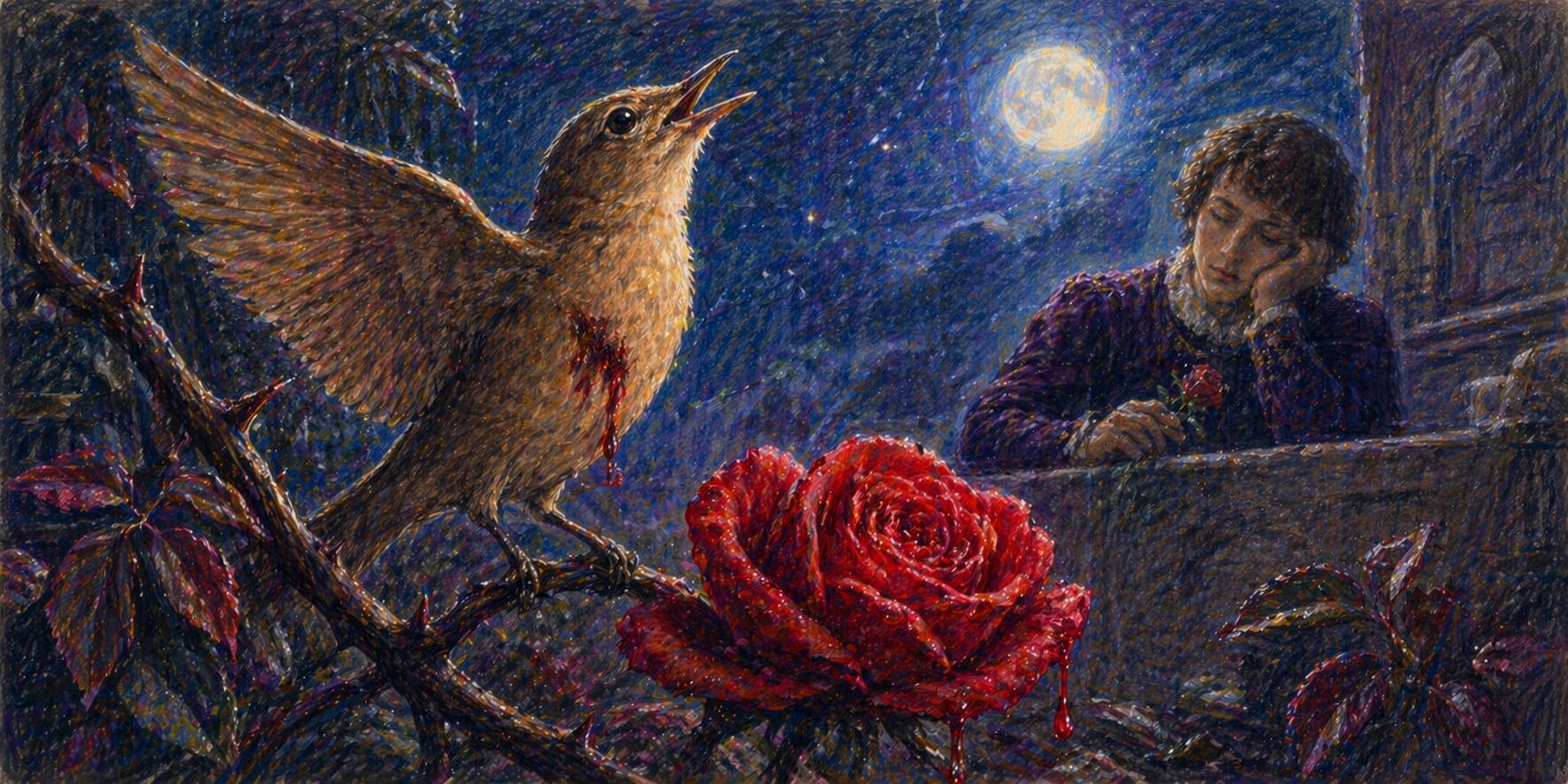
She sang first of the birth of love in the heart of a boy and a girl. And on the top-most spray of the Rose-tree there blossomed a marvellous rose, petal following petal, as song followed song.
Cô hát trước tiên về sự ra đời của tình yêu trong lòng một chàng trai và một cô gái. Và trên cành cao nhất của cây Hồng nở ra một bông hồng kỳ diệu, cánh hoa tiếp theo cánh hoa, như bài ca tiếp theo bài ca.
Pale was it, at first, as the mist that hangs over the river — pale as the feet of the morning, and silver as the wings of the dawn. As the shadow of a rose in a mirror of silver, as the shadow of a rose in a water-pool, so was the rose that blossomed on the topmost spray of the Tree.
Lúc đầu nó nhạt màu, như sương mù lơ lửng trên sông — nhạt như chân buổi sớm mai, và bạc như cánh của bình minh. Như bóng một bông hồng trong gương bạc, như bóng một bông hồng trong vũng nước, đó là bông hồng nở trên cành cao nhất của cây.
But the Tree cried to the Nightingale to press closer against the thorn. “Press closer, little Nightingale,” cried the Tree, “or the Day will come before the rose is finished.”
Nhưng cây kêu gọi chim Họa Mi ép sát hơn vào chiếc gai. “Ép sát hơn đi, chim Họa Mi nhỏ,” cây kêu lên, “nếu không Ngày sẽ đến trước khi bông hồng hoàn thành.”
So the Nightingale pressed closer against the thorn, and louder and louder grew her song, for she sang of the birth of passion in the soul of a man and a maid.
Vì vậy chim Họa Mi ép sát hơn vào chiếc gai, và bài ca của cô ngày càng to hơn, vì cô hát về sự ra đời của đam mê trong tâm hồn của một người đàn ông và một người con gái.
And a delicate flush of pink came into the leaves of the rose, like the flush in the face of the bridegroom when he kisses the lips of the bride. But the thorn had not yet reached her heart, so the rose’s heart remained white, for only a Nightingale’s heart’s-blood can crimson the heart of a rose.
Và một màu hồng phớt tinh tế lan vào những cánh hoa hồng, như màu hồng trên khuôn mặt chú rể khi anh hôn môi cô dâu. Nhưng chiếc gai chưa chạm đến trái tim cô, vì vậy lòng bông hồng vẫn còn trắng, vì chỉ có máu từ trái tim của chim Họa Mi mới có thể nhuộm đỏ lòng bông hồng.
But the Tree cried to the Nightingale to press closer against the thorn. “Press closer, little Nightingale,” cried the Tree, “or the Day will come before the rose is finished.”
Nhưng cây lại kêu gọi chim Họa Mi ép sát hơn vào chiếc gai. “Ép sát hơn đi, chim Họa Mi nhỏ,” cây kêu lên, “nếu không Ngày sẽ đến trước khi bông hồng hoàn thành.”
So the Nightingale pressed closer against the thorn, and the thorn touched her heart, and a fierce pang of pain shot through her. Bitter, bitter was the pain, and wilder and wilder grew her song, for she sang of the Love that is perfected by Death, of the Love that dies not in the tomb.
Vì vậy chim Họa Mi ép sát hơn vào chiếc gai, và chiếc gai chạm đến trái tim cô, và một cơn đau dữ dội xuyên qua cô. Đắng cay, thật đắng cay là nỗi đau, và bài ca của cô ngày càng hoang dại hơn, vì cô hát về Tình Yêu được hoàn thiện bởi Cái Chết, về Tình Yêu không chết trong nấm mồ.
And the marvellous rose became crimson, like the rose of the eastern sky. Crimson was the girdle of petals, and crimson as a ruby was the heart.
Và bông hồng kỳ diệu trở nên đỏ thẫm, như bông hồng của bầu trời phương đông. Đỏ thẫm là vành cánh hoa, và đỏ thẫm như hồng ngọc là lòng bông hoa.
But the Nightingale’s voice grew fainter, and her little wings began to beat, and a film came over her eyes. Fainter and fainter grew her song, and she felt something choking her in her throat.
Nhưng giọng chim Họa Mi ngày càng yếu dần, và đôi cánh nhỏ của cô bắt đầu đập, và một màng mờ phủ lên mắt cô. Bài ca ngày càng yếu dần, và cô cảm thấy có gì đó đang nghẹn trong cổ họng.
Then she gave one last burst of music. The white Moon heard it, and she forgot the dawn, and lingered on in the sky. The red rose heard it, and it trembled all over with ecstasy, and opened its petals to the cold morning air. Echo bore it to her purple cavern in the hills, and woke the sleeping shepherds from their dreams. It floated through the reeds of the river, and they carried its message to the sea.
Rồi cô tung ra một cơn bùng phát âm nhạc cuối cùng. Mặt Trăng trắng nghe thấy, và quên mất bình minh, và nán lại trên bầu trời. Bông hồng đỏ nghe thấy, và run rẩy khắp mình trong xuất thần, và mở những cánh hoa ra đón không khí buổi sáng lạnh lẽo. Tiếng vang mang nó đến hang động tím của mình trong những ngọn đồi, và đánh thức những người chăn cừu đang ngủ khỏi giấc mơ. Nó trôi nổi qua những lau sậy của dòng sông, và chúng mang thông điệp của nó ra biển.
“Look, look!” cried the Tree, “the rose is finished now”; but the Nightingale made no answer, for she was lying dead in the long grass, with the thorn in her heart.
“Nhìn kìa, nhìn kìa!” cây kêu lên, “bông hồng đã hoàn thành rồi”; nhưng chim Họa Mi không trả lời, vì cô đang nằm chết trong đám cỏ dài, với chiếc gai trong trái tim.
End of Episode 3 — Stay tuned for the next episode! / Kết thúc Episode 3 — Hãy đón đọc episode tiếp theo!
Final Part: The Rose Destroyed
Part Cuối: Bông Hồng Bị Hủy Hoại
And at noon the Student opened his window and looked out.
Và đến trưa Sinh Viên mở cửa sổ và nhìn ra ngoài.
“Why, what a wonderful piece of luck!” he cried; “here is a red rose! I have never seen any rose like it in all my life. It is so beautiful that I am sure it has a long Latin name”; and he leaned down and plucked it.
“Ôi, thật là may mắn tuyệt vời!” anh kêu lên; “đây là một bông hồng đỏ! Tôi chưa bao giờ thấy bông hồng nào như thế này trong suốt cuộc đời. Nó đẹp đến mức tôi chắc chắn nó có một cái tên Latin dài”; và anh cúi xuống và hái nó.
Then he put on his hat, and ran up to the Professor’s house with the rose in his hand.
Rồi anh đội mũ lên, và chạy đến nhà Giáo Sư với bông hồng trên tay.
The daughter of the Professor was sitting in the doorway winding blue silk on a reel, and her little dog was lying at her feet.
Con gái của Giáo Sư đang ngồi ở cửa quấn lụa xanh vào ống cuộn, và con chó nhỏ của cô đang nằm dưới chân cô.
“You said that you would dance with me if I brought you a red rose,” cried the Student. “Here is the reddest rose in all the world. You will wear it to-night next your heart, and as we dance together it will tell you how I love you.”
“Cô nói rằng cô sẽ khiêu vũ với tôi nếu tôi mang đến cho cô một bông hồng đỏ,” Sinh Viên kêu lên. “Đây là bông hồng đỏ nhất trên toàn thế giới. Cô sẽ đeo nó tối nay kề trái tim cô, và khi chúng ta cùng khiêu vũ nó sẽ nói với cô rằng tôi yêu cô như thế nào.”
But the girl frowned. “I am afraid it will not go with my dress,” she answered; “and, besides, the Chamberlain’s nephew has sent me some real jewels, and everybody knows that jewels cost far more than flowers.”
Nhưng cô gái cau mày. “Tôi sợ rằng nó sẽ không hợp với váy của tôi,” cô trả lời; “hơn nữa, cháu trai của Thị Lang đã gửi cho tôi một số đồ trang sức thật, và ai cũng biết rằng đồ trang sức tốn kém hơn hoa rất nhiều.”
“Well, upon my word, you are very ungrateful,” said the Student angrily; and he threw the rose into the street, where it fell into the gutter, and a cart-wheel went over it.
“Thôi nào, thật ra, cô thật vô ơn,” Sinh Viên nói tức giận; và anh ném bông hồng ra đường phố, nơi nó rơi vào rãnh nước, và một bánh xe bò lăn qua nó.
“Ungrateful!” said the girl. “I tell you what, you are very rude; and, after all, who are you? Only a Student. Why, I don’t believe you have even got silver buckles to your shoes as the Chamberlain’s nephew has”; and she got up from her chair and went into the house.
“Vô ơn!” cô gái nói. “Tôi nói thật nhé, anh rất thô lỗ; hơn nữa, anh là ai? Chỉ là một sinh viên. Ơ kìa, tôi không tin rằng anh thậm chí có khóa bạc trên giày như cháu trai của Thị Lang”; và cô đứng dậy khỏi ghế và vào nhà.
“What a silly thing Love is,” said the Student as he walked away. “It is not half as useful as Logic, for it does not prove anything, and it is always telling one of things that are not going to happen, and making one believe things that are not true. In fact, it is quite unpractical, and, as in this age to be practical is everything, I shall go back to Philosophy and study Metaphysics.”
“Tình Yêu thật là ngớ ngẩn,” Sinh Viên nói khi bước đi. “Nó không có ích bằng một nửa Luận Lý, vì nó không chứng minh được gì, và nó luôn nói với người ta về những điều sẽ không xảy ra, và khiến người ta tin vào những điều không đúng. Thực ra, nó hoàn toàn không thực tế, và vì trong thời đại này thực dụng là tất cả, tôi sẽ quay lại Triết Học và nghiên cứu Siêu Hình Học.”
So he returned to his room and pulled out a great dusty book, and began to read.
Vì vậy anh trở về phòng và lôi ra một cuốn sách dày đầy bụi bặm, và bắt đầu đọc.
The End / Kết Thúc
Special Topic: Wilde’s Tragedy of True Love
Bình Luận: Bi Kịch Của Tình Yêu Thực Sự trong Wilde
“The Nightingale and the Rose” (1888) is one of Oscar Wilde’s most heartbreaking and philosophically rich fairy tales — a story that operates on multiple levels at once: as a meditation on the nature of love, as a satire on materialism and intellectual vanity, and as a tragedy of the highest order.
“Chim Họa Mi và Bông Hồng” (1888) là một trong những câu chuyện cổ tích xé lòng và giàu triết học nhất của Oscar Wilde — một câu chuyện vận hành trên nhiều tầng cùng một lúc: như một sự suy ngẫm về bản chất của tình yêu, như một sự châm biếm về chủ nghĩa vật chất và sự tự phụ trí tuệ, và như một bi kịch thuộc hàng cao nhất.
The story’s irony is devastating in its precision: the one being who truly understands love — who acts on it, sacrifices for it, and dies for it — is a bird. The humans in the story — the Student, the Professor’s daughter — are entirely blind to it.
Sự mỉa mai của câu chuyện tàn khốc trong sự chính xác của nó: sinh vật duy nhất thực sự hiểu tình yêu — người hành động vì nó, hy sinh vì nó, và chết vì nó — là một con chim. Những con người trong câu chuyện — Sinh Viên, con gái Giáo Sư — hoàn toàn mù quáng trước nó.
The Student claims to be in love, but his love is entirely self-referential — he wants the girl to dance with him, to hold her in his arms, to feel her head on his shoulder. It is a love of possession and sensation, not a love of the other person.
Sinh Viên tuyên bố đang yêu, nhưng tình yêu của anh hoàn toàn hướng vào bản thân — anh muốn cô gái khiêu vũ với anh, muốn ôm cô trong vòng tay, muốn cảm nhận đầu cô trên vai anh. Đó là tình yêu của sự chiếm hữu và cảm giác, không phải tình yêu hướng đến người khác.
When his gift is rejected, he abandons love entirely — declaring it “silly” and “unpractical” — and returns to his books. He never grieves for the rose, never wonders at its perfection, never asks where it came from.
Khi món quà của anh bị từ chối, anh từ bỏ tình yêu hoàn toàn — tuyên bố nó “ngớ ngẩn” và “không thực tế” — và quay lại sách vở. Anh không bao giờ đau buồn vì bông hồng, không bao giờ ngạc nhiên trước sự hoàn hảo của nó, không bao giờ hỏi nó đến từ đâu.
The Professor’s daughter is equally hollow: she rejects the rose not because she doesn’t love the Student, but because it doesn’t match her dress — and because someone richer has sent her jewels.
Con gái Giáo Sư cũng rỗng tuếch tương tự: cô từ chối bông hồng không phải vì cô không yêu Sinh Viên, mà vì nó không hợp váy — và vì có người giàu hơn đã gửi cho cô đồ trang sức.
Against these two figures of emptiness, Wilde sets the Nightingale — a creature who has never met the Student, who owes him nothing, but who recognizes in his weeping the authentic voice of love, and chooses to answer it with everything she has.
Đối lập với hai nhân vật trống rỗng này, Wilde đặt chim Họa Mi — một sinh vật chưa bao giờ gặp Sinh Viên, không nợ anh gì, nhưng nhận ra trong tiếng khóc của anh giọng nói chân thực của tình yêu, và chọn cách đáp lại nó bằng tất cả những gì cô có.
Her sacrifice is absolute, freely given, and completely misunderstood by the very person it was made for.
Sự hy sinh của cô là tuyệt đối, được trao tự nguyện, và hoàn toàn bị hiểu nhầm bởi chính người mà nó được thực hiện vì.
The Student, after hearing her final song, dismisses her as “all style, without any sincerity” — and this is perhaps the most painful line in the story, because it is so perfectly, appallingly wrong.
Sinh Viên, sau khi nghe bài ca cuối cùng của cô, gạt cô sang một bên như “tất cả đều là phong cách, không có sự chân thành” — và đây có lẽ là dòng đau đớn nhất trong câu chuyện, vì nó sai một cách hoàn hảo, kinh hoàng.
Wilde was a man who knew the gap between the world’s understanding of art and what art actually costs — who understood that the deepest creativity is always a kind of bleeding, that beauty is never free, and that those who consume it most carelessly are often those who understand it least.
Wilde là người biết khoảng cách giữa sự hiểu biết của thế giới về nghệ thuật và những gì nghệ thuật thực sự tốn — người hiểu rằng sự sáng tạo sâu sắc nhất luôn là một loại chảy máu, rằng vẻ đẹp không bao giờ miễn phí, và những người tiêu thụ nó bất cẩn nhất thường là những người hiểu nó ít nhất.
For Vietnamese readers, the story touches something universally recognized: the loneliness of those who love truly in a world that values appearances and practicality above all else, and the quiet, tragic dignity of giving everything for something that will never be properly valued.
Đối với độc giả Việt Nam, câu chuyện chạm đến điều được nhận ra rộng rãi: sự cô đơn của những người yêu thực sự trong một thế giới đề cao vẻ bề ngoài và tính thực dụng hơn tất cả, và phẩm giá lặng lẽ, bi thảm của việc cho đi tất cả vì điều gì đó sẽ không bao giờ được đánh giá đúng.
The rose, crushed under a cart-wheel in the gutter, is the story’s final image — and it says everything: that what was built from the highest sacrifice can be destroyed in a moment of indifference, and that the world will not pause to notice.
Bông hồng bị nghiền nát dưới bánh xe bò trong rãnh nước là hình ảnh cuối cùng của câu chuyện — và nó nói lên tất cả: rằng những gì được xây dựng từ sự hy sinh cao nhất có thể bị hủy hoại trong một khoảnh khắc thờ ơ, và thế giới sẽ không dừng lại để chú ý.
The End / Kết Thúc
“She said that she would dance with me if I brought her red roses,” cried the young Student; “but in all my garden there is no red rose.”
From her nest in the holm-oak tree the Nightingale heard him, and she looked out through the leaves, and wondered.
“No red rose in all my garden!” he cried, and his beautiful eyes filled with tears. “Ah, fon what little things does happiness depend! I have read all that the wise men have written, and all the secrets of philosophy are mine, yet for want of a red rose is my life made wretched.”
“Here at last is a true lover,” said the Nightingale. “Night after night have I sung of him, though I knew him not: night after night have I told his story to the stars, and now I see him. His hair is dark as the hyacinth-blossom, and his lips are red as the rose of his desire; but passion has made his face like pale ivory, and sorrow has set her seal upon his brow.”
“The Prince gives a ball to-morrow night,” murmured the young Student, “and my love will be of the company. If I bring her a red rose she will dance with me till dawn. If I bring her a red rose, I shall hold her in my arms, and she will lean her head upon my shoulder, and her hand will be clasped in mine. But there is no red rose in my garden, so I shall sit lonely, and she will pass me by. She will have no heed of me, and my heart will break.”
“Here indeed is the true lover,” said the Nightingale. “What I sing of, he suffers – what is joy to me, to him is pain. Surely Love is a wonderful thing. It is more precious than emeralds, and dearer than fine opals. Pearls and pomegranates cannot buy it, nor is it set forth in the marketplace. It may not be purchased of the merchants, nor can it be weighed out in the balance for gold.”
“The musicians will sit in their gallery,” said the young Student, “and play upon their stringed instruments, and my love will dance to the sound of the harp and the violin. She will dance so lightly that her feet will not touch the floor, and the courtiers in their gay dresses will throng round her. But with me she will not dance, for I have no red rose to give her”; and he flung himself down on the grass, and buried his face in his hands, and wept.
“Why is he weeping?” asked a little Green Lizard, as he ran past him with his tail in the air.
“Why, indeed?” said a Butterfly, who was fluttering about after a sunbeam.
“Why, indeed?” whispered a Daisy to his neighbour, in a soft, low voice.
“He is weeping for a red rose,” said the Nightingale.
“For a red rose?” they cried; “how very ridiculous!” and the little Lizard, who was something of a cynic, laughed outright.
But the Nightingale understood the secret of the Student’s sorrow, and she sat silent in the oak-tree, and thought about the mystery of Love.
Suddenly she spread her brown wings for flight, and soared into the air. She passed through the grove like a shadow, and like a shadow she sailed across the garden.
In the centre of the grass-plot was standing a beautiful Rose-tree, and when she saw it she flew over to it, and lit upon a spray.
“Give me a red rose,” she cried, “and I will sing you my sweetest song.”
But the Tree shook its head.
“My roses are white,” it answered; “as white as the foam of the sea, and whiter than the snow upon the mountain. But go to my brother who grows round the old sun-dial, and perhaps he will give you what you want.”
So the Nightingale flew over to the Rose-tree that was growing round the old sun-dial.
“Give me a red rose,” she cried, “and I will sing you my sweetest song.”
But the Tree shook its head.
“My roses are yellow,” it answered; “as yellow as the hair of the mermaiden who sits upon an amber throne, and yellower than the daffodil that blooms in the meadow before the mower comes with his scythe. But go to my brother who grows beneath the Student’s window, and perhaps he will give you what you want.”
So the Nightingale flew over to the Rose-tree that was growing beneath the Student’s window.
“Give me a red rose,” she cried, “and I will sing you my sweetest song.”
But the Tree shook its head.
“My roses are red,” it answered, “as red as the feet of the dove, and redder than the great fans of coral that wave and wave in the ocean-cavern. But the winter has chilled my veins, and the frost has nipped my buds, and the storm has broken my branches, and I shall have no roses at all this year.”
“One red rose is all I want,” cried the Nightingale, “only one red rose! Is there no way by which I can get it?”
“There is a way,” answered the Tree; “but it is so terrible that I dare not tell it to you.”
“Tell it to me,” said the Nightingale, “I am not afraid.”
“If you want a red rose,” said the Tree, “you must build it out of music by moonlight, and stain it with your own heart’s-blood. You must sing to me with your breast against a thorn. All night long you must sing to me, and the thorn must pierce your heart, and your life-blood must flow into my veins, and become mine.”
“Death is a great price to pay for a red rose,” cried the Nightingale, “and Life is very dear to all. It is pleasant to sit in the green wood, and to watch the Sun in his chariot of gold, and the Moon in her chariot of pearl. Sweet is the scent of the hawthorn, and sweet are the bluebells that hide in the valley, and the heather that blows on the hill. Yet Love is better than Life, and what is the heart of a bird compared to the heart of a man?”
So she spread her brown wings for flight, and soared into the air. She swept over the garden like a shadow, and like a shadow she sailed through the grove.
The young Student was still lying on the grass, where she had left him, and the tears were not yet dry in his beautiful eyes.
“Be happy,” cried the Nightingale, “be happy; you shall have your red rose. I will build it out of music by moonlight, and stain it with my own heart’s-blood. All that I ask of you in return is that you will be a true lover, for Love is wiser than Philosophy, though she is wise, and mightier than Power, though he is mighty. Flame- coloured are his wings, and coloured like flame is his body. His lips are sweet as honey, and his breath is like frankincense.”
The Student looked up from the grass, and listened, but he could not understand what the Nightingale was saying to him, for he only knew the things that are written down in books.
But the Oak-tree understood, and felt sad, for he was very fond of the little Nightingale who had built her nest in his branches.
“Sing me one last song,” he whispered; “I shall feel very lonely when you are gone.”
So the Nightingale sang to the Oak-tree, and her voice was like water bubbling from a silver jar.
When she had finished her song the Student got up, and pulled a note-book and a lead-pencil out of his pocket.
“She has form,” he said to himself, as he walked away through the grove – “that cannot be denied to her; but has she got feeling? I am afraid not. In fact, she is like most artists; she is all style, without any sincerity. She would not sacrifice herself for others. She thinks merely of music, and everybody knows that the arts are selfish. Still, it must be admitted that she has some beautiful notes in her voice. What a pity it is that they do not mean anything, or do any practical good.” And he went into his room, and lay down on his little pallet-bed, and began to think of his love; and, after a time, he fell asleep.
And when the Moon shone in the heavens the Nightingale flew to the Rose-tree, and set her breast against the thorn. All night long she sang with her breast against the thorn, and the cold crystal Moon leaned down and listened. All night long she sang, and the thorn went deeper and deeper into her breast, and her life-blood ebbed away from her.
She sang first of the birth of love in the heart of a boy and a girl. And on the top-most spray of the Rose-tree there blossomed a marvellous rose, petal following petal, as song followed song. Pale was it, at first, as the mist that hangs over the river – pale as the feet of the morning, and silver as the wings of the dawn. As the shadow of a rose in a mirror of silver, as the shadow of a rose in a water-pool, so was the rose that blossomed on the topmost spray of the Tree.
But the Tree cried to the Nightingale to press closer against the thorn. “Press closer, little Nightingale,” cried the Tree, “or the Day will come before the rose is finished.”
So the Nightingale pressed closer against the thorn, and louder and louder grew her song, for she sang of the birth of passion in the soul of a man and a maid.
And a delicate flush of pink came into the leaves of the rose, like the flush in the face of the bridegroom when he kisses the lips of the bride. But the thorn had not yet reached her heart, so the rose’s heart remained white, for only a Nightingale’s heart’s-blood can crimson the heart of a rose.
And the Tree cried to the Nightingale to press closer against the thorn. “Press closer, little Nightingale,” cried the Tree, “or the Day will come before the rose is finished.”
So the Nightingale pressed closer against the thorn, and the thorn touched her heart, and a fierce pang of pain shot through her. Bitter, bitter was the pain, and wilder and wilder grew her song, for she sang of the Love that is perfected by Death, of the Love that dies not in the tomb.
And the marvellous rose became crimson, like the rose of the eastern sky. Crimson was the girdle of petals, and crimson as a ruby was the heart.
But the Nightingale’s voice grew fainter, and her little wings began to beat, and a film came over her eyes. Fainter and fainter grew her song, and she felt something choking her in her throat.
Then she gave one last burst of music. The white Moon heard it, and she forgot the dawn, and lingered on in the sky. The red rose heard it, and it trembled all over with ecstasy, and opened its petals to the cold morning air. Echo bore it to her purple cavern in the hills, and woke the sleeping shepherds from their dreams. It floated through the reeds of the river, and they carried its message to the sea.
“Look, look!” cried the Tree, “the rose is finished now”; but the Nightingale made no answer, for she was lying dead in the long grass, with the thorn in her heart.
And at noon the Student opened his window and looked out.
“Why, what a wonderful piece of luck!” he cried; “here is a red rose! I have never seen any rose like it in all my life. It is so beautiful that I am sure it has a long Latin name”; and he leaned down and plucked it.
Then he put on his hat, and ran up to the Professor’s house with the rose in his hand.
The daughter of the Professor was sitting in the doorway winding blue silk on a reel, and her little dog was lying at her feet.
“You said that you would dance with me if I brought you a red rose,” cried the Student. “Here is the reddest rose in all the world. You will wear it to-night next your heart, and as we dance together it will tell you how I love you.”
But the girl frowned.
“I am afraid it will not go with my dress,” she answered; “and, besides, the Chamberlain’s nephew has sent me some real jewels, and everybody knows that jewels cost far more than flowers.”
“Well, upon my word, you are very ungrateful,” said the Student angrily; and he threw the rose into the street, where it fell into the gutter, and a cart-wheel went over it.
“Ungrateful!” said the girl. “I tell you what, you are very rude; and, after all, who are you? Only a Student. Why, I don’t believe you have even got silver buckles to your shoes as the Chamberlain’s nephew has”; and she got up from her chair and went into the house.
“What a silly thing Love is,” said the Student as he walked away. “It is not half as useful as Logic, for it does not prove anything, and it is always telling one of things that are not going to happen, and making one believe things that are not true. In fact, it is quite unpractical, and, as in this age to be practical is everything, I shall go back to Philosophy and study Metaphysics.”
So he returned to his room and pulled out a great dusty book, and began to read.
Mastering “The Nightingale and the Rose”
Explore the sacrifice, the logic, and the irony.
1. Why is the Student weeping in his garden?
2. How does the Nightingale perceive Love?
3. What is the literal “price” of the red rose for the Nightingale?
4. The Student calls the Nightingale’s song “unpractical.” What does this reveal about him?
5. What does the word “Inappreciative” mean in the context of the Student?
6. Why did the girl reject the rose at the end?
7. What happened to the rose after the Student threw it away?
8. What is the meaning of “Cynicism” as reflected in the Student’s final actions?
9. “Love is wise, but Philosophy is wiser.” Who thinks this?
10. What is the literary tone of Oscar Wilde in the ending?