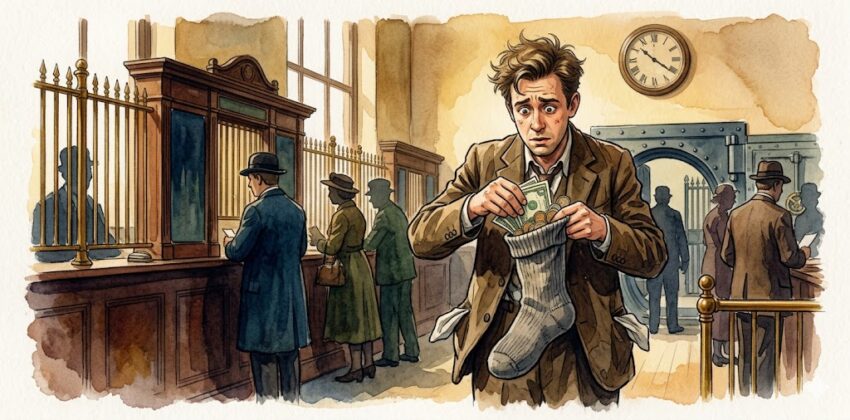
Xuất bản năm 1910 bởi bậc thầy châm biếm Stephen Leacock, câu chuyện biến trải nghiệm ngân hàng bình thường thành cơn ác mộng dở khóc dở cười. Bạn có thấy mình trong đó?
My Financial Career / Sự Nghiệp Tài Chính Của Tôi by Stephen Leacock
Part 1: The Manager’s Private Room
Phần 1: Căn Phòng Riêng Của Giám Đốc
When I go into a bank I get rattled. The clerks rattle me; the wickets rattle me; the sight of the money rattles me; everything rattles me.
Mỗi khi tôi bước vào ngân hàng là tôi bị rối loạn. Các nhân viên làm tôi rối; các ô giao dịch làm tôi rối; cảnh tiền bạc làm tôi rối; tất cả mọi thứ đều làm tôi rối.
The moment I cross the threshold of a bank and attempt to transact business there, I become an irresponsible idiot.
Ngay khoảnh khắc tôi bước qua ngưỡng cửa ngân hàng và cố gắng giao dịch ở đó, tôi trở thành một kẻ ngốc vô trách nhiệm.
I knew this beforehand, but my salary had been raised to fifty dollars a month and I felt that the bank was the only place for it.
Tôi biết điều này từ trước, nhưng lương của tôi đã được tăng lên năm mươi đô-la một tháng và tôi cảm thấy ngân hàng là nơi duy nhất thích hợp cho số tiền đó.
So I shambled in and looked timidly round at the clerks. I had an idea that a person about to open an account must needs consult the manager.
Vì vậy tôi lảo đảo bước vào và nhút nhát nhìn quanh những nhân viên. Tôi có ý nghĩ rằng một người sắp mở tài khoản nhất thiết phải tham vấn với giám đốc.
I went up to a wicket marked “Accountant.” The accountant was a tall, cool devil. The very sight of him rattled me. My voice was sepulchral.
Tôi bước đến ô giao dịch có biển đề “Kế Toán Viên.” Kế toán viên là một tên cao lớn, lạnh lùng như quỷ. Chỉ nhìn thấy anh ta thôi đã làm tôi rối. Giọng tôi trầm như giọng đọc lễ tang.
“Can I see the manager?” I said, and added solemnly, “alone.” I don’t know why I said “alone.”
“Tôi có thể gặp giám đốc không?” tôi nói, rồi thêm vào một cách trang trọng, “riêng.” Tôi không biết tại sao tôi nói “riêng.”
“Certainly,” said the accountant, and fetched him.
“Tất nhiên,” kế toán viên nói, rồi đi gọi ông ta.
The manager was a grave, calm man. I held my fifty-six dollars clutched in a crumpled ball in my pocket.
Giám đốc là người nghiêm túc, điềm tĩnh. Tôi giữ chặt năm mươi sáu đô-la của mình cuộn thành một nắm nhàu nát trong túi.
“Are you the manager?” I said. God knows I didn’t doubt it.
“Ông có phải là giám đốc không?” tôi hỏi. Chúa biết là tôi không hề nghi ngờ điều đó.
“Yes,” he said.
“Vâng,” ông nói.
“Can I see you,” I asked, “alone?” I didn’t want to say “alone” again, but without it the thing seemed self-evident.
“Tôi có thể gặp ông,” tôi hỏi, “riêng không?” Tôi không muốn nói “riêng” một lần nữa, nhưng nếu không có từ đó thì câu hỏi có vẻ hiển nhiên quá.
The manager looked at me in some alarm. He felt that I had an awful secret to reveal.
Giám đốc nhìn tôi với vẻ lo lắng nào đó. Ông cảm thấy rằng tôi có một bí mật kinh khủng cần tiết lộ.
“Come in here,” he said, and led the way to a private room. He turned the key in the lock.
“Vào đây,” ông nói, và dẫn đường đến một căn phòng riêng. Ông xoay chìa khóa trong ổ khóa.
“We are safe from interruption here,” he said; “sit down.”
“Ở đây chúng ta an toàn khỏi sự làm phiền,” ông nói; “ngồi xuống đi.”
We both sat down and looked at each other. I found no voice to speak.
Chúng tôi cùng ngồi xuống và nhìn nhau. Tôi không tìm được giọng để nói.
“You are one of Pinkerton’s men, I presume,” he said.
“Ông là một trong những người của Pinkerton, tôi đoán vậy,” ông nói.
He had gathered from my mysterious manner that I was a detective. I knew what he was thinking, and it made me worse.
Ông đã suy ra từ cử chỉ bí ẩn của tôi rằng tôi là thám tử. Tôi biết ông đang nghĩ gì, và điều đó làm tôi tệ hơn.
“No, not from Pinkerton’s,” I said, seeming to imply that I came from a rival agency. “To tell the truth,” I went on, as if I had been prompted to lie about it, “I am not a detective at all. I have come to open an account. I intend to keep all my money in this bank.”
“Không, không phải từ Pinkerton’s,” tôi nói, có vẻ ngụ ý rằng tôi đến từ một cơ quan cạnh tranh. “Nói thật mà,” tôi tiếp tục, như thể tôi đã được xúi giục nói dối về chuyện đó, “tôi không phải thám tử chút nào. Tôi đến để mở tài khoản. Tôi có ý định giữ tất cả tiền của mình ở ngân hàng này.”
The manager looked relieved but still serious; he concluded now that I was a son of Baron Rothschild or a young Gould.
Giám đốc có vẻ nhẹ nhõm nhưng vẫn nghiêm túc; ông kết luận bây giờ rằng tôi là con trai của Nam tước Rothschild hay một Gould trẻ tuổi.
“A large account, I suppose,” he said.
“Tài khoản lớn, tôi đoán vậy,” ông nói.
“Fairly large,” I whispered. “I propose to deposit fifty-six dollars now and fifty dollars a month regularly.”
“Khá lớn,” tôi thì thầm. “Tôi dự định gửi năm mươi sáu đô-la ngay bây giờ và năm mươi đô-la mỗi tháng đều đặn.”
The manager got up and opened the door. He called to the accountant. “Mr. Montgomery,” he said unkindly loud, “this gentleman is opening an account, he will deposit fifty-six dollars. Good morning.”
Giám đốc đứng dậy và mở cửa. Ông gọi kế toán viên. “Ông Montgomery,” ông nói to một cách không mấy lịch sự, “quý ngài này đang mở tài khoản, ông ấy sẽ gửi năm mươi sáu đô-la. Chào buổi sáng.”
I rose. A big iron door stood open at the side of the room. “Good morning,” I said, and stepped into the safe.
Tôi đứng dậy. Một cánh cửa sắt lớn đứng mở ở cạnh phòng. “Chào buổi sáng,” tôi nói, và bước vào két sắt.
“Come out,” said the manager coldly, and showed me the other way.
“Ra ngoài đi,” giám đốc nói lạnh lùng, và chỉ cho tôi hướng khác.
End of Episode 1 — Stay tuned for the next episode! / Kết thúc Episode 1 — Hãy đón đọc episode tiếp theo!
Final Part: The Great Withdrawal
Part Cuối: Cuộc Rút Tiền Vĩ Đại
I went up to the accountant’s wicket and poked the ball of money at him with a quick convulsive movement as if I were doing a conjuring trick.
Tôi bước đến ô giao dịch của kế toán viên và chọc nắm tiền vào phía anh ta bằng một cử động giật nhanh như thể tôi đang làm trò ảo thuật.
My face was ghastly pale. “Here,” I said, “deposit it.” The tone of the words seemed to mean, “Let us do this painful thing while the fit is on us.”
Mặt tôi tái nhợt kinh khủng. “Đây,” tôi nói, “gửi đi.” Giọng điệu của những lời này có vẻ như muốn nói, “Hãy làm cái việc đau đớn này trong khi cơn bốc đồng đang ập đến.”
He took the money and gave it to another clerk. He made me write the sum on a slip and sign my name in a book. I no longer knew what I was doing. The bank swam before my eyes.
Anh ta lấy tiền và đưa cho một nhân viên khác. Anh ta bắt tôi viết số tiền lên một tờ giấy và ký tên vào một cuốn sổ. Tôi không còn biết mình đang làm gì nữa. Ngân hàng quay vòng trước mắt tôi.
“Is it deposited?” I asked in a hollow, vibrating voice. “It is,” said the accountant.
“Đã gửi chưa?” tôi hỏi bằng giọng rỗng tuếch, run rẩy. “Rồi,” kế toán viên nói.
“Then I want to draw a cheque.”
“Vậy thì tôi muốn rút tiền bằng séc.”
My idea was to draw out six dollars of it for present use. Someone gave me a chequebook through a wicket and someone else began telling me how to write it out. The people in the bank had the impression that I was an invalid millionaire.
Ý định của tôi là rút sáu đô-la để dùng trước mắt. Ai đó đưa cho tôi cuốn séc qua ô giao dịch và người khác bắt đầu hướng dẫn tôi cách điền. Những người trong ngân hàng có ấn tượng rằng tôi là một triệu phú tàn tật.
I wrote something on the cheque and thrust it in at the clerk. He looked at it. “What! are you drawing it all out again?” he asked in surprise.
Tôi viết gì đó lên tờ séc và nhét vào cho nhân viên. Anh ta nhìn vào đó. “Cái gì! Ông rút hết ra rồi à?” anh ta hỏi ngạc nhiên.
Then I realized that I had written fifty-six instead of six. I was too far gone to reason now. I had a feeling that it was impossible to explain the thing. All the clerks had stopped writing to look at me.
Rồi tôi nhận ra mình đã viết năm mươi sáu thay vì sáu. Tôi đã quá điên loạn để lý luận bây giờ. Tôi có cảm giác rằng không thể nào giải thích chuyện này được. Tất cả các nhân viên đã dừng viết để nhìn tôi.
Reckless with misery, I made a plunge. “Yes, the whole thing.”
Liều lĩnh vì khổ sở, tôi lao đầu vào. “Vâng, rút hết.”
“You withdraw your money from the bank?” “Every cent of it.”
“Ông rút tiền ra khỏi ngân hàng?” “Từng xu một.”
“Are you not going to deposit any more?” said the clerk, astonished. “Never.”
“Ông sẽ không gửi thêm nữa sao?” nhân viên hỏi, kinh ngạc. “Không bao giờ.”
An idiot hope struck me that they might think something had insulted me while I was writing the cheque and that I had changed my mind. I made a wretched attempt to look like a man with a fearfully quick temper.
Một hy vọng ngớ ngẩn nảy ra trong tôi rằng họ có thể nghĩ điều gì đó đã xúc phạm tôi trong khi tôi viết séc và tôi đã đổi ý. Tôi cố gắng khổ sở để trông giống như một người đàn ông có tính nóng nảy kinh khủng.
The clerk prepared to pay the money. “How will you have it?” he said. “What?” “How will you have it?”
Nhân viên chuẩn bị trả tiền. “Ông muốn nhận thế nào?” anh ta hỏi. “Cái gì?” “Ông muốn nhận thế nào?”
“Oh” — I caught his meaning and answered without even trying to think — “in fifties.”
“Ồ” — tôi hiểu ý anh ta và trả lời mà không cần cố nghĩ — “tờ năm mươi.”
He gave me a fifty-dollar bill. “And the six?” he asked dryly. “In sixes,” I said.
Anh ta đưa cho tôi tờ năm mươi đô-la. “Còn sáu đô-la?” anh ta hỏi khô khan. “Tờ sáu,” tôi nói.
He gave it me and I rushed out.
Anh ta đưa tiền và tôi lao ra ngoài.
As the big door swung behind me I caught the echo of a roar of laughter that went up to the ceiling of the bank. Since then I bank no more. I keep my money in cash in my trousers pocket and my savings in silver dollars in a sock.
Khi cánh cửa lớn đóng lại sau lưng tôi, tôi nghe thấy tiếng vang của một tràng cười vang lên đến trần ngân hàng. Kể từ đó tôi không dùng ngân hàng nữa. Tôi giữ tiền mặt trong túi quần và tiền tiết kiệm bằng đô-la bạc trong một chiếc tất.
The End / Kết Thúc
Special Topic: Leacock’s Comedy of Social Anxiety
Bình Luận: Hài Kịch Về Nỗi Lo Xã Hội của Leacock
“My Financial Career” (1910) is one of Stephen Leacock’s most celebrated humorous sketches — a short, sharp comedy of social anxiety that has lost none of its resonance in over a century of reading.
“Sự Nghiệp Tài Chính Của Tôi” (1910) là một trong những bức phác thảo hài hước nổi tiếng nhất của Stephen Leacock — một hài kịch ngắn, sắc bén về nỗi lo xã hội đã không mất đi sức vang vọng sau hơn một thế kỷ được đọc.
Leacock was a Canadian humorist, economist, and professor, and his comedy is never purely silly — it is always grounded in something genuinely observed about human psychology and social performance.
Leacock là nhà hài hước, kinh tế học và giáo sư người Canada, và hài kịch của ông không bao giờ thuần túy ngớ ngẩn — nó luôn được đặt nền tảng trên điều gì đó được quan sát thực sự về tâm lý con người và sự trình diễn xã hội.
The premise of the story is deceptively simple: a man goes to a bank to open an account. But the narrator is gripped by a specific, modern form of anxiety — the fear of institutional spaces, of formal procedures, of being judged inadequate by people in official roles.
Tiền đề của câu chuyện đơn giản đến mức đánh lừa: một người đàn ông đến ngân hàng để mở tài khoản. Nhưng người kể chuyện bị nỗi lo âu hiện đại đặc thù chi phối — nỗi sợ không gian thể chế, quy trình trang trọng, bị đánh giá là không đủ năng lực bởi những người trong vai trò chính thức.
What makes the story so enduring is how precisely Leacock captures the snowball effect of social panic: each small mistake generates the need to cover it up, which generates a larger mistake, which requires an even more extreme cover, until the narrator has talked himself into withdrawing his entire deposit rather than simply correcting a number on a cheque.
Điều làm cho câu chuyện trường tồn là sự chính xác của Leacock khi nắm bắt hiệu ứng quả cầu tuyết của hoảng loạn xã hội: mỗi sai lầm nhỏ tạo ra nhu cầu che đậy, điều này tạo ra sai lầm lớn hơn, đòi hỏi màn che phủ cực đoan hơn, cho đến khi người kể chuyện đã tự thuyết phục mình rút toàn bộ tiền gửi thay vì chỉ đơn giản sửa một con số trên tờ séc.
The key comic device is the narrator’s self-awareness — he knows, from the very first sentence, that he becomes an idiot in banks. This awareness doesn’t help him; it makes things worse, because he is simultaneously living the experience and observing himself live it, which doubles the paralysis.
Thiết bị hài kịch then chốt là sự tự nhận thức của người kể chuyện — anh biết, ngay từ câu đầu tiên, rằng anh trở thành kẻ ngốc trong ngân hàng. Sự nhận thức này không giúp ích cho anh; nó làm mọi thứ tệ hơn, vì anh vừa đang sống trải nghiệm vừa quan sát mình sống nó, điều này nhân đôi sự tê liệt.
The word “alone” — repeated twice in the manager’s office — is a perfect comic gem. The narrator doesn’t know why he says it; it simply escapes him, and once said, it cannot be unsaid, and so the manager concludes he must be a detective with terrible secrets.
Từ “riêng” — được lặp lại hai lần trong văn phòng giám đốc — là một viên ngọc hài kịch hoàn hảo. Người kể chuyện không biết tại sao anh nói nó; nó chỉ đơn giản thoát ra, và một khi đã nói, không thể rút lại, vì vậy giám đốc kết luận anh phải là thám tử với những bí mật khủng khiếp.
The moment when the narrator accidentally walks into the vault — “Good morning,” I said, and stepped into the safe — is perhaps the most perfectly timed physical comedy beat in the story. It is the kind of mistake that only someone completely untethered from their surroundings could make.
Khoảnh khắc người kể chuyện vô tình bước vào két sắt — “Chào buổi sáng,” tôi nói, và bước vào két sắt — có lẽ là nhịp điệu hài kịch thể xác được tính thời gian hoàn hảo nhất trong câu chuyện. Đó là loại sai lầm mà chỉ có người hoàn toàn thoát khỏi nhận thức về môi trường xung quanh mới có thể mắc phải.
The ending — keeping money in a sock — is both absurd and entirely logical from the narrator’s perspective. He has learned his lesson: institutional spaces require a kind of social competence he simply does not possess, and it is more dignified to acknowledge this than to keep subjecting himself to public humiliation.
Cái kết — giữ tiền trong tất — vừa vô lý vừa hoàn toàn hợp lý từ góc nhìn của người kể chuyện. Anh đã học được bài học: các không gian thể chế đòi hỏi một loại năng lực xã hội mà anh đơn giản không có, và sẽ trang nhã hơn khi thừa nhận điều này hơn là tiếp tục tự mình chịu nhục trước công chúng.
For Vietnamese readers, the story speaks to an experience that crosses all cultures: the suffocating self-consciousness of entering a formal institution where you feel you don’t belong, where every small action seems to be watched and judged, and where the anxiety of performing correctly makes correct performance impossible.
Đối với độc giả Việt Nam, câu chuyện nói đến một trải nghiệm vượt qua mọi nền văn hóa: sự tự ý thức ngộp thở khi bước vào một tổ chức trang trọng nơi bạn cảm thấy mình không thuộc về, nơi mọi hành động nhỏ có vẻ đang bị quan sát và phán xét, và nơi nỗi lo lắng về việc thực hiện đúng đắn khiến việc thực hiện đúng đắn trở nên không thể.
Leacock’s greatest gift as a humorist was his ability to take the most ordinary human weakness — social anxiety, the fear of looking foolish — and magnify it just enough to produce laughter without cruelty, recognition without condescension.
Tài năng lớn nhất của Leacock với tư cách nhà hài hước là khả năng lấy điểm yếu con người bình thường nhất — lo lắng xã hội, nỗi sợ trông ngốc nghếch — và khuếch đại nó vừa đủ để tạo ra tiếng cười mà không có sự tàn nhẫn, sự nhận ra mà không có sự trịch thượng.
The End / Kết Thúc
When I go into a bank I get rattled. The clerks rattle me; the wickets rattle me; the sight of the money rattles me; everything rattles me.
The moment I cross the threshold of a bank and attempt to transact business there, I become an irresponsible idiot.
I knew this beforehand, but my salary had been raised to fifty dollars a month and I felt that the bank was the only place for it.
So I shambled in and looked timidly round at the clerks. I had an idea that a person about to open an account must needs consult the manager.
I went up to a wicket marked “Accountant.” The accountant was a tall, cool devil. The very sight of him rattled me. My voice was sepulchral.
“Can I see the manager?” I said, and added solemnly, “alone.” I don’t know why I said “alone.”
“Certainly,” said the accountant, and fetched him.
The manager was a grave, calm man. I held my fifty-six dollars clutched in a crumpled ball in my pocket.
“Are you the manager?” I said. God knows I didn’t doubt it.
“Yes,” he said.
“Can I see you,” I asked, “alone?” I didn’t want to say “alone” again, but without it the thing seemed self-evident.
The manager looked at me in some alarm. He felt that I had an awful secret to reveal.
“Come in here,” he said, and led the way to a private room. He turned the key in the lock.
“We are safe from interruption here,” he said; “sit down.”
We both sat down and looked at each other. I found no voice to speak.
“You are one of Pinkerton’s men, I presume,” he said.
He had gathered from my mysterious manner that I was a detective. I knew what he was thinking, and it made me worse.
“No, not from Pinkerton’s,” I said, seeming to imply that I came from a rival agency. “To tell the truth,” I went on, as if I had been prompted to lie about it, “I am not a detective at all. I have come to open an account. I intend to keep all my money in this bank.”
The manager looked relieved but still serious; he concluded now that I was a son of Baron Rothschild or a young Gould.
“A large account, I suppose,” he said.
“Fairly large,” I whispered. “I propose to deposit fifty-six dollars now and fifty dollars a month regularly.”
The manager got up and opened the door. He called to the accountant.
“Mr. Montgomery,” he said unkindly loud, “this gentleman is opening an account, he will deposit fifty-six dollars. Good morning.”
I rose.
A big iron door stood open at the side of the room.
“Good morning,” I said, and stepped into the safe.
“Come out,” said the manager coldly, and showed me the other way.
I went up to the accountant’s wicket and poked the ball of money at him with a quick convulsive movement as if I were doing a conjuring trick.
My face was ghastly pale.
“Here,” I said, “deposit it.” The tone of the words seemed to mean, “Let us do this painful thing while the fit is on us.”
He took the money and gave it to another clerk.
He made me write the sum on a slip and sign my name in a book. I no longer knew what I was doing. The bank swam before my eyes.
“Is it deposited?” I asked in a hollow, vibrating voice.
“It is,” said the accountant.
“Then I want to draw a cheque.”
My idea was to draw out six dollars of it for present use. Someone gave me a chequebook through a wicket and someone else began telling me how to write it out. The people in the bank had the impression that I was an invalid millionaire. I wrote something on the cheque and thrust it in at the clerk. He looked at it.
“What! are you drawing it all out again?” he asked in surprise. Then I realized that I had written fifty-six instead of six. I was too far gone to reason now. I had a feeling that it was impossible to explain the thing. All the clerks had stopped writing to look at me.
Reckless with misery, I made a plunge.
“Yes, the whole thing.”
“You withdraw your money from the bank?”
“Every cent of it.”
“Are you not going to deposit any more?” said the clerk, astonished.
“Never.”
An idiot hope struck me that they might think something had insulted me while I was writing the cheque and that I had changed my mind. I made a wretched attempt to look like a man with a fearfully quick temper.
The clerk prepared to pay the money.
“How will you have it?” he said.
“What?”
“How will you have it?”
“Oh”—I caught his meaning and answered without even trying to think—”in fifties.”
He gave me a fifty-dollar bill.
“And the six?” he asked dryly.
“In sixes,” I said.
He gave it me and I rushed out.
As the big door swung behind me I caught the echo of a roar of laughter that went up to the ceiling of the bank. Since then I bank no more. I keep my money in cash in my trousers pocket and my savings in silver dollars in a sock.
Mastering “My Financial Career”
Analyze social anxiety, institutional irony, and narrative structure.
1. What is the main cause of the narrator’s “rattled” state when entering a bank?
2. Why did the narrator choose the bank as the place for his money?
3. What does the repetitive use of the word “alone” signify in the manager’s office?
4. Why does the manager initially mistake the narrator for a Pinkerton’s detective?
5. What is the “Snowball Effect” of social panic described in the story?
6. What irony is found in the moment the narrator steps into the safe (vault)?
7. When the narrator realizes he wrote “56” instead of “6” on the cheque, why doesn’t he correct it?
8. What does the phrase “in sixes” (when asking for money) reveal about the narrator’s state of mind?
9. What is the tone of the bank’s staff at the end of the story?
10. What is the ultimate “lesson” the narrator learns from this “financial career”?