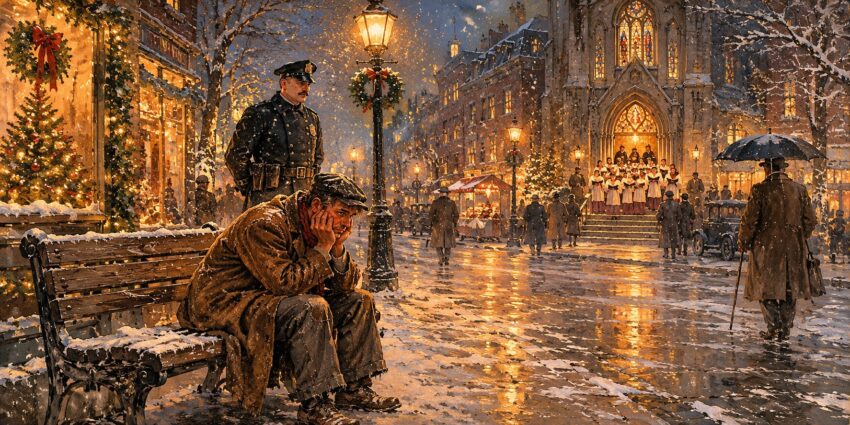
Một trong những truyện ngắn hài hước và chua cay nhất của O. Henry — “The Cop and the Anthem” kể về Soapy, người vô gia cư ở New York cố hết cách để bị bắt vào tù cho ấm, nhưng số phận lại chơi khăm ông theo cách không ai ngờ tới.
The Cop and the Anthem / Cảnh Sát và Bài Thánh Ca by O. Henry
Part 1: Soapy’s Winter Plan
Phần 1: Kế Hoạch Mùa Đông Của Soapy
On his bench in Madison Square Soapy moved uneasily.
Trên chiếc ghế dài của mình ở Madison Square, Soapy cựa quậy bồn chồn.
When wild geese honk high of nights, and when women without sealskin coats grow kind to their husbands, and when Soapy moves uneasily on his bench in the park, you may know that winter is near at hand.
Khi ngỗng trời kêu vang cao trong đêm, và khi những người phụ nữ không có áo khoác da hải cẩu trở nên dịu dàng với chồng, và khi Soapy cựa quậy bồn chồn trên ghế dài trong công viên, bạn có thể biết rằng mùa đông đang đến gần.
A dead leaf fell in Soapy’s lap.
Một chiếc lá khô rơi vào lòng Soapy.
That was Jack Frost’s card.
Đó là danh thiếp của Jack Frost.
Jack is kind to the regular denizens of Madison Square, and gives fair warning of his annual call.
Jack tốt bụng với những cư dân thường xuyên của Madison Square, và báo trước một cách công bằng về chuyến viếng thăm hàng năm của mình.
At the corners of four streets he hands his pasteboard to the North Wind, footman of the mansion of All Outdoors, so that the inhabitants thereof may make ready.
Ở góc bốn con phố, ông đưa danh thiếp cho Gió Bắc, người hầu của lâu đài Thiên Nhiên Bên Ngoài, để những cư dân ở đó có thể chuẩn bị.
Soapy’s mind became cognisant of the fact that the time had come for him to resolve himself into a singular Committee of Ways and Means to provide against the coming rigour.
Tâm trí Soapy nhận thức được rằng đã đến lúc ông phải tự biến mình thành một Ủy ban Phương tiện và Cách thức duy nhất để phòng bị trước cái lạnh sắp đến.
And therefore he moved uneasily on his bench.
Và vì vậy ông cựa quậy bồn chồn trên ghế dài.
The hibernatorial ambitions of Soapy were not of the highest.
Tham vọng trú đông của Soapy không phải loại cao cả nhất.
In them there were no considerations of Mediterranean cruises, of soporific Southern skies drifting in the Vesuvian Bay.
Trong đó không có chuyện tàu du lịch Địa Trung Hải, không có bầu trời phương Nam buồn ngủ trôi dạt trong Vịnh Vesuvian.
Three months on the Island was what his soul craved.
Ba tháng trên Đảo là điều linh hồn ông khao khát.
Three months of assured board and bed and congenial company, safe from Boreas and bluecoats, seemed to Soapy the essence of things desirable.
Ba tháng được đảm bảo ăn ở và bầu bạn tâm đầu ý hợp, an toàn khỏi gió bắc và áo xanh cảnh sát, dường như với Soapy là tinh tuý của những điều đáng mong muốn.
For years the hospitable Blackwell’s had been his winter quarters.
Nhiều năm qua, Blackwell’s hiếu khách đã là nơi trú đông của ông.
Just as his more fortunate fellow New Yorkers had bought their tickets to Palm Beach and the Riviera each winter, so Soapy had made his humble arrangements for his annual hegira to the Island.
Cũng như những người New York may mắn hơn mua vé đến Palm Beach và Riviera mỗi mùa đông, Soapy đã thực hiện những sắp xếp khiêm tốn của mình cho cuộc hành hương hàng năm đến Đảo.
And now the time was come.
Và bây giờ thời điểm đã đến.
On the previous night three Sabbath newspapers, distributed beneath his coat, about his ankles and over his lap, had failed to repulse the cold as he slept on his bench near the spurting fountain in the ancient square.
Đêm trước, ba tờ báo Chủ nhật, trải dưới áo khoác, quanh mắt cá chân và trên đùi ông, đã không thể ngăn cái lạnh khi ông ngủ trên ghế dài gần đài phun nước phun vọt trong quảng trường cổ kính.
So the Island loomed big and timely in Soapy’s mind.
Vì vậy, Đảo hiện ra to lớn và đúng lúc trong tâm trí Soapy.
He scorned the provisions made in the name of charity for the city’s dependents.
Ông khinh thường những điều khoản được thực hiện nhân danh từ thiện cho những người phụ thuộc của thành phố.
In Soapy’s opinion the Law was more benign than Philanthropy.
Theo quan điểm của Soapy, Luật pháp nhân từ hơn Từ thiện.
There was an endless round of institutions, municipal and eleemosynary, on which he might set out and receive lodging and food accordant with the simple life.
Có vô số tổ chức, thành phố và từ thiện, mà ông có thể tìm đến và nhận nơi ở và thức ăn phù hợp với cuộc sống đơn giản.
But to one of Soapy’s proud spirit the gifts of charity are encumbered.
Nhưng với một tâm hồn tự trọng như Soapy, những món quà từ thiện đều bị ràng buộc.
If not in coin you must pay in humiliation of spirit for every benefit received at the hands of philanthropy.
Nếu không phải bằng tiền thì bạn phải trả bằng sự sỉ nhục tinh thần cho mỗi lợi ích nhận được từ tay từ thiện.
As Caesar had his Brutus, every bed of charity must have its toll of a bath, every loaf of bread its compensation of a private and personal inquisition.
Như Caesar có Brutus của mình, mỗi chiếc giường từ thiện phải đánh đổi bằng một lần tắm, mỗi ổ bánh mì phải bù đắp bằng một cuộc thẩm vấn riêng tư và cá nhân.
Wherefore it is better to be a guest of the law, which though conducted by rules, does not meddle unduly with a gentleman’s private affairs.
Vì vậy tốt hơn là làm khách của luật pháp, tuy được điều hành bằng quy tắc nhưng không can thiệp quá mức vào chuyện riêng tư của một quý ông.
Soapy, having decided to go to the Island, at once set about accomplishing his desire.
Soapy, đã quyết định đến Đảo, lập tức bắt tay vào thực hiện mong muốn của mình.
There were many easy ways of doing this.
Có nhiều cách dễ dàng để làm điều này.
The pleasantest was to dine luxuriously at some expensive restaurant; and then, after declaring insolvency, be handed over quietly and without uproar to a policeman.
Dễ chịu nhất là ăn tối sang trọng tại một nhà hàng đắt tiền; và sau đó, sau khi tuyên bố vỡ nợ, được bàn giao lặng lẽ và không ồn ào cho một cảnh sát.
An accommodating magistrate would do the rest.
Một thẩm phán dễ dãi sẽ lo phần còn lại.
Soapy left his bench and strolled out of the square and across the level sea of asphalt, where Broadway and Fifth Avenue flow together.
Soapy rời ghế dài và tản bộ ra khỏi quảng trường và băng qua biển nhựa đường bằng phẳng, nơi Broadway và Đại lộ Năm hòa vào nhau.
Up Broadway he turned, and halted at a glittering cafe, where are gathered together nightly the choicest products of the grape, the silkworm and the protoplasm.
Ông rẽ lên Broadway, và dừng lại ở một quán cà phê lấp lánh, nơi hàng đêm tụ tập những sản phẩm tuyển chọn nhất của nho, tằm và chất nguyên sinh.
Soapy had confidence in himself from the lowest button of his vest upward.
Soapy tự tin vào bản thân từ chiếc cúc thấp nhất của áo gi-lê trở lên.
He was shaven, and his coat was decent and his neat black, ready-tied four-in-hand had been presented to him by a lady missionary on Thanksgiving Day.
Ông đã cạo râu, áo khoác tươm tất và chiếc cà vạt đen gọn gàng buộc sẵn đã được một nữ truyền giáo tặng cho ông vào Ngày Lễ Tạ Ơn.
If he could reach a table in the restaurant unsuspected success would be his.
Nếu ông có thể đến được một bàn trong nhà hàng mà không bị nghi ngờ thì thành công sẽ là của ông.
The portion of him that would show above the table would raise no doubt in the waiter’s mind.
Phần cơ thể hiện ra trên bàn sẽ không gây ra nghi ngờ gì trong tâm trí người phục vụ.
A roasted mallard duck, thought Soapy, would be about the thing–with a bottle of Chablis, and then Camembert, a demi-tasse and a cigar.
Một con vịt trời quay, Soapy nghĩ, sẽ là thứ phù hợp — cùng với một chai Chablis, rồi Camembert, một tách cà phê nhỏ và một điếu xì gà.
One dollar for the cigar would be enough.
Một đô la cho điếu xì gà là đủ.
The total would not be so high as to call forth any supreme manifestation of revenge from the cafe management; and yet the meat would leave him filled and happy for the journey to his winter refuge.
Tổng số sẽ không cao đến mức gây ra bất kỳ hành động trả thù tột cùng nào từ ban quản lý quán; nhưng thức ăn sẽ khiến ông no nê và vui vẻ cho hành trình đến nơi trú đông.
But as Soapy set foot inside the restaurant door the head waiter’s eye fell upon his frayed trousers and decadent shoes.
Nhưng khi Soapy đặt chân vào cửa nhà hàng, mắt người trưởng phục vụ liền rơi vào đôi quần sờn rách và đôi giày tàn tạ của ông.
Strong and ready hands turned him about and conveyed him in silence and haste to the sidewalk and averted the ignoble fate of the menaced mallard.
Những bàn tay khỏe mạnh và nhanh nhẹn xoay ông lại và đưa ông một cách im lặng và vội vàng ra vỉa hè và tránh cho con vịt trời bị đe dọa khỏi số phận tầm thường.
Soapy turned off Broadway.
Soapy rời Broadway.
It seemed that his route to the coveted island was not to be an epicurean one.
Có vẻ như con đường đến hòn đảo mơ ước của ông sẽ không phải là con đường của kẻ sành ăn.
Some other way of entering limbo must be thought of.
Phải nghĩ ra cách khác để vào cõi lửng lơ.
At a corner of Sixth Avenue electric lights and cunningly displayed wares behind plate-glass made a shop window conspicuous.
Ở góc Đại lộ Sáu, đèn điện và hàng hóa được bày trí khéo léo sau kính tấm làm cho một tủ kính cửa hàng nổi bật.
Soapy took a cobblestone and dashed it through the glass.
Soapy nhặt một viên đá cuội và đập vỡ kính.
People came running around the corner, a policeman in the lead.
Người ta chạy quanh góc phố, một cảnh sát dẫn đầu.
Soapy stood still, with his hands in his pockets, and smiled at the sight of brass buttons.
Soapy đứng yên, tay trong túi, và mỉm cười khi thấy những chiếc cúc đồng.
“Where’s the man that done that?” inquired the officer excitedly.
“Người đập kính đó đâu rồi?” viên cảnh sát hỏi hồi hộp.
“Don’t you figure out that I might have had something to do with it?” said Soapy, not without sarcasm, but friendly, as one greets good fortune.
“Anh không nghĩ rằng tôi có thể liên quan đến chuyện này sao?” Soapy nói, không thiếu mỉa mai, nhưng thân thiện, như người chào đón vận may.
The policeman’s mind refused to accept Soapy even as a clue.
Tâm trí cảnh sát từ chối chấp nhận Soapy ngay cả là manh mối.
Men who smash windows do not remain to parley with the law’s minions.
Những kẻ đập vỡ kính không ở lại để đàm phán với tay sai của pháp luật.
They take to their heels.
Họ bỏ chạy.
The policeman saw a man half way down the block running to catch a car.
Viên cảnh sát nhìn thấy một người đàn ông ở giữa khu nhà đang chạy để bắt xe.
With drawn club he joined in the pursuit.
Với dùi cui rút ra, ông tham gia vào cuộc truy đuổi.
Soapy, with disgust in his heart, loafed along, twice unsuccessful.
Soapy, trong lòng đầy chán nản, thơ thẩn đi, thất bại hai lần.
On the opposite side of the street was a restaurant of no great pretensions.
Ở phía bên kia đường là một nhà hàng không có gì to tát.
It catered to large appetites and modest purses.
Nó phục vụ cho những cái bụng lớn và túi tiền khiêm tốn.
Its crockery and atmosphere were thick; its soup and napery thin.
Đồ gốm và không khí của nó thô kệch; súp và khăn trải bàn mỏng manh.
Into this place Soapy took his accusive shoes and telltale trousers without challenge.
Vào nơi này Soapy mang đôi giày buộc tội và đôi quần tố cáo vào mà không bị ngăn cản.
At a table he sat and consumed beefsteak, flapjacks, doughnuts and pie.
Ông ngồi vào bàn và ăn bít tết, bánh kếp, bánh vòng và bánh pie.
And then to the waiter be betrayed the fact that the minutest coin and himself were strangers.
Rồi ông tiết lộ với người phục vụ sự thật rằng đồng xu nhỏ nhất và bản thân ông là người xa lạ.
“Now, get busy and call a cop,” said Soapy. “And don’t keep a gentleman waiting.”
“Bây giờ, nhanh lên và gọi cảnh sát,” Soapy nói. “Và đừng để một quý ông phải chờ.”
“No cop for youse,” said the waiter, with a voice like butter cakes and an eye like the cherry in a Manhattan cocktail. “Hey, Con!”
“Không có cảnh sát nào cho anh đâu,” người phục vụ nói, với giọng như bánh bơ và mắt như quả anh đào trong cocktail Manhattan. “Này, Con!”
Neatly upon his left ear on the callous pavement two waiters pitched Soapy.
Gọn gàng vào tai trái trên vỉa hè cứng lạnh, hai người phục vụ ném Soapy ra ngoài.
He arose, joint by joint, as a carpenter’s rule opens, and beat the dust from his clothes.
Ông đứng dậy, từng khớp một, như thước gấp của thợ mộc mở ra, và phủi bụi khỏi quần áo.
Arrest seemed but a rosy dream.
Bị bắt dường như chỉ là một giấc mơ hồng.
The Island seemed very far away.
Đảo dường như rất xa.
A policeman who stood before a drug store two doors away laughed and walked down the street.
Một cảnh sát đứng trước cửa hiệu thuốc cách hai cửa cười và đi xuống phố.
End of Episode 1 — Stay tuned for the next episode! / Kết thúc Phần 1 — Hãy đón đọc phần tiếp theo!
Final Part: The Failed Schemes and the Anthem
Phần Cuối: Những Mưu Kế Thất Bại và Bài Thánh Ca
Five blocks Soapy travelled before his courage permitted him to woo capture again.
Soapy đi năm khu nhà trước khi lòng can đảm cho phép ông tán tỉnh việc bị bắt lại.
This time the opportunity presented what he fatuously termed to himself a “cinch.”
Lần này cơ hội xuất hiện điều mà ông ngớ ngẩn tự gọi là “chắc chắn.”
A young woman of a modest and pleasing guise was standing before a show window gazing with sprightly interest at its display of shaving mugs and inkstands, and two yards from the window a large policeman of severe demeanour leaned against a water plug.
Một người phụ nữ trẻ có dáng vẻ khiêm tốn và dễ chịu đang đứng trước tủ kính cửa hàng nhìn với vẻ thích thú linh hoạt vào những chiếc cốc cạo râu và lọ mực, và cách cửa sổ hai thước, một cảnh sát to lớn với vẻ nghiêm khắc tựa vào một cột nước.
It was Soapy’s design to assume the role of the despicable and execrated “masher.”
Kế hoạch của Soapy là đảm nhận vai kẻ đáng khinh và bị nguyền rủa — tên “sàm sỡ.”
The refined and elegant appearance of his victim and the contiguity of the conscientious cop encouraged him to believe that he would soon feel the pleasant official clutch upon his arm that would insure his winter quarters on the right little, tight little isle.
Vẻ ngoài tinh tế và thanh lịch của nạn nhân và sự gần gũi của viên cảnh sát tận tâm khuyến khích ông tin rằng ông sẽ sớm cảm nhận được cái nắm tay chính thức dễ chịu vào cánh tay sẽ đảm bảo nơi trú đông của ông trên hòn đảo nhỏ bé xinh xắn.
Soapy straightened the lady missionary’s readymade tie, dragged his shrinking cuffs into the open, set his hat at a killing cant and sidled toward the young woman.
Soapy chỉnh lại chiếc cà vạt may sẵn của nữ truyền giáo, kéo những cổ tay áo co rút ra ngoài, đội mũ theo góc nghiêng chết người và bước nghiêng về phía người phụ nữ trẻ.
He made eyes at her, was taken with sudden coughs and “hems,” smiled, smirked and went brazenly through the impudent and contemptible litany of the “masher.”
Ông nhìn đắm đuối cô, giả vờ ho và khịt mũi đột ngột, mỉm cười, cười sả và trơ tráo thực hiện bài kinh cầu ngạo mạn và đáng khinh của tên “sàm sỡ.”
With half an eye Soapy saw that the policeman was watching him fixedly.
Liếc qua, Soapy thấy viên cảnh sát đang nhìn chằm chằm vào ông.
The young woman moved away a few steps, and again bestowed her absorbed attention upon the shaving mugs.
Người phụ nữ trẻ bước đi vài bước, và lại dành sự chú ý say mê vào những chiếc cốc cạo râu.
Soapy followed, boldly stepping to her side, raised his hat and said:
Soapy theo sau, bước mạnh dạn đến bên cô, nhấc mũ và nói:
“Ah there, Bedelia! Don’t you want to come and play in my yard?”
“Ồ kìa, Bedelia! Cô không muốn đến chơi ở sân nhà tôi sao?”
The policeman was still looking.
Viên cảnh sát vẫn đang nhìn.
The persecuted young woman had but to beckon a finger and Soapy would be practically en route for his insular haven.
Người phụ nữ trẻ bị quấy rối chỉ cần vẫy một ngón tay và Soapy sẽ gần như trên đường đến thiên đường đảo của ông.
Already he imagined he could feel the cozy warmth of the station-house.
Ông đã tưởng tượng cảm nhận được hơi ấm ấm cúng của đồn cảnh sát.
The young woman faced him and, stretching out a hand, caught Soapy’s coat sleeve.
Người phụ nữ trẻ quay mặt về phía ông và, đưa tay ra, nắm lấy tay áo của Soapy.
“Sure, Mike,” she said joyfully, “if you’ll blow me to a pail of suds. I’d have spoke to you sooner, but the cop was watching.”
“Chắc chắn rồi, Mike,” cô nói vui vẻ, “nếu anh mời tôi một xô bia. Tôi đã định nói chuyện với anh sớm hơn, nhưng cảnh sát đang nhìn.”
With the young woman playing the clinging ivy to his oak Soapy walked past the policeman overcome with gloom.
Với người phụ nữ trẻ đóng vai thường xuân leo bám vào cây sồi của ông, Soapy bước qua viên cảnh sát ngập trong u tối.
He seemed doomed to liberty.
Ông dường như bị kết án tự do.
At the next corner he shook off his companion and ran.
Ở góc tiếp theo ông thoát khỏi người bạn đồng hành và chạy.
He halted in the district where by night are found the lightest streets, hearts, vows and librettos.
Ông dừng lại ở khu vực mà về đêm người ta tìm thấy những con phố, trái tim, lời thề và những bài libretto nhẹ nhàng nhất.
Women in furs and men in greatcoats moved gaily in the wintry air.
Những phụ nữ mặc áo lông thú và đàn ông mặc áo choàng lớn di chuyển vui vẻ trong không khí mùa đông.
A sudden fear seized Soapy that some dreadful enchantment had rendered him immune to arrest.
Một nỗi sợ đột ngột ập đến Soapy rằng một phép thuật khủng khiếp nào đó đã khiến ông miễn nhiễm với việc bị bắt.
The thought brought a little of panic upon it, and when he came upon another policeman lounging grandly in front of a transplendent theatre he caught at the immediate straw of “disorderly conduct.”
Suy nghĩ đó mang theo một chút hoảng loạn, và khi ông gặp một cảnh sát khác đang ngồi lười biếng một cách oai vệ trước một rạp hát lộng lẫy, ông nắm lấy cái phao tức thời là “hành vi gây rối.”
On the sidewalk Soapy began to yell drunken gibberish at the top of his harsh voice.
Trên vỉa hè Soapy bắt đầu hét những lời vô nghĩa say xỉn với giọng khàn khàn to nhất có thể.
He danced, howled, raved and otherwise disturbed the welkin.
Ông nhảy múa, hú, nói mê sảng và làm náo loạn bầu trời theo nhiều cách khác.
The policeman twirled his club, turned his back to Soapy and remarked to a citizen.
Viên cảnh sát xoay dùi cui, quay lưng về phía Soapy và nhận xét với một công dân.
“‘Tis one of them Yale lads celebratin’ the goose egg they give to the Hartford College. Noisy; but no harm. We’ve instructions to lave them be.”
“Đó là một trong những chàng trai Yale đang ăn mừng điểm trứng vịt họ ghi được với Đại học Hartford. Ồn ào; nhưng không có hại. Chúng tôi có lệnh để mặc họ.”
Disconsolate, Soapy ceased his unavailing racket.
Buồn bã, Soapy ngừng tiếng ồn vô ích của mình.
Would never a policeman lay hands on him?
Liệu có bao giờ một cảnh sát đặt tay lên ông không?
In his fancy the Island seemed an unattainable Arcadia.
Trong tưởng tượng của ông, Đảo dường như là một Arcadia không thể đạt được.
He buttoned his thin coat against the chilling wind.
Ông cài chiếc áo khoác mỏng lại chống lại gió lạnh.
In a cigar store he saw a well-dressed man lighting a cigar at a swinging light.
Trong một cửa hàng xì gà ông thấy một người đàn ông ăn mặc đẹp đang châm xì gà ở ngọn đèn đu đưa.
His silk umbrella he had set by the door on entering.
Ông ta đã đặt chiếc ô lụa ở cửa khi vào.
Soapy stepped inside, secured the umbrella and sauntered off with it slowly.
Soapy bước vào, lấy chiếc ô và thơ thẩn đi ra với nó chậm chạp.
The man at the cigar light followed hastily.
Người đàn ông ở chỗ châm xì gà đi theo vội vàng.
“My umbrella,” he said, sternly.
“Cái ô của tôi,” ông ta nói, nghiêm khắc.
“Oh, is it?” sneered Soapy, adding insult to petit larceny. “Well, why don’t you call a policeman? I took it. Your umbrella! Why don’t you call a cop? There stands one on the corner.”
“Ồ, vậy ư?” Soapy mỉa mai, thêm sỉ nhục vào tội trộm vặt. “Thôi thì tại sao anh không gọi cảnh sát? Tôi đã lấy nó. Cái ô của anh! Tại sao anh không gọi cảnh sát? Kia có một người đứng ở góc phố.”
The umbrella owner slowed his steps.
Chủ chiếc ô chậm bước lại.
Soapy did likewise, with a presentiment that luck would again run against him.
Soapy cũng vậy, với linh cảm rằng may mắn lại một lần nữa chống lại ông.
The policeman looked at the two curiously.
Viên cảnh sát nhìn cả hai với vẻ tò mò.
“Of course,” said the umbrella man–“that is–well, you know how these mistakes occur–I–if it’s your umbrella I hope you’ll excuse me–I picked it up this morning in a restaurant–If you recognise it as yours, why–I hope you’ll–“
“Tất nhiên,” người đàn ông có ô nói — “đó là — thôi thì, anh biết những sự nhầm lẫn như thế này xảy ra như thế nào — tôi — nếu đó là ô của anh tôi hy vọng anh sẽ tha thứ cho tôi — tôi đã nhặt nó sáng nay trong một nhà hàng — Nếu anh nhận ra đó là của anh, thì — tôi hy vọng anh sẽ —”
“Of course it’s mine,” said Soapy, viciously.
“Tất nhiên là của tôi,” Soapy nói, độc ác.
The ex-umbrella man retreated.
Người cựu chủ ô rút lui.
The policeman hurried to assist a tall blonde in an opera cloak across the street in front of a street car that was approaching two blocks away.
Viên cảnh sát vội vàng giúp một phụ nữ tóc vàng cao trong áo choàng opera qua đường trước một xe điện đang đến từ hai khu nhà xa.
Soapy walked eastward through a street damaged by improvements.
Soapy đi về phía đông qua một con phố bị hư hại vì công trình cải tạo.
He hurled the umbrella wrathfully into an excavation.
Ông ném chiếc ô tức giận vào một hố đào.
He muttered against the men who wear helmets and carry clubs.
Ông lầm bầm chống lại những người đội mũ cối và mang dùi cui.
Because he wanted to fall into their clutches, they seemed to regard him as a king who could do no wrong.
Bởi vì ông muốn rơi vào tay họ, họ dường như coi ông như một vị vua không thể làm sai.
At length Soapy reached one of the avenues to the east where the glitter and turmoil was but faint.
Cuối cùng Soapy đến một trong những đại lộ về phía đông nơi sự lấp lánh và hỗn loạn chỉ mờ nhạt.
He set his face down this toward Madison Square, for the homing instinct survives even when the home is a park bench.
Ông hướng mặt về phía Madison Square, vì bản năng về nhà vẫn sống ngay cả khi nhà là một chiếc ghế dài trong công viên.
But on an unusually quiet corner Soapy came to a standstill.
Nhưng ở một góc phố yên tĩnh bất thường, Soapy dừng lại.
Here was an old church, quaint and rambling and gabled.
Đây là một nhà thờ cũ, kỳ quặc và rải rác và có đỉnh tam giác.
Through one violet-stained window a soft light glowed, where, no doubt, the organist loitered over the keys, making sure of his mastery of the coming Sabbath anthem.
Qua một ô cửa sổ kính màu tím, ánh sáng nhẹ nhàng tỏa ra, nơi không nghi ngờ gì người chơi đàn organ đang lảng vảng trên các phím, đảm bảo sự thành thạo của mình với bài thánh ca Ngày Sabbath sắp đến.
For there drifted out to Soapy’s ears sweet music that caught and held him transfixed against the convolutions of the iron fence.
Vì đó, âm nhạc ngọt ngào trôi vào tai Soapy đã bắt và giữ ông đứng im bất động tựa vào những đường cong của hàng rào sắt.
The moon was above, lustrous and serene; vehicles and pedestrians were few; sparrows twittered sleepily in the eaves–for a little while the scene might have been a country churchyard.
Mặt trăng ở trên cao, óng ánh và thanh bình; xe cộ và người đi bộ thưa thớt; chim sẻ hót buồn ngủ dưới mái hiên — trong chốc lát cảnh vật có thể là một nghĩa địa nhà thờ vùng quê.
And the anthem that the organist played cemented Soapy to the iron fence, for he had known it well in the days when his life contained such things as mothers and roses and ambitions and friends and immaculate thoughts and collars.
Và bài thánh ca mà người chơi đàn organ chơi đã gắn chặt Soapy vào hàng rào sắt, vì ông đã biết nó rõ trong những ngày khi cuộc sống của ông còn chứa đựng những thứ như mẹ và hoa hồng và tham vọng và bạn bè và những suy nghĩ tinh khiết và cổ áo sạch sẽ.
The conjunction of Soapy’s receptive state of mind and the influences about the old church wrought a sudden and wonderful change in his soul.
Sự kết hợp giữa trạng thái tâm hồn dễ tiếp nhận của Soapy và những ảnh hưởng xung quanh nhà thờ cũ đã tạo ra một sự thay đổi đột ngột và kỳ diệu trong linh hồn ông.
He viewed with swift horror the pit into which he had tumbled, the degraded days, unworthy desires, dead hopes, wrecked faculties and base motives that made up his existence.
Ông nhìn với nỗi kinh hoàng nhanh chóng hố mà ông đã rơi vào, những ngày sa đọa, những ham muốn bất xứng, những hy vọng chết, những năng lực bị phá hủy và những động cơ thấp hèn tạo nên sự tồn tại của ông.
And also in a moment his heart responded thrillingly to this novel mood.
Và cũng trong một khoảnh khắc, trái tim ông rung động hồi hộp với tâm trạng mới lạ này.
An instantaneous and strong impulse moved him to battle with his desperate fate.
Một xung lực tức thời và mạnh mẽ thúc đẩy ông chiến đấu với số phận tuyệt vọng của mình.
He would pull himself out of the mire; he would make a man of himself again; he would conquer the evil that had taken possession of him.
Ông sẽ tự kéo mình ra khỏi bùn lầy; ông sẽ làm lại con người của mình; ông sẽ chinh phục cái ác đã chiếm hữu ông.
There was time; he was comparatively young yet; he would resurrect his old eager ambitions and pursue them without faltering.
Còn thời gian; ông vẫn còn tương đối trẻ; ông sẽ hồi sinh những tham vọng nhiệt thành cũ và theo đuổi chúng không do dự.
Those solemn but sweet organ notes had set up a revolution in him.
Những nốt nhạc organ trang trọng nhưng ngọt ngào đó đã tạo ra một cuộc cách mạng trong ông.
To-morrow he would go into the roaring downtown district and find work.
Ngày mai ông sẽ vào khu trung tâm thành phố ồn ào và tìm việc làm.
A fur importer had once offered him a place as driver.
Một nhà nhập khẩu lông thú đã từng đề nghị ông một chỗ làm tài xế.
He would find him to-morrow and ask for the position.
Ông sẽ tìm ông ta vào ngày mai và xin vị trí đó.
He would be somebody in the world.
Ông sẽ là ai đó trong thế giới này.
He would–
Ông sẽ —
Soapy felt a hand laid on his arm.
Soapy cảm thấy một bàn tay đặt lên cánh tay ông.
He looked quickly around into the broad face of a policeman.
Ông nhìn nhanh quanh vào khuôn mặt rộng của một cảnh sát.
“What are you doin’ here?” asked the officer.
“Anh đang làm gì ở đây?” viên cảnh sát hỏi.
“Nothin’,” said Soapy.
“Không làm gì,” Soapy nói.
“Then come along,” said the policeman.
“Vậy thì đi theo,” viên cảnh sát nói.
“Three months on the Island,” said the Magistrate in the Police Court the next morning.
“Ba tháng trên Đảo,” thẩm phán ở Tòa án Cảnh sát nói vào sáng hôm sau.
The End / Kết Thúc
Special Topic: The Cruelest Joke of Fate
Bình Luận: Trò Đùa Tàn Nhẫn Nhất Của Số Phận
“The Cop and the Anthem” is one of O. Henry’s most perfectly constructed stories — a masterwork of comic irony that delivers its final twist with the precision of a locked mechanism.
“The Cop and the Anthem” là một trong những câu chuyện được xây dựng hoàn hảo nhất của O. Henry — một kiệt tác trào phúng hài hước mang lại cú twist cuối cùng với sự chính xác của một cơ chế khóa.
Published in 1904, it follows Soapy, a homeless man in New York City who devises increasingly elaborate schemes to get himself arrested — not to escape justice, but to secure three months of free food and shelter on Blackwell’s Island.
Được xuất bản năm 1904, nó theo dõi Soapy, một người vô gia cư ở thành phố New York người đặt ra những kế hoạch ngày càng phức tạp để bị bắt — không phải để trốn tránh công lý, mà để đảm bảo ba tháng thức ăn và nơi ở miễn phí trên Đảo Blackwell.
O. Henry’s genius lies in his understanding of irony as a structural principle, not merely a rhetorical device.
Thiên tài của O. Henry nằm ở sự hiểu biết về sự trớ trêu như một nguyên tắc cấu trúc, không chỉ là một biện pháp tu từ.
The story is built on a single ironic framework: Soapy commits crimes and goes free; Soapy is innocent and gets arrested.
Câu chuyện được xây dựng trên một khuôn khổ trớ trêu duy nhất: Soapy phạm tội và được tự do; Soapy vô tội và bị bắt.
Every failed attempt is a variation on this theme — smashing a window (the real criminal runs away), eating without paying (thrown out instead of arrested), playing the masher (the woman turns out to be a prostitute who welcomes his advances), making a drunken scene (mistaken for a Yale student celebrating a football victory), stealing an umbrella (the owner backs down, embarrassed because he stole it first).
Mỗi lần thất bại là một biến thể trên chủ đề này — đập vỡ cửa sổ (tên tội phạm thật chạy trốn), ăn mà không trả tiền (bị ném ra thay vì bị bắt), đóng vai kẻ sàm sỡ (người phụ nữ hóa ra là gái điếm chào đón sự tán tỉnh của ông), tạo cảnh say xỉn (bị nhầm là sinh viên Yale ăn mừng chiến thắng bóng đá), ăn trộm ô (chủ nhân rút lui vì xấu hổ vì chính ông ta đã lấy cắp nó trước).
Each scheme backfires not through incompetence but through the city’s indifference — a world so chaotic that even deliberate wrongdoing fails to register.
Mỗi kế hoạch thất bại không phải vì bất tài mà vì sự thờ ơ của thành phố — một thế giới hỗn loạn đến mức ngay cả hành động sai trái có chủ ý cũng không được chú ý.
The church scene is the story’s emotional and philosophical center.
Cảnh nhà thờ là trung tâm cảm xúc và triết học của câu chuyện.
Standing before the old church, hearing the anthem, Soapy undergoes a genuine conversion — he is moved by memory, by the life he once had and could have again, by the possibility of redemption.
Đứng trước nhà thờ cũ, nghe bài thánh ca, Soapy trải qua một cuộc hoán cải thực sự — ông bị xúc động bởi ký ức, bởi cuộc sống ông đã từng có và có thể có lại, bởi khả năng cứu chuộc.
This is not parody or sentimentality — O. Henry treats the moment with genuine tenderness, listing “mothers and roses and ambitions and friends and immaculate thoughts and collars” as the lost contents of a better life.
Đây không phải là giễu nhại hay tình cảm ủy mị — O. Henry xử lý khoảnh khắc với sự dịu dàng thực sự, liệt kê “mẹ và hoa hồng và tham vọng và bạn bè và những suy nghĩ tinh khiết và cổ áo sạch sẽ” như những nội dung đã mất của một cuộc sống tốt đẹp hơn.
And it is at precisely this moment — when Soapy has abandoned his criminal intentions and resolved to reform — that the hand of the law finally descends.
Và chính vào khoảnh khắc này — khi Soapy đã từ bỏ ý định tội phạm và quyết tâm cải tạo — bàn tay của pháp luật cuối cùng hạ xuống.
The final line — “Three months on the Island” — is one of the most devastating punchlines in American short fiction.
Dòng cuối — “Ba tháng trên Đảo” — là một trong những cú chốt tàn nhẫn nhất trong truyện ngắn Mỹ.
Soapy gets exactly what he wanted — but only after he stopped wanting it, and only after he had glimpsed the alternative.
Soapy nhận được chính xác những gì ông muốn — nhưng chỉ sau khi ông ngừng muốn nó, và chỉ sau khi ông thoáng thấy sự thay thế.
The timing is the cruelty; the cruelty is the comedy; the comedy is the truth.
Thời điểm là sự tàn nhẫn; sự tàn nhẫn là hài kịch; hài kịch là sự thật.
Beneath the comedy, “The Cop and the Anthem” is a story about the gulf between intention and outcome — about a world in which the systems designed to punish the guilty and protect the innocent operate with spectacular indifference to both.
Bên dưới hài kịch, “The Cop and the Anthem” là câu chuyện về vực thẳm giữa ý định và kết quả — về một thế giới trong đó những hệ thống được thiết kế để trừng phạt kẻ có tội và bảo vệ người vô tội hoạt động với sự thờ ơ ngoạn mục đối với cả hai.
For students of English, this story is an ideal study in comic timing and the techniques of the surprise ending.
Đối với người học tiếng Anh, câu chuyện này là nghiên cứu lý tưởng về thời điểm hài hước và các kỹ thuật kết thúc bất ngờ.
O. Henry uses elaborate, Latinate vocabulary — “hibernatorial ambitions,” “eleemosynary,” “hegira” — not to show off but to create ironic distance: the pompous language dignifies Soapy’s humble schemes, making the gap between his self-regard and his reality comic.
O. Henry sử dụng từ vựng phức tạp, gốc Latin — “tham vọng trú đông,” “từ thiện,” “cuộc hành hương” — không phải để khoe khoang mà để tạo khoảng cách trào phúng: ngôn ngữ hoa mỹ tôn vinh những kế hoạch khiêm tốn của Soapy, làm cho khoảng cách giữa tự đánh giá của ông và thực tế của ông trở nên hài hước.
Notice also how each failed scheme has its own internal logic and payoff — they are not repetitive but escalating, each one stranger than the last, building toward the moment when the story pivots from farce to something genuinely moving.
Hãy chú ý cũng cách mỗi kế hoạch thất bại có logic và phần thưởng nội tại riêng — chúng không lặp đi lặp lại mà leo thang, mỗi cái kỳ lạ hơn cái trước, xây dựng đến khoảnh khắc khi câu chuyện chuyển từ hài kịch pha trò thành điều gì đó thực sự xúc động.
The End / Kết Thúc
Mastering “The Cop and the Anthem”
Explore situational irony, social satire, and the paradox of reform.
1. What is Soapy’s primary motivation at the beginning of the story?
2. How does O. Henry use “Irony” in Soapy’s various attempts to get arrested?
3. Why is Soapy refused entry into the first high-end restaurant he visits?
4. What is the symbolic significance of the “Anthem” heard near the end of the story?
5. What happens when Soapy tries to harass a woman in the street (the “Mash”)?
6. Why doesn’t the policeman arrest Soapy for breaking the shop window with a stone?
7. What is O. Henry’s subtle critique of the “Charity” systems of the time?
8. What is the ultimate “Twist Ending” of the story?
9. What does the “black-shadowed” iron fence symbolize at the end?
10. What is the tone of the final sentence: “Three months on the Island,” said the Magistrate.