Skip to content

Sophie's Garden

Where stories, ideas, and wisdom come to life.

Menu
  • Danh Mục
    • Classic Literature
    • Children & Young Adult
    • Short Stories & Fables
    • Aesop
    • Horror & Mystery
    • Philosophy & Ethics
  • Trình Độ
    • B1
    • B2
    • C1
    • C2
  • Văn Học Việt Nam
  • About me
Menu

The Bear and the Bees / Con Gấu và Đàn Ong by Aesop

Posted on May 2, 2026May 2, 2026 by Sophie
A1, Aesop, Children & Young Adult, Philosophy & Ethics, Short Stories & Fables

Ngụ ngôn cổ điển của Aesop này đã được kể lại hàng thế kỷ qua nhiều nền văn hóa—và thông điệp của nó vẫn còn nguyên vẹn: một cơn giận bốc đồng có thể biến một rắc rối nhỏ thành thảm họa không thể cứu vãn.

Nội Dung
Bình Luận
Quizz!

The Bear and the Bees / Con Gấu và Đàn Ong by Aesop

The Bear Who Lost His Temper
Con Gấu Mất Kiểm Soát

A Bear roaming the woods in search of berries came upon a fallen tree in which a swarm of Bees had stored their honey.
Một con Gấu đang lang thang trong rừng tìm quả mọng thì bắt gặp một thân cây đổ, nơi một đàn Ong đã tích trữ mật của chúng.

The Bear began to sniff around the log very carefully to find out if the Bees were at home.
Con Gấu bắt đầu khịt mũi quanh khúc gỗ rất thận trọng để xem đàn Ong có ở nhà không.

Just then one of the swarm came home from the clover field with a load of nectar.
Đúng lúc đó, một con ong trong đàn bay về từ cánh đồng hoa cỏ ba lá với một bụng mật đầy ắp.

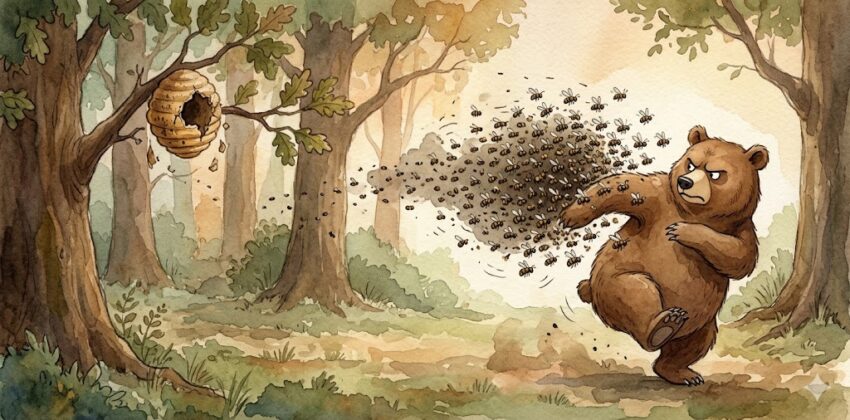
Guessing what the Bear was after, the Bee flew at him, stung him sharply, and then disappeared into the hollow log.
Đoán được con Gấu đang nhòm ngó điều gì, con Ong lao thẳng vào nó, đốt một phát đau nhói, rồi biến mất vào trong khúc gỗ rỗng.

The Bear lost his temper in an instant, and sprang upon the log tooth and claw, to destroy the nest.
Con Gấu nổi giận trong tích tắc, lao vào khúc gỗ với nanh vuốt, quyết phá tan cái tổ.

But this only brought out the whole swarm.
Nhưng điều đó chỉ khiến cả đàn ong ùa ra.

The poor Bear had to take to his heels, and he was able to save himself only by diving into a pool of water.
Con Gấu tội nghiệp phải bỏ chạy tán loạn, và chỉ có thể tự cứu mình bằng cách lao xuống một vũng nước.

It is wiser to bear a single injury in silence than to provoke a thousand by flying into a rage.
Chịu đựng một vết thương trong im lặng còn khôn ngoan hơn là nổi giận bốc đồng để rồi rước thêm nghìn vết thương khác.

The End / Kết Thúc

Special Topic: One Sting, One Choice, One Disaster
Bình Luận: Một Vết Đốt, Một Lựa Chọn, Một Thảm Họa

“The Bear and the Bees” is a fable about escalation — about the precise moment when a manageable situation becomes a catastrophe, and who is responsible for that transformation.
“Con Gấu và Đàn Ong” là một ngụ ngôn về sự leo thang — về khoảnh khắc chính xác khi một tình huống có thể kiểm soát được trở thành thảm họa, và ai chịu trách nhiệm cho sự biến đổi đó.

The Bear begins with a perfectly reasonable goal: he wants honey.
Con Gấu bắt đầu với một mục tiêu hoàn toàn hợp lý: nó muốn có mật ong.

He even approaches the log carefully, sniffing to check whether the Bees are home — a sign that some caution is present in him, however thin.
Nó thậm chí tiếp cận khúc gỗ một cách thận trọng, khịt mũi kiểm tra xem đàn Ong có ở nhà không — dấu hiệu cho thấy trong nó vẫn còn chút thận trọng, dù rất mỏng manh.

Then comes the single sting — one bee, one sharp pain, one moment of humiliation.
Rồi một vết đốt duy nhất ập đến — một con ong, một cơn đau buốt, một khoảnh khắc nhục nhã.

And in that instant, all caution vanishes.
Và trong khoảnh khắc đó, mọi thận trọng tan biến.

The Bear does not pause to weigh the consequences — he simply acts, driven entirely by rage.
Con Gấu không dừng lại để cân nhắc hậu quả — nó chỉ hành động, bị cơn thịnh nộ dẫn dắt hoàn toàn.

This is the fable’s central insight: the Bear’s real enemy is not the Bee that stung him, but his own inability to absorb a small injury without retaliating.
Đây là cái nhìn sâu sắc trọng tâm của ngụ ngôn: kẻ thù thực sự của con Gấu không phải con Ong đã đốt nó, mà là sự bất lực của chính nó khi không thể chịu đựng một vết thương nhỏ mà không trả đũa.

The single sting was survivable — a minor irritation, quickly forgotten.
Một vết đốt duy nhất là điều có thể chịu đựng được — một khó chịu nhỏ, nhanh chóng bị lãng quên.

The thousand stings that follow are entirely the Bear’s own doing.
Nghìn vết đốt tiếp theo hoàn toàn là do chính con Gấu tạo ra.

Aesop structures the fable with mathematical precision: one injury endured in silence costs nothing; one injury met with rage costs everything.
Aesop xây dựng ngụ ngôn với sự chính xác như toán học: một vết thương được chịu đựng trong im lặng không tốn gì; một vết thương được đáp lại bằng cơn thịnh nộ tốn tất cả.

The moral — “It is wiser to bear a single injury in silence than to provoke a thousand by flying into a rage” — is one of Aesop’s most actionable lessons.
Bài học đạo đức — “Chịu đựng một vết thương trong im lặng còn khôn ngoan hơn là nổi giận bốc đồng để rồi rước thêm nghìn vết thương khác” — là một trong những bài học thực tiễn nhất của Aesop.

It does not ask us to be passive or to accept injustice — it asks us to calculate before we react.
Nó không yêu cầu chúng ta thụ động hay chấp nhận bất công — nó yêu cầu chúng ta tính toán trước khi phản ứng.

Is this injury worth the war it will start?
Vết thương này có đáng để bắt đầu một cuộc chiến không?

The Bear never asks that question — and the pool of water he dives into at the end is his only refuge from the consequences of skipping it.
Con Gấu không bao giờ đặt ra câu hỏi đó — và vũng nước mà nó lao xuống ở cuối câu chuyện là nơi trú ẩn duy nhất của nó khỏi hậu quả của việc bỏ qua câu hỏi ấy.

The fable has endured for centuries because the Bear’s mistake is timeless: in arguments, in politics, in everyday conflicts, the first provocation is rarely the one that does the real damage.
Ngụ ngôn này tồn tại hàng thế kỷ vì sai lầm của con Gấu là vĩnh cửu: trong các cuộc tranh cãi, trong chính trị, trong những xung đột hàng ngày, sự khiêu khích đầu tiên hiếm khi là thứ gây ra thiệt hại thực sự.

It is the response to that provocation — uncontrolled, disproportionate, blinded by anger — that turns one sting into a thousand.
Chính là phản ứng với sự khiêu khích đó — mất kiểm soát, thái quá, bị cơn tức giận che mắt — mới là thứ biến một vết đốt thành nghìn vết đốt.

The End / Kết Thúc

The Bear and the Bees – Deep Learning Quiz

Mastering “The Bear and the Bees”

Analyze the consequences of blind rage and the power of collective defense.

1. What is the initial event that sparks the Bear’s anger?

A. A single bee stings him and flies back to the hive.
✔ Correct! It was a minor, individual act that the Bear chose to escalate into a war against the entire community.
B. The bees refused to give him any honey.
✘ Incorrect. There was no request made; the conflict began with a single sting.
C. He was hungry and decided to attack the hive for food.
✘ Incorrect. While he may have wanted honey later, his initial motive was revenge for the sting.
D. The hive fell on his head by accident.
✘ Incorrect. The sting was a deliberate (though small) act of defense by a single bee.

2. How does the Bear react to being stung by one bee?

A. He laughs it off and walks away.
✘ Incorrect. The Bear’s temperament is the central flaw in the story.
B. He loses his temper and attacks the entire hive with his claws.
✔ Correct! This overreaction is the turning point that leads to his downfall.
C. He waits for the bees to come out and apologize.
✘ Incorrect. He seeks immediate and total destruction of their home.
D. He tries to smoke the bees out of the hive.
✘ Incorrect. He uses brute force, not strategy.

3. What was the bees’ collective response to the Bear’s attack on the hive?

A. The entire swarm flew out and attacked the Bear together.
✔ Correct! They demonstrated the power of unity against a much larger, more powerful individual.
B. They abandoned the hive and let the Bear have the honey.
✘ Incorrect. Bees are famous for defending their home to the end.
C. Half the bees fled while the other half stayed to fight.
✘ Incorrect. Aesop emphasizes the “whole swarm” rising up.
D. They surrendered and offered the Bear a peace treaty.
✘ Incorrect. In nature and in fables, bees react with immediate, collective defense.

4. What is the final fate of the Bear in this fable?

A. He successfully eats all the honey.
✘ Incorrect. His rage prevents him from enjoying any reward.
B. He destroys the hive but is slightly annoyed.
✘ Incorrect. The consequences are much more severe.
C. He is forced to save himself by diving into a pond, covered in stings.
✔ Correct! He ends up defeated and in pain because he couldn’t ignore a single minor injury.
D. He becomes friends with the bees.
✘ Incorrect. Fables like this rarely end in friendship; they end in a harsh lesson.

5. What is the primary moral lesson of “The Bear and the Bees”?

A. Honey is not worth the effort it takes to get it.
✘ Incorrect. This is a practical tip, not a moral lesson.
B. It is better to bear a single injury in silence than to provoke a thousand by seeking revenge.
✔ Correct! This is the classic Aesop moral—warning against the disproportionate escalation of conflict.
C. Bears are much stronger than bees.
✘ Incorrect. The story actually proves the opposite when the small act together.
D. Always look for a pond before attacking a beehive.
✘ Incorrect. While funny, the lesson is about emotional control, not escape routes.

6. Why is the Bear’s behavior described as “foolish” in the analysis?

A. Because his desire for revenge caused him far more pain than the original sting.
✔ Correct! He traded one small sting for hundreds of stings by letting his anger control him.
B. Because he didn’t realize bees have stings.
✘ Incorrect. He knew they had stings; he just underestimated the power of the swarm.
C. Because he forgot that bears are allergic to honey.
✘ Incorrect. Bears love honey; that’s why they usually approach hives carefully.
D. Because he attacked the hive during the day.
✘ Incorrect. The timing wasn’t the issue; the lack of self-control was.

7. In a social or political context, what do the “Bees” represent?

A. A group of individuals who cannot agree on anything.
✘ Incorrect. They are the ultimate example of coordination.
B. A community that gains strength through unity and collective action.
✔ Correct! They show how small individuals can defeat a “giant” if they stand together.
C. Soldiers who are forced to fight against their will.
✘ Incorrect. They fight naturally to protect their home and queen.
D. A monarchy that is failing.
✘ Incorrect. The bee colony is actually a highly successful organizational structure.

8. What does the “Pond” symbolize in the story’s resolution?

A. A place for the Bear to wash off the honey.
✘ Incorrect. He never got the honey!
B. A desperate refuge and a place of humiliation.
✔ Correct! The mighty Bear has to hide underwater from tiny insects, highlighting his complete failure.
C. The Bear’s new home.
✘ Incorrect. It is only a temporary place of safety from the bees.
D. A source of fresh water for the bees.
✘ Incorrect. The pond serves the Bear’s escape, not the bees’ needs.

9. What is the difference between “Justice” and “Revenge” in this fable?

A. Justice would be addressing the one bee; Revenge is attacking the whole hive.
✔ Correct! The Bear’s reaction was disproportionate, making it an act of destructive revenge rather than a balanced response.
B. There is no difference; they are the same thing.
✘ Incorrect. Fables often distinguish between right action and emotional reaction.
C. Justice is the Bear winning; Revenge is the bees winning.
✘ Incorrect. Justice is about the scale of the response.
D. Justice is honey; Revenge is stings.
✘ Incorrect. Those are rewards and punishments, not the concepts themselves.

10. How could the Bear have achieved his goal (honey) more effectively?

A. By bringing a larger animal to help him.
✘ Incorrect. That would just lead to more angry bees.
B. By destroying the hive even faster.
✘ Incorrect. Violence was the cause of his problem.
C. By keeping his temper and using a calmer, more strategic approach.
✔ Correct! Self-control and patience are usually the keys to success in fables where anger leads to failure.
D. By waiting for winter when the bees are asleep.
✘ Incorrect. While practical, the moral focus is on his character flaw (anger) in the moment.

Related Posts:

  • ffda0feb-d3a9-48c4-9fc8-ac43608c43c6
    A Dark Brown Dog / Con Chó Nâu Sẫm by Stephen Crane
  • 9b53a5b8-3624-430b-94c3-e5c0cbbbd07e
    'Oh, Whistle, and I'll Come to You My Lad' / 'Ôi,…
  • fd02c452-778f-49f1-b565-368ce93bb9af
    The Snows of Kilimanjaro / Tuyết Trên Đỉnh…
  • a0458116-ecf4-40dc-94dc-776e1ae01e57
    Fat and Thin / Béo và Gầy by Anton Chekhov
  • 00ea8b13-1253-46d9-8969-807694d4a445
    The Story of Keesh / Câu Chuyện Về Keesh by Jack London
  • dc576fa8-441f-4a17-9a2a-fcb1635ea502
    The Nightingale and the Rose / Chim Họa Mi và Bông…

Post navigation

← The Ass and Its Shadow / Con Lừa và Cái Bóng by Aesop
The Ass and the Grasshoppers / Con Lừa và Những Chú Châu Chấu by Aesop →

Leave a Reply Cancel reply

Your email address will not be published. Required fields are marked *

Related Posts:

  • ffda0feb-d3a9-48c4-9fc8-ac43608c43c6
    A Dark Brown Dog / Con Chó Nâu Sẫm by Stephen Crane
  • 9b53a5b8-3624-430b-94c3-e5c0cbbbd07e
    'Oh, Whistle, and I'll Come to You My Lad' / 'Ôi,…
  • fd02c452-778f-49f1-b565-368ce93bb9af
    The Snows of Kilimanjaro / Tuyết Trên Đỉnh…
  • a0458116-ecf4-40dc-94dc-776e1ae01e57
    Fat and Thin / Béo và Gầy by Anton Chekhov
  • 00ea8b13-1253-46d9-8969-807694d4a445
    The Story of Keesh / Câu Chuyện Về Keesh by Jack London
  • dc576fa8-441f-4a17-9a2a-fcb1635ea502
    The Nightingale and the Rose / Chim Họa Mi và Bông…
© 2026 Sophie's Garden | Powered by Minimalist Blog WordPress Theme